Derivatives Trader
Derivatives traders buy and sell contracts whose value is tied to another asset, such as a share index, currency or commodity, either to hedge a position or to take a view on where prices are heading.
- Median salary
- $137,900
4.4%vs last year, before tax
- People employed
- 1,400
0.0%vs last year
- Projected growth
- +12.5%
to 2035
- AI exposure*
- Moderate
- automation risk
- Average hours
- 46/wk
+6h vs all jobs
- Shortage status
- Not in shortage
national
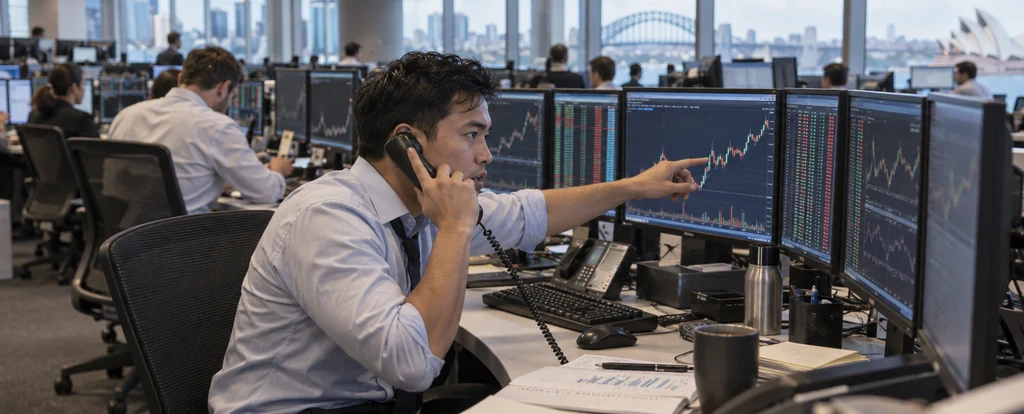
The work happens on a dealing room at a bank, fund or proprietary trading firm, where futures, options and swaps are priced and executed across equity, fixed income, currency and commodity markets, and prices move all day. A derivatives trader deals in a contract on a price rather than ownership of the underlying asset, which is what separates the role from a stockbroker, and a position might be held for seconds, days or weeks. Desks are small and tightly regulated, so capital limits, position limits and collateral rules shape what a trader can do at any moment.
How much do derivatives traders earn?
The median full-time salary for a derivatives trader is $137,900 per annum, before tax, up $29,200 since 2018.
Pay on a dealing desk leans on the bonus, which is tied to the profit of the book over the year and can be a large share of total earnings. The capital you are trusted to run, the product you trade and whether you work at a bank, a fund or a proprietary firm all move the number. A lean year on the desk shows up quickly in the next bonus, and part of a large bonus is usually deferred rather than paid straight away.
What does a derivatives trader do day to day?
The list below is what fills most weeks; the exact mix shifts with seniority and whatever stage the current work is at.
- Executing futures, options and swap trades on exchanges and in over-the-counter markets, often within seconds of a price move
- Watching open positions through the session for profit, loss and shifts in risk exposure
- Reading economic releases, market data and price charts to decide when to enter or exit a position
- Managing collateral and counterparty credit on each trade, which sets how much capital is tied up
- Reconciling fills and reporting positions against regulatory and internal limits at the close
What skills do derivatives traders need?
Employers look for financial analysis and modelling, risk and internal controls, data analysis, backed by Bloomberg Terminal fluency and strong problem solving.
Specialist skills
- Financial analysis and modelling
- Risk and internal controls
- Data analysis
- Statistical modelling
- Regulatory compliance
Software and tools
- Bloomberg Terminal
- Reuters Eikon
- Python or C++ for pricing models
- Murex or Calypso trading systems
- Excel
General skills
- Problem solving
- Attention to detail
Is the job growing?
About 1,400 people work as derivatives traders in Australia, and employment is projected to grow 12.5% over the decade to 2035. That's healthy, above-average growth, and the role should stay in solid demand.
How do you become a derivatives trader?
Here's the path most derivatives traders take, step by step.
- 1Complete a degree in finance, economics, mathematics or engineering
A Bachelor degree is the most common qualification in the current workforce, held by 52% of traders, and degrees in finance, economics, mathematics, engineering or actuarial studies fit the work best. Quantitative subjects such as statistics, econometrics and programming carry more weight on pricing-heavy desks than a general business major.
- 2Get onto a graduate or summer internship program at a bank, fund or trading firm
Dealing desks are small and recruit in small numbers, mostly through structured programs that open applications about a year ahead. An internship on a desk is often the route that leads to an offer, because the firm has already seen how you handle live prices.
- 3Start close to the desk in trade support, risk, middle office or a junior dealer seat
These roles build the pricing, system and settlement knowledge that desk work depends on, and internal moves onto a desk are common because the team already knows you. Expect to learn the trading systems the firm runs, such as Murex or Calypso, alongside Excel and Python.
- 4Complete the training and registration your firm's licence requires
Firms hold an Australian financial services licence, and staff dealing in derivatives complete the training and registration that licence requires, with RG 146 covering the knowledge base for many roles. Desks also accredit traders on the specific exchanges, clearing arrangements and systems they use, and the detail varies by firm.
- 5Consider postgraduate study for model-heavy or systematic desks
A postgraduate qualification in quantitative finance or financial mathematics is held by 21% of the current workforce and helps for desks where pricing engines and automated strategies drive the trading.
Ready to apply as a derivatives trader?
Whether you're working toward becoming a derivatives trader or already are one and want a hand with the next step (sharpening your resume for ATS screening, tightening your cover letter, or knowing what you'll actually be asked at interview), here are examples grounded in this specific role, not generic templates.
What jobs can a derivatives trader move to?
Moving into Quantitative Trader typically comes with the biggest pay rise, worth $10,300 a year more on average.
| Move to | Typical pay change | Overlap | Retraining |
|---|---|---|---|
| Quantitative Trader A derivatives trader brings market intuition and pricing models to quantitative trading, with a short course in quantitative methods. | +$10,300 | 57% | short course |
| Futures Dealer A derivatives trader brings contract pricing and hedging knowledge to exchange-traded futures, with a short course covering market rules. | +$0 | 45% | short course |
| Foreign Exchange Dealer A derivatives trader brings options and forward pricing skills to currency markets, needing little extra training to trade foreign exchange. | +$0 | 78% | minimal |
| Investment Banker A derivatives trader brings pricing and risk skills to deal valuation and client advisory, though corporate finance study is required. | −$3,600 | 35% | reskill |
| Risk Analyst A derivatives trader brings deep understanding of market risk and hedging to risk analysis, with minimal retraining needed. | −$21,400 | 78% | minimal |
Moves are chosen from Jobs and Skills Australia's Data on Occupation Mobility, which follows income tax records between 2011-12 and 2020-21, together with entry requirements and skill overlap. A known move is one people were seen making in that data. Pay change compares median full-time pay for the two roles.
Who works as a derivatives trader?
The typical derivatives trader is 38 years old; 81% are men, 83% work full-time, and full-timers average 46 hours a week.
- 38
- Median age
- 19%
- Female share
- 83%
- Full-time
- +6h
- vs all-jobs avg
What's it like being a derivatives trader?
A trading day is short and intense: the market opens, positions move, and the desk's profit or loss is visible in real time. The day often starts before the local open because overseas markets are already trading, and it can run late when a United States session matters. The job suits someone who stays calm while losing money, can decide with incomplete information, and will cut a view quickly when the market disagrees.
What people like
- Feedback is immediate. Profit and loss is marked continuously, so you know by the close whether a call was right, which some traders find motivating and others find relentless.
- The problems are quantitative. Pricing an option, sizing a hedge or working out why a valuation and the market disagree is a technical puzzle you can get your teeth into.
- Markets are never finished. Rates, currencies and commodities each move for their own reasons, so there is always another market or product to learn.
- Small desks mean a visible contribution. A dealing team can be a handful of people, so the trades you price and the risk you carry are clearly yours.
What people find hard
- Bad days arrive without warning. A surprise data release or a central bank move can erase a month of gains before you have time to react.
- Pay follows the desk, not just your own book. A good year for you personally can still pay poorly if the desk's overall result is weak, because bonus pools are set at desk level.
- Limits and reporting shape every trade. Position limits, capital charges and daily reporting obligations mean you cannot act on every view you hold.
- Flat markets test discipline. When volatility drops there is less to trade, and the temptation to force a position is higher.
Based on our synthesis of professional-body surveys and public accounts of the role, not first-person verified reviews.
Which industries employ derivatives traders?
Financial and Insurance Services employs the largest share of derivatives traders.
Top employing industries
- 1Financial and Insurance Services
Ranked by employment share; the source doesn't publish an exact percentage per industry.
| Bachelor degree | 51.6% | |
|---|---|---|
| Postgraduate | 21.4% | |
| Year 12 or below | 13.5% | |
| Diploma / Advanced Diploma | 6% | |
| Certificate III/IV | 4.1% |
Will AI replace derivatives traders?
Derivatives trading sits in the middle: pricing libraries, execution algorithms and automated limit checks already handle much of what used to be manual work, and systematic desks compete directly with people making calls by hand. The part that stays with a trader is deciding which risks are worth taking with the firm's capital, sizing them and answering for the outcome, and that judgement is hard to automate because markets move faster than any pricing engine. Expect the job to keep shifting towards supervising automated strategies, interpreting their output and managing the positions they produce.
Share of typical working time by exposure level
- Watching the screen and tracking open positionsSoftware flags limit breaches and unusual price moves, but reading order flow and deciding what a move means for an existing position is still a person's call.30%moderate
- Pricing contracts and calibrating valuationsStandard option and swap pricing runs through libraries in the trading system, so the work becomes checking inputs, calibrating volatility and noticing when a valuation and the market disagree.25%high
- Deciding and executing tradesExecution algorithms slice large orders and work them through the market, while the decision about direction, size and when to stop stays with the trader inside the desk's limits.25%moderate
- Talking to clients and counterparties about hedges, margin and limitsAgreeing margin terms, explaining a hedge to a client and negotiating limits with the risk team depend on context and negotiation that software does not carry.20%low
Common questions about becoming a derivatives trader
Straight answers to the questions people ask most.
How much do derivatives traders earn?
Derivatives traders earn a median of $137,900 per year before tax, and total pay usually adds a bonus tied to the profit of the desk. Bonuses swing total earnings a long way in a good year or a bad one, and they are never guaranteed.
How do you become a derivatives trader?
The usual route is a quantitative degree, an internship or graduate program at a bank, fund or trading firm, and then a first role in trade support, risk or a junior dealer seat. Employers look for evidence you understand pricing and risk, so a pricing project, a trading competition or programming work counts for more than a general finance qualification on its own. Because the occupation is small, most openings come through graduate intakes or internal moves rather than advertised mid-level roles.
Are derivatives traders in demand in Australia?
Derivatives traders are currently not in shortage, and employment is projected to grow 12.5% over the decade to 2035. That projection covers a small occupation of about 1,400 people, so the number of new seats in any year is modest relative to larger finance roles. The practical implication is that skills in pricing, risk and programming travel well, and a sideways entry through risk or quantitative analysis often works better than waiting for a trading seat to open.
Will AI replace derivatives traders?
Parts of the job are already automated, with pricing libraries, execution algorithms and limit monitoring handling much of the routine work on most desks. What stays with a trader is deciding which positions are worth holding, sizing them against the firm's capital and answering for the result, which is why the role carries moderate exposure rather than disappearing. The mix keeps shifting towards supervising automated strategies, interpreting their output and managing the positions they create.
Where can derivatives traders move next?
Currency and futures dealing are close neighbours, so a move to a foreign exchange dealer role needs little retraining, and pay is about the same. Moving into a quantitative trader role takes a short course in quantitative methods and brings $10,300 more, because the mathematical side of the work carries across. Investment banking uses the same pricing and risk skills for deal valuation, though corporate finance study is required, and pay is $3,600 less.
What are the hours like?
Full-time derivatives traders average 46 hours a week, and starts can be early because offshore markets are already open. Much of that time is spent in front of screens, and desks covering United States markets often run into the evening.
Related roles
- Investment Banker
- Futures Dealer
- Foreign Exchange Dealer
- Risk Analyst
- Quantitative Trader
- Foreign Exchange Dealer
Not sure this is you? Take the career quiz and get a ranked shortlist of roles that fit how you like to work.