Futures Dealer
Futures dealers buy and sell exchange-listed contracts on commodities, currencies, interest rates and share indices, hedging price risk or taking positions for the firm's own book.
- Median salary
- $137,900
4.2%vs last year, before tax
- People employed
- 90
10.0%vs last year
- Projected growth
- +12.5%
to 2035
- AI exposure*
- Moderate
- automation risk
- Average hours
- 52/wk
+12h vs all jobs
- Shortage status
- Not in shortage
national
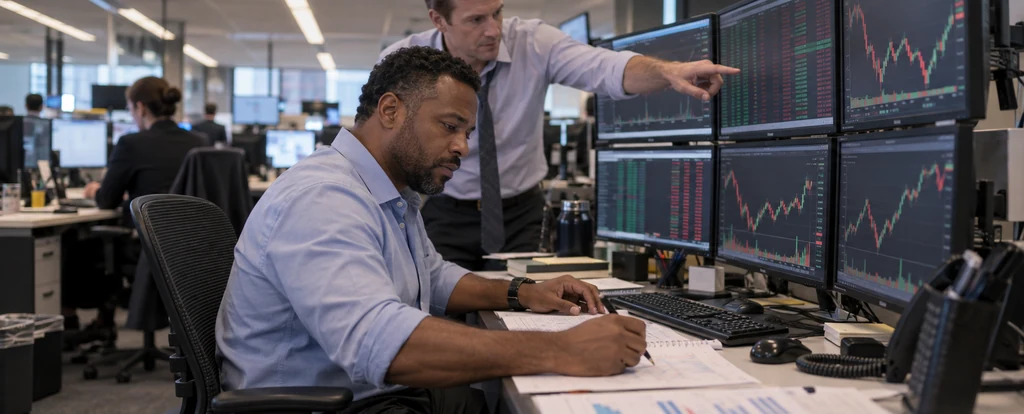
Futures dealing happens on a trading desk rather than in a branch, and most dealers work for investment banks, hedge funds or specialist derivatives firms trading standardised contracts on exchanges such as the ASX 24 or the CME. The day sits somewhere between watching positions, reading the market and executing orders, and dealers hold RG146 accreditation to deal in these products for clients or for the firm's own account. The job is often confused with stockbroking, but a futures dealer trades exchange-listed derivatives rather than company shares.
How much do futures dealers earn?
The median full-time salary for a futures dealer is $137,900 per annum, before tax, up $29,000 since 2018.
Dealing desks usually pay a base salary plus a bonus tied to the desk's profit, so total earnings can move a long way between a good year and a bad one. The product you trade and the type of firm matter as much as experience: a rates or energy desk at a large bank, a hedge fund and a small proprietary firm each structure pay differently, and a move into risk or portfolio management brings a different structure again.
What does a futures dealer do day to day?
The list below is what fills most weeks; the exact mix shifts with seniority and whatever stage the current work is at.
- Executing buy and sell orders for futures contracts across commodity, rate and index markets
- Watching open positions through the session and adjusting them as margin and risk limits move
- Reading economic releases, central bank statements and price charts for entry and exit signals
- Working with risk and clearing teams on margin calls, position limits and trade reporting
- Reconciling trades and handing over open positions at the close of the session
What skills do futures dealers need?
Employers look for financial analysis and modelling, risk and internal controls, data analysis, backed by Bloomberg Terminal fluency and strong problem solving.
Specialist skills
- Financial analysis and modelling
- Risk and internal controls
- Data analysis
- Strategy development
Software and tools
- Bloomberg Terminal
- Reuters Eikon
- CME Direct
- Python or R for data modelling
- Excel
General skills
- Problem solving
- Time and deadline management
- Written communication
Is the job growing?
About 90 people work as futures dealers in Australia, and employment is projected to grow 12.5% over the decade to 2035. That's healthy, above-average growth, and the role should stay in solid demand.
How do you become a futures dealer?
Here's the path most futures dealers take, step by step.
- 1Study finance, economics, commerce or a quantitative field
The most common qualification among futures dealers is Bachelor degree, usually with majors that cover derivatives, statistics and econometrics. Some people enter with a postgraduate qualification after working in another part of finance, so a later degree is a workable route rather than a wasted one.
- 2Meet the RG146 training standards
To deal in derivatives you need to meet ASIC's RG146 training standards, which most employers arrange through a provider in the first weeks on the desk. Check which units apply to your role, because the requirements differ between dealing for clients and dealing for the firm's own account.
- 3Get onto a desk
Graduate and internship programs at banks, brokers and funds are the main way in, and they are competitive because only a small number of firms run futures desks in Australia. Moving across from operations, risk or middle office is the other realistic route, and it uses knowledge of the same trades from the other side.
- 4Learn the platforms and the contracts
Day to day you work in CME Direct, the ASX 24 systems and market data terminals such as Bloomberg or Reuters Eikon. Learning tick sizes, contract specifications and how margin is calculated is what lets you trade without checking every step.
- 5Specialise in a market
Dealers tend to settle into a product area such as interest rate, energy or equity index futures, because the drivers of each market take time to learn. That specialisation is what makes you useful to a desk and what shapes the moves open to you later.
Ready to apply as a futures dealer?
Whether you're working toward becoming a futures dealer or already are one and want a hand with the next step (sharpening your resume for ATS screening, tightening your cover letter, or knowing what you'll actually be asked at interview), here are examples grounded in this specific role, not generic templates.
What jobs can a futures dealer move to?
None of the roles futures dealers typically move into pay more than the role itself. Equities Trader is the closest match. If a bigger salary is the goal, moving up into a senior or principal position within the role is usually the faster route than moving sideways.
| Move to | Typical pay change | Overlap | Retraining |
|---|---|---|---|
| Equities Trader Futures dealers bring exchange execution, hedging and market making skills to equities trading, needing little extra training. | +$0 | 80% | minimal |
| Derivatives Trader Futures dealers bring exchange-traded derivative pricing and margining skills to derivatives trading, with some retraining. | +$0 | 45% | short course |
| Investment Banker Futures dealers bring derivatives pricing and risk management, moving into investment banking with little extra training. | −$3,600 | 65% | minimal |
| Commodity Trader Futures dealers bring commodity futures expertise to broader commodity trading, with pricing and hedging knowledge carrying across. | −$3,900 | 63% | minimal |
| Treasurer Futures dealers bring hedging and risk management to corporate treasury, with further study in treasury operations. | −$28,500 | 36% | reskill |
Moves are chosen from Jobs and Skills Australia's Data on Occupation Mobility, which follows income tax records between 2011-12 and 2020-21, together with entry requirements and skill overlap. A known move is one people were seen making in that data. Pay change compares median full-time pay for the two roles.
Who works as a futures dealer?
The typical futures dealer is 50 years old; 93% are men, 85% work full-time, and full-timers average 52 hours a week.
- 50
- Median age
- 7%
- Female share
- 85%
- Full-time
- +12h
- vs all-jobs avg
What's it like being a futures dealer?
The rhythm follows the market rather than the office clock: dealers are at the desk before the session opens, and it runs into the evening when overseas markets are trading. Profit and loss is visible on the screen all day, so the pressure is constant and measurable. It suits people who stay steady while a position is losing and can act on a view without waiting for certainty.
What people like
- The scoreboard is immediate. Positions are marked to market within minutes, so you find out during the session whether your read on the market was right rather than waiting months for a project to land.
- Macro events land on your desk. Rates decisions, harvest results, currency moves and geopolitical news all arrive at the same screen, and the job is working out what each one means for the contracts you hold.
- Small teams and short chains of command. A dealing desk is often a handful of people, so a junior's view on a position can reach the person setting the risk limits in the same conversation.
- You can specialise in a market you already follow closely. Dealers settle into a product area such as energy, rates or equity indices, and the reading you do outside work often feeds directly into how you trade.
What people find hard
- Losing days are part of the job. No dealer avoids drawdowns, and the skill lies in cutting a position before a bad day becomes a bad month, which takes discipline that rarely feels natural at first.
- The market sets the hours. Sessions that overlap with London, Chicago or Singapore push starts early and finishes late, and full-time dealers average 52 hours a week. Some firms rotate staff across shifts, but the schedule is never really yours.
- Limits and compliance shape every strategy. Position limits, margin requirements and trade reporting sit around each trade, and part of the day goes into confirming that what you want to do sits inside the firm's risk appetite.
- It is a narrow field in Australia. Only a small number of firms run futures desks locally, so there are fewer places to move between than in broader finance roles, and leaving one desk can mean relocating or shifting into a related market.
Based on our synthesis of professional-body surveys and public accounts of the role, not first-person verified reviews.
Which industries employ futures dealers?
Financial and Insurance Services employs the largest share of futures dealers, followed by Professional, Scientific and Technical Services.
Top employing industries
- 1Financial and Insurance Services
- 2Professional, Scientific and Technical Services
Ranked by employment share; the source doesn't publish an exact percentage per industry.
| Bachelor degree | 41.6% | |
|---|---|---|
| Year 12 or below | 22.5% | |
| Postgraduate | 18% | |
| Diploma / Advanced Diploma | 9% | |
| Certificate III/IV | 3.4% |
Will AI replace futures dealers?
Futures dealing sits in the middle of the range: pricing, execution and position keeping are already heavily automated, so a dealer spends more time on the exceptions, the larger trades and the decisions the systems do not make. Judgement about which risks to carry overnight, and what a client is genuinely trying to hedge, is still human work.
Share of typical working time by exposure level
- Executing orders through exchange and broker systemsAlgorithms handle routine order flow in the most liquid contracts, so a dealer is left managing larger blocks and orders where the market is too thin for a model to work cleanly.30%high
- Monitoring positions and managing margin and risk limitsPlatforms flag a limit breach or a margin call automatically, but someone still decides which position to cut and in what order.25%moderate
- Pricing and hedging positionsPricing models produce a fair value in seconds, while the dealer chooses which risks to keep and how to hedge the awkward parts of the curve where there is little trading.25%moderate
- Talking to clients, brokers and the rest of the deskWorking out what a client is actually trying to hedge, and negotiating a block trade with a broker, happens in conversation rather than through a screen.20%low
Common questions about becoming a futures dealer
Straight answers to the questions people ask most.
How much do futures dealers earn?
$137,900 per year before tax is the median for full-time futures dealers. Total pay usually includes a bonus tied to the desk's performance, so earnings can move a long way from one year to the next, and the base salary alone is a smaller figure.
How do you become a futures dealer?
Most futures dealers start with a bachelor degree in finance, economics or a quantitative field, then join a graduate or internship program on a dealing desk. Employers arrange the RG146 training needed to deal in derivatives, and some people cross over from operations, risk or middle office roles instead.
Are futures dealers in demand?
Futures dealers are currently not in shortage, and employment in the role is projected to grow 12.5% over the decade to 2035. It is a small occupation in Australia, so openings tend to come through graduate intakes and internal moves at the firms that run these desks rather than through advertised vacancies.
Will AI replace futures dealers?
Automation has already taken over much of the routine execution, so algorithms quote prices, route orders and manage straightforward hedges while dealers handle the larger and less standard trades. Deciding which risks to hold overnight, and what a client is actually trying to hedge, still calls for a person. Forming a market view and negotiating with brokers and clients is the part that is least exposed.
What can futures dealers move into?
Equities trading uses much the same exchange execution and market making skills, so the move takes little extra training, and pay there is about the same than in futures dealing. Commodity trading draws on similar pricing and hedging knowledge, and pay is $3,900 less. Some dealers move into investment banking, where derivatives pricing and risk skills are useful, with pay $3,600 less.
Do futures dealers work long hours?
Yes, full-time futures dealers average 52 hours a week, and the day starts before the session opens. Overlap with overseas markets pushes the finish later, though some firms rotate staff across shifts to cover the longer trading day.
Related roles
Not sure this is you? Take the career quiz and get a ranked shortlist of roles that fit how you like to work.