First Aid Trainer
First aid trainers teach people how to respond to medical emergencies, and their courses are what keep workplace first aid certificates current.
- Median salary*
- $72,800
4.3%vs last year, before tax
- People employed
- 980
2.0%vs last year
- Projected growth
- +11.5%
to 2035
- AI exposure*
- Low
- automation risk
- Average hours
- 41/wk
+1h vs all jobs
- Shortage status
- Not in shortage
national
First aid trainers work for registered training organisations, private providers and large employers that run their own courses, delivering at training centres, workplaces and community venues. The role is teaching rather than treating: the clinical content follows national first aid guidelines, and the trainer's job is to make the steps stick under pressure. Most trainers start on a casual or sessional basis, picking up courses as bookings come in.
How much do first aid trainers earn?
The median full-time salary for a first aid trainer is $72,800 per annum, before tax, up $15,400 since 2018.
How you are engaged matters as much as the role itself, because sessional and casual trainers are usually paid per course or per day, with higher rates for evening and weekend sessions. Trainers who hold broader qualifications and can deliver more than one course tend to command better rates, and in-house roles with large employers can sit above the award. Contracting directly to clients means covering your own insurance, equipment and travel, which changes what you take home.
What does a first aid trainer do day to day?
The list below is what fills most weeks; the exact mix shifts with seniority and whatever stage the current work is at.
- Delivering first aid and CPR sessions to workplace teams, school staff, community groups and individuals
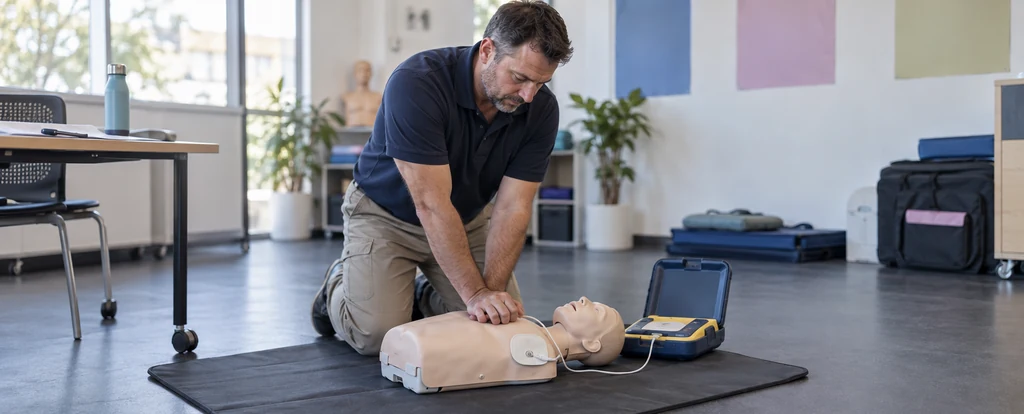
- Demonstrating and assessing practical skills such as chest compressions, bandaging and use of an AED
- Setting up and checking training equipment, including manikins, defibrillator trainers and consumables
- Marking assessments and entering student records in the training provider's system
- Keeping your own first aid qualifications current and updating course content when the guidelines change
What skills do first aid trainers need?
Employers look for teaching and instruction, health education and advice, emergency response, backed by CPR manikins fluency and strong written communication.
Specialist skills
- Teaching and instruction
- Health education and advice
- Emergency response
- Patient care and support
- Clinical assessment and treatment
Software and tools
- CPR manikins
- AED training units
- First aid training kits
- aXcelerate
- Moodle
General skills
- Written communication
- Attention to detail
- Problem solving
Is the job growing?
About 980 people work as first aid trainers in Australia, and employment is projected to grow 11.5% over the decade to 2035. That's healthy, above-average growth, and the role should stay in solid demand.
How do you become a first aid trainer?
Here's the path most first aid trainers take, step by step.
- 1Get your own first aid and CPR certificates
You cannot teach what you do not hold, so start with HLTAID011 Provide First Aid (HLTAID011) and HLTAID009 Provide CPR, and keep them renewed on schedule. The skills you learn in the course become the content you deliver.
- 2Complete the Certificate IV in Training and Assessment
The TAE40122 is the qualification registered training organisations require before you can deliver and assess nationally accredited courses. It is usually studied over several months, online or blended, and it is the main cost of entering the field.
- 3Build evidence of current industry skills
Providers have to show that their trainers have vocational currency, so experience as a nurse, paramedic, lifeguard, dental assistant or workplace first aider strengthens an application. Volunteering as a first aider at community events counts towards it as well.
- 4Start as a sessional trainer with a registered training organisation
Most trainers begin casually, delivering courses alongside an experienced lead trainer, and the bookings build as you prove reliable. Ask about mentoring and assessment moderation, because that is where new trainers learn the standard expected.
- 5Keep your scope and currency up to date
Training providers must show that their staff maintain professional development, so renew your first aid certificates, complete regular updates and widen your scope to other courses as you gain experience.
Ready to apply as a first aid trainer?
Whether you're working toward becoming a first aid trainer or already are one and want a hand with the next step (sharpening your resume for ATS screening, tightening your cover letter, or knowing what you'll actually be asked at interview), here are examples grounded in this specific role, not generic templates.
What jobs can a first aid trainer move to?
Moving into VET Trainer typically comes with the biggest pay rise, worth $37,900 a year more on average.
| Move to | Typical pay change | Overlap | Retraining |
|---|---|---|---|
| VET Trainer First aid trainers can become vocational trainers, using their training and assessment skills to teach broader subjects after further study. | +$37,900 | 21% | reskill |
| Learning and Development Specialist First aid trainers bring delivery and assessment skills to designing workplace learning programs, but need reskilling in learning and development.Known move | +$28,900 | 18% | reskill |
| Instructional Designer First aid trainers can move into instructional design using their teaching experience, though they need further study in learning theory and digital course design.Known move | +$28,900 | 11% | reskill |
| Disability Support Worker First aid trainers can move into disability support using their care and emergency response knowledge, though a substantial course in individual support is needed. | +$18,800 | 36% | reskill |
Moves are chosen from Jobs and Skills Australia's Data on Occupation Mobility, which follows income tax records between 2011-12 and 2020-21, together with entry requirements and skill overlap. A known move is one people were seen making in that data. Pay change compares median full-time pay for the two roles.
Who works as a first aid trainer?
The typical first aid trainer is 50 years old; 52% are women, 35% work full-time, and full-timers average 41 hours a week.
- 50
- Median age
- 52%
- Female share
- 35%
- Full-time
- +1h
- vs all-jobs avg
What's it like being a first aid trainer?
The work runs to a schedule of bookings, so a week might be three full-day courses, a couple of evening sessions and a day of marking. The pressure sits in the room, where you need to hold a group's attention through repetitive safety content and still assess every participant properly. It suits people who are comfortable presenting, patient with beginners and genuinely interested in how adults learn.
What people like
- Watching skills click. A participant who arrives nervous about compressions usually leaves able to perform them, and that change happens inside a single day.
- Different rooms and different crowds. Construction crews, school staff, childcare educators and office teams each bring their own questions, which keeps the material from going stale.
- A clear finish line. Every course ends with people holding a certificate they need for work, study or a volunteer role, so the day has a visible result.
- Control over when you work. Sessional and contract trainers can shape their week around study, family or another job in a way a standard office role rarely allows.
What people find hard
- Delivering the same course again and again. The content is fixed by national guidelines, so most trainers repeat the same sessions many times a year.
- Paperwork after the manikins are packed away. Assessment records, marking and compliance evidence have to be completed for every participant, and it adds up across a full course load.
- Income that follows bookings. Casual and sessional trainers are paid per course, so quiet periods such as January and the end of year mean noticeably less work.
- Participants who would rather be elsewhere. Some groups attend only because their employer requires it, and the trainer still has to find a way to reach them.
Based on our synthesis of professional-body surveys and public accounts of the role, not first-person verified reviews.
Which industries employ first aid trainers?
Education and Training employs the largest share of first aid trainers, followed by Health Care and Social Assistance.
Top employing industries
- 1Education and Training
- 2Health Care and Social Assistance
Ranked by employment share; the source doesn't publish an exact percentage per industry.
| Certificate III/IV | 27.6% | |
|---|---|---|
| Bachelor degree | 24% | |
| Diploma / Advanced Diploma | 21.5% | |
| Year 12 or below | 13% | |
| Postgraduate | 9.4% |
Will AI replace first aid trainers?
This is a low-exposure job, because its core is standing in a room getting people to perform physical skills correctly under your eye. Software already helps with slides, bookings and record keeping in many training providers' systems, but it cannot watch a group's compressions or sign off on competence. The parts of the job that stay human are the parts the certificate depends on.
Share of typical working time by exposure level
- Running hands-on CPR and first aid sessionsParticipants practise compressions on a manikin and have their technique corrected in the room, which a video or an app cannot replace.40%low
- Assessing participants against the practical performance criteriaJudging whether someone can roll a casualty into the recovery position is an in-person call that the trainer signs off on.25%low
- Preparing course materials, slides and scenario equipmentAI can draft slide content or scenario wording, but someone still has to check it against the current guidelines and set up the manikins and AED trainers.20%moderate
- Course administration, bookings and student recordsScheduling, enrolment and results entry in systems such as aXcelerate are the parts of the job most open to automation.15%high
Common questions about becoming a first aid trainer
Straight answers to the questions people ask most.
How much do first aid trainers earn?
First aid trainers earn $72,800 per year before tax, based on full-time workers. Because much of the work is sessional, pay is often set per course or per day, so what you take home over a year depends on how many bookings you pick up.
How do you become a first aid trainer?
You need current first aid and CPR certificates plus the Certificate IV in Training and Assessment (TAE40122), which is what allows you to deliver accredited courses. Most people then start as a sessional trainer with a registered training organisation and build their course load from there.
Are first aid trainers in demand?
First aid trainers are currently not in shortage, and employment in the field is projected to grow 11.5% over the decade to 2035. First aid certificates expire and have to be renewed, which brings participants back on a regular cycle, though a lot of the work is casual or sessional rather than full time.
Will AI replace first aid trainers?
The exposure here is low, because training people to perform physical skills on a manikin and assessing them doing it is not something software can take over. AI is more likely to change the administrative side, helping with scheduling, enrolment and record keeping in systems such as aXcelerate.
What can first aid trainers move into?
Trainers with several years of delivery behind them often move into learning and development specialist or instructional designer roles, designing workplace training rather than presenting it, and those moves come with a pay difference of $28,900 more. Both need further study in learning design, although the facilitation and assessment skills carry across. Some trainers instead build their own training business or contract as a sole trader, which is often where earnings grow.
Do you need to be a nurse or paramedic to train first aid?
No, but a clinical or emergency background makes it easier to get started. Registered training organisations need evidence of current industry skills, and nurses, paramedics, lifeguards, ski patrollers and experienced workplace first aiders can all meet that requirement in different ways.
Related roles
- Learning and Development Specialist
- Instructional Designer
- Disability Support Worker
- VET Trainer
- Lifeguard
- Ski Patroller
Not sure this is you? Take the career quiz and get a ranked shortlist of roles that fit how you like to work.