Front End Developer
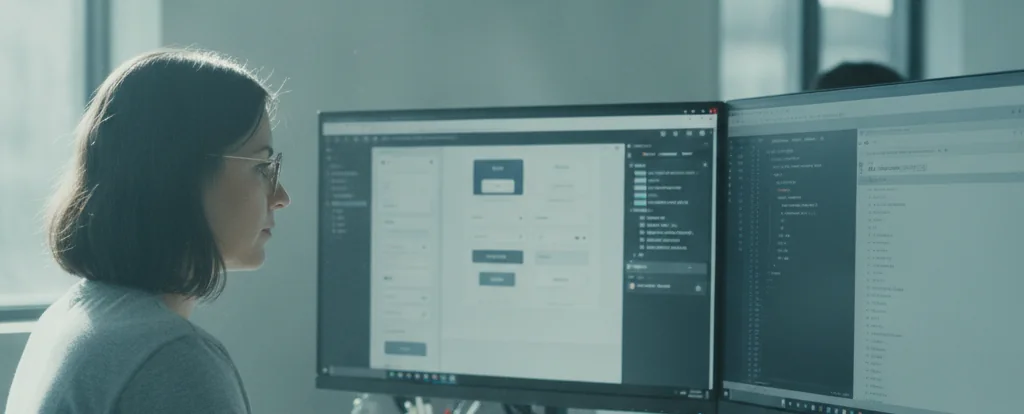
Front end developers build the parts of a website or app that people see and use in their browser, turning a design into a working interface.
- Median salary
- $128,800
4.3%vs last year, before tax
- People employed
- 9,000
2.3%vs last year
- Projected growth
- +26.9%
to 2035
- AI exposure*
- Moderate
- automation risk
- Average hours
- 41/wk
+1h vs all jobs
- Shortage status
- Not in shortage
national
Front end developers write the HTML, CSS and JavaScript that runs inside a browser, turning a designer's mockup into a page or app that people can actually use. Most work in a small product team, alongside a designer who supplies the visual design and a back end developer who owns the server, database and API. The role is often confused with full stack development, which covers both ends of the same build, while front end work specialises in the interface layer, the part a user sees, clicks and types into.
How much do front end developers earn?
The median full-time salary for a front end developer is $128,800 per annum, before tax, up $27,100 since 2018.
Pay moves mainly with the type of employer rather than the job title: product companies, financial services and large technology teams pay above agencies, government and not-for-profits. Contract and day-rate work usually pays more than a permanent salary in exchange for less security, and seniority or a specialisation such as accessibility or design systems lifts the figure further. Award coverage is uncommon, because most front end developers are on individual arrangements.
What does a front end developer do day to day?
The list below is what fills most weeks; the exact mix shifts with seniority and whatever stage the current work is at.
- Turning a design file into an interface that behaves the way people expect once they start clicking, typing and resizing
- Checking a page across browsers, screen sizes and assistive technology, then tracking down the one rule that breaks the layout on an older phone
- Connecting a component to a back end API and deciding what the page should show while the data is loading, slow or missing
- Reviewing a colleague's pull request and explaining, in writing, why a different approach would hold up better
- Trimming page weight and load time once a feature works, because a slow interface loses people before the content appears
What skills do front end developers need?
Employers look for web and application development, programming and software development, uX and interaction design, backed by React fluency and strong problem solving.
Specialist skills
- Web and application development
- Programming and software development
- UX and interaction design
- Software testing and QA
- Agile delivery
Software and tools
- React
- Visual Studio Code
- Git
- Chrome DevTools
- Figma
General skills
- Problem solving
- Written communication
- Attention to detail
Is the job growing?
About 9,000 people work as front end developers in Australia, and employment is projected to grow 26.9% over the decade to 2035. That's very strong growth. Few roles in Australia are expanding this fast, and it points to solid demand for years to come.
How do you become a front end developer?
Here's the path most front end developers take, step by step.
- 1Learn the fundamentals of HTML, CSS and JavaScript
These three languages are the whole toolkit at the start, and they are free to learn. A self-directed curriculum, a TAFE course or a bootcamp all work, and the realistic time frame is six to twelve months of steady practice before you can build something on your own.
- 2Consider a degree or diploma
A bachelor degree in information technology or computer science is common in the field, with 47% of front end developers holding a Bachelor degree, and diplomas cover a similar technical grounding in less time. The work is not licensed, so no qualification is legally required, though some larger employers and graduate programs screen on one.
- 3Build a portfolio of real projects
Two or three finished projects you can link to, hosted on GitHub and running live, show an employer how you structure code and handle a browser. Course exercises look alike across applicants; something you chose to build, with a README explaining the decisions, is what gets a junior interview.
- 4Apply for junior roles or step across from a nearby job
Junior front end and graduate developer roles are the usual entry point, and internships or paid traineeships with a product team are worth the lower starting rate for the mentoring. Web designers, web administrators and IT support officers can move in as well, usually after a short course or a concentrated period of learning JavaScript and a framework.
- 5Keep the toolkit current
Employers list specific frameworks, and React appears most often in Australian ads, so most developers add one framework properly rather than collecting many. Version control with Git, browser developer tools and a design tool such as Figma are expected on day one.
Ready to apply as a front end developer?
Whether you're working toward becoming a front end developer or already are one and want a hand with the next step (sharpening your resume for ATS screening, tightening your cover letter, or knowing what you'll actually be asked at interview), here are examples grounded in this specific role, not generic templates.
What jobs can a front end developer move to?
Moving into Software Engineer typically comes with the biggest pay rise, worth $3,100 a year more on average.
| Move to | Typical pay change | Overlap | Retraining |
|---|---|---|---|
| Software Engineer Front end developers bring interface and browser expertise to broader software engineering, with further study in back end and systems.Known move | +$3,100 | 41% | reskill |
| DevOps Engineer Front end developers can move into devops, applying build and deployment familiarity while learning cloud infrastructure and automation.Known move | +$3,100 | 33% | reskill |
| Full Stack Developer Front end developers expand into full stack work by adding server side and storage skills, building on strong user interface foundations. | +$0 | 81% | minimal |
| Back End Developer Front end developers bring scripting and problem solving skills to back end development, needing server side languages and system integration. | +$0 | 37% | reskill |
| Mobile App Developer Front end developers can specialise in mobile apps, transferring layout and interaction skills to platform specific frameworks with short training. | +$0 | 54% | short course |
Moves are chosen from Jobs and Skills Australia's Data on Occupation Mobility, which follows income tax records between 2011-12 and 2020-21, together with entry requirements and skill overlap. A known move is one people were seen making in that data. Pay change compares median full-time pay for the two roles.
Who works as a front end developer?
The typical front end developer is 35 years old; 80% are men, 78% work full-time, and full-timers average 41 hours a week.
- 35
- Median age
- 20%
- Female share
- 78%
- Full-time
- +1h
- vs all-jobs avg
What's it like being a front end developer?
Front end work runs in short cycles: pick up a task from the backlog, build the interface, get it reviewed, ship it, then fix what real users find. Much of the day is spent inside an editor and a browser, moving between writing code, checking how a page looks and behaves, and talking through edge cases with a designer or back end developer. The people who enjoy it tend to like fiddly problems with a visible result, and are comfortable with the fact that an interface is never finished, only shipped.
What people like
- Your work is visible almost immediately. You write a component, refresh the browser and it is there, which gives a much shorter feedback loop than most development work offers.
- A steady supply of small puzzles. A layout that breaks on one screen size, a form that submits twice, a dropdown that closes too early: each is a contained problem with a cause you can find.
- Craft that people notice. Getting the spacing, loading states and keyboard behaviour right is the difference between an interface that feels solid and one that feels cheap, and that detail is yours to control.
- Close to the people using the product. You sit near the design and product decisions, so you often see how a feature lands with real users rather than only handing code over a wall.
What people find hard
- Browser and device quirks. The same code can behave differently across browsers and older phones, and a chunk of the working week goes to testing combinations you cannot control.
- Design changes late in the build. A revised flow or a new state arriving after the component is built means rework, and the deadline rarely moves with it.
- Constant framework churn. The tools that were standard three years ago are not the ones employers list now, so some of your own time goes to keeping up.
- Performance and accessibility squeezed at the end. Both are easiest to handle while building, but on tight schedules they often land in the last week, when there is least room to fix them properly.
Based on our synthesis of professional-body surveys and public accounts of the role, not first-person verified reviews.
Which industries employ front end developers?
Professional, Scientific and Technical Services employs the largest share of front end developers, followed by Information Media and Telecommunications.
Top employing industries
- 1Professional, Scientific and Technical Services
- 2Information Media and Telecommunications
- 3Financial and Insurance Services
Ranked by employment share; the source doesn't publish an exact percentage per industry.
| Bachelor degree | 47.3% | |
|---|---|---|
| Postgraduate | 21.1% | |
| Diploma / Advanced Diploma | 12% | |
| Year 12 or below | 11.9% | |
| Certificate III/IV | 5% |
Will AI replace front end developers?
AI reaches a fair part of this job, but it changes the mix of work more than it removes the role. Assistants such as GitHub Copilot and the AI features built into editors and Figma now generate a usable first pass at components, markup and styling from a prompt or a design file. What stays with the developer is behaviour: how a page responds while data loads, whether the layout holds on a small screen or a screen reader, and how new code fits a codebase with its own conventions and history.
Share of typical working time by exposure level
- Writing component code in ReactAn assistant will draft a component, its props and basic state handling from a description, so the developer spends more of this time reading, correcting and fitting that code into the existing structure.30%high
- Translating Figma designs into CSS layoutsTools can generate markup and styles from a design file, but spacings, breakpoints, hover and focus states and long text still need someone to set them up properly.25%moderate
- Debugging browser and cross-device issuesWorking out why a dropdown misbehaves on one phone or in one browser means reproducing it, reading the DOM in dev tools and testing the fix where the problem happens.25%low
- Performance, accessibility and code reviewChecking load time against a slow connection, testing keyboard navigation and screen reader output, and judging whether a colleague's pull request should be approved are calls a person makes.20%low
Common questions about becoming a front end developer
Straight answers to the questions people ask most.
How much do front end developers earn?
Front end developers earn a median of $128,800 per year before tax. What moves that figure most is the type of employer and the arrangement, since product companies and financial services tend to pay above agencies or government, and contract rates usually exceed permanent salaries.
How do I become a front end developer?
Learn HTML, CSS and JavaScript, then build two or three real projects you can show in a portfolio on GitHub. A degree, diploma or bootcamp speeds up the technical grounding, and junior roles, internships or a move across from web design or IT support are the usual ways in.
Are front end developers in demand?
Front end developers are currently not in shortage, and employment is projected to grow 26.9% over the decade to 2035 over the decade to 2035. Demand sits across almost every industry that runs a website or app, which means the skills carry between employers even when one sector slows.
Will AI replace front end developers?
AI has taken over a real share of the routine work. Assistants such as GitHub Copilot and the AI features in editors and Figma produce a usable first pass at components and styling from a prompt or a design file. What they do not do is decide how a page should behave while data is loading, check that it works for someone using a screen reader, or fit code into a codebase with its own conventions.
What can a front end developer move into?
Full stack development builds on the same interface foundations, adding server side and storage skills, and pays about the same. Software engineering pays $3,100 more with further study in back end systems, and devops pays $3,100 more once you learn cloud infrastructure and automation. Experienced developers also contract or run their own consultancy, which is often where earnings grow, though finding clients comes with it.
Do front end developers need a degree?
No, the role is not licensed and employers hire on demonstrated skill. That said, most people working in it are qualified: about 47% of front end developers hold a Bachelor degree, and larger employers and graduate programs often screen on one.
Related roles
- Software Engineer
- Full Stack Developer
- DevOps Engineer
- Back End Developer
- Mobile App Developer
- Web Designer
Not sure this is you? Take the career quiz and get a ranked shortlist of roles that fit how you like to work.