Hotel Receptionist
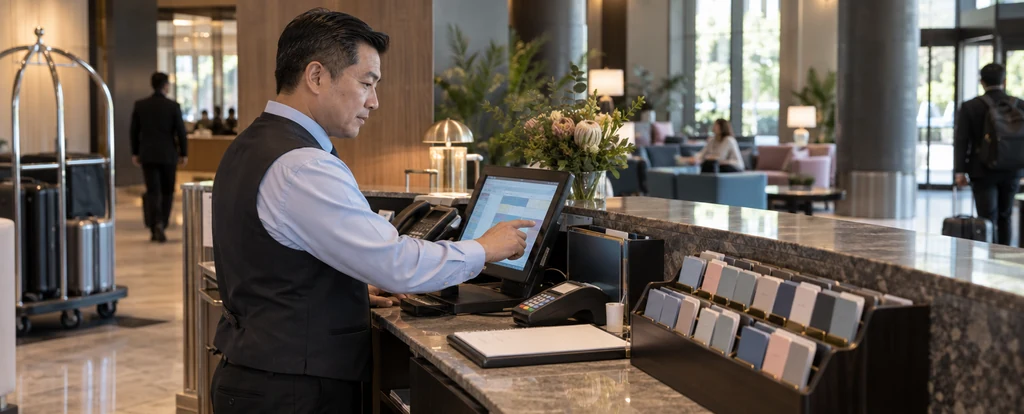
Hotel receptionists look after guests from the moment they arrive, handling check-ins, bookings and whatever comes up during a stay.
- Median salary*
- $57,200
3.8%vs last year, before tax
- People employed
- 8,600
0.0%vs last year
- Projected growth*
- −3.5%
to 2035
- AI exposure*
- High
- automation risk
- Average hours*
- 38/wk
−2h vs all jobs
- Shortage status*
- Not in shortage
national
Hotel receptionists work at the front desk of hotels, motels, resorts and serviced apartments, managing arrivals and departures and the questions in between. The desk is staffed across a long day, so shifts are rostered through evenings, weekends and public holidays. The role is often confused with a concierge or porter job, but receptionists are the ones doing the bookings, payments and records rather than carrying bags or booking tours.
How much do hotel receptionists earn?
The median full-time salary for a hotel receptionist is $57,200 per annum, before tax, up $11,900 since 2018.
Most front desk work is covered by the Hospitality Industry (General) Award, which sets a base rate and adds loadings for evening, weekend and public holiday shifts, so your roster affects your pay as much as your experience does. Larger hotels often pay above the award and may offer an annual salary for a full-time roster, while small properties tend to sit closer to the minimum. Being able to run the desk alone and manage the property management system is what moves you up the front office ladder.
What does a hotel receptionist do day to day?
The list below is what fills most weeks; the exact mix shifts with seniority and whatever stage the current work is at.
- Checking guests in and out, allocating rooms and issuing keys or key cards
- Taking bookings by phone, email and the property's booking channels, and updating the property management system
- Answering questions about the property, transport, local restaurants and things to do in the area
- Handling payments, reconciling the front desk float and preparing invoices for corporate accounts
- Passing maintenance and housekeeping issues to the right department and following them up
What skills do hotel receptionists need?
Employers look for front-of-house service, operations management, backed by Opera Cloud PMS fluency and strong customer service.
Specialist skills
- Front-of-house service
- Operations management
Software and tools
- Opera Cloud PMS
- Microsoft Office
- Booking.com extranet
- Protel AIR
- Microsoft Excel
General skills
- Customer service
- Written communication
- Attention to detail
- Problem solving
- Digital literacy
Is the job growing?
About 8,600 people work as hotel receptionists in Australia, and employment is projected to decline 3.5% over the decade to 2035. That's a real decline, worth weighing carefully before training into the role.
How do you become a hotel receptionist?
Here's the path most hotel receptionists take, step by step.
- 1Build customer service experience
Most receptionists start from school, or from a job dealing with the public: waiting, retail, a call centre or another role inside a hotel. That experience is what hotel managers look for, more than a particular qualification.
- 2Consider a Certificate III in Hospitality (Accommodation Services)
TAFE and private providers offer the qualification, which covers front office procedures, reservations and guest service. It takes around a year part time and can be done while you work, and it helps most when you are aiming for a supervisory desk role.
- 3Learn the property management system
Hotels run software such as Opera Cloud or Protel AIR, and training usually happens on the job. Being able to check a guest in, take a booking and correct an error without help is what gets you onto busier shifts and night shifts.
- 4Pick up the certificates the property needs
A Responsible Service of Alcohol certificate is required if the desk handles bar sales, and a first aid certificate helps on night shifts when fewer staff are on site. Requirements vary between states and employers, so check what the hotel asks for.
- 5Move up or sideways after a couple of years
Front desk experience leads to duty manager or front office supervisor roles, or into reservations and revenue work. Larger chains run internal training programs for these moves, and further study in hospitality management is often part of the step up.
Ready to apply as a hotel receptionist?
Whether you're working toward becoming a hotel receptionist or already are one and want a hand with the next step (sharpening your resume for ATS screening, tightening your cover letter, or knowing what you'll actually be asked at interview), here are examples grounded in this specific role, not generic templates.
What jobs can a hotel receptionist move to?
Moving into Hotel Manager typically comes with the biggest pay rise, worth $37,800 a year more on average.
| Move to | Typical pay change | Overlap | Retraining |
|---|---|---|---|
| Hotel Manager Receptionists bring guest service and hotel operations knowledge to managing a property, requiring substantial study in hospitality management. | +$37,800 | 32% | reskill |
| Hotel Service Manager Receptionists bring front desk and guest relations experience to supervising hotel operations, adding further study in hospitality management. | +$16,100 | 29% | reskill |
| Bed and Breakfast Operator Receptionists bring bookings and guest care skills to running a small accommodation business, adding a short course in hospitality operations. | +$10,400 | 59% | short course |
| Reservations Agent Hotel receptionists bring booking systems and guest service skills to reservations work, moving into a specialist sales and scheduling role. | +$2,600 | 73% | minimal |
Moves are chosen from Jobs and Skills Australia's Data on Occupation Mobility, which follows income tax records between 2011-12 and 2020-21, together with entry requirements and skill overlap. A known move is one people were seen making in that data. Pay change compares median full-time pay for the two roles.
Who works as a hotel receptionist?
The typical hotel receptionist is 32 years old; 73% are women, 38% work full-time, and full-timers average 38 hours a week.
- 32
- Median age
- 73%
- Female share
- 38%
- Full-time
- −2h
- vs all-jobs avg
What's it like being a hotel receptionist?
The rhythm of the job is set by arrivals: a rush in the late afternoon as rooms turn over, quieter stretches overnight and early in the morning, and a steady stream of phone and email enquiries in between. It suits people who like dealing with a wide range of guests, can stay calm when several things need attention at once, and don't mind being tied to a desk for most of a shift. The work is largely administrative, so the satisfaction comes from getting the details right and from being the person who sorts out a guest's problem.
What people like
- You see the result of your work straight away. A guest checks in, gets the room they wanted and has a good stay, and you hear about it before anyone else does.
- The desk is the hub of the building. You deal with housekeeping, maintenance, food and beverage and management through the day, so you pick up how a hotel actually runs.
- Rostered shifts can suit other commitments. Because the desk is staffed across a long day, part-time and casual rosters are common, and some receptionists trade weekend or night work for days off during the week.
- There is a clear path upwards. Reception is one of the standard entry points into hotel management, and the front desk experience counts towards supervisor and duty manager roles.
What people find hard
- Difficult guests arrive at your desk first. Complaints about noise, a room that is not ready or a bill come to you before anyone else, and you are the one explaining what the hotel can and cannot do.
- Your roster includes nights, weekends and public holidays. Hotels are busiest exactly when most people are off, so Christmas, Easter and school holidays are ordinary working days at the front desk.
- Slow stretches break into a rush. Mid-afternoon can pass with almost nothing happening, then a coach group or a cancelled flight fills the lobby and several guests want your attention at once.
- Much of the day is administration. Between guests the job is data entry, float reconciliations and answering emails, and that side of the work is less varied than people expect.
Based on our synthesis of professional-body surveys and public accounts of the role, not first-person verified reviews.
Which industries employ hotel receptionists?
Accommodation and Food Services employs the largest share of hotel receptionists, followed by Arts and Recreation Services.
Top employing industries
- 1Accommodation and Food Services
- 2Arts and Recreation Services
- 3Transport, Postal and Warehousing
- 4Rental, Hiring and Real Estate Services
- 5Administrative and Support Services
Ranked by employment share; the source doesn't publish an exact percentage per industry.
| Certificate III/IV | 34% | |
|---|---|---|
| Diploma / Advanced Diploma | 26% | |
| Bachelor degree | 20% | |
| Year 12 or below | 20% |
Will AI replace hotel receptionists?
This is a job where automation already handles a good share of the routine work. Self-service kiosks, mobile keys and online booking engines cover straightforward check-ins and reservations, and chatbots answer the standard questions about parking and check-out times. What keeps people at the desk is the unpredictable part, along with the local knowledge and small judgements guests expect from a person.
Share of typical working time by exposure level
- Checking guests in and outKiosks and mobile keys now let guests arrive without stopping at the desk, though staff still step in when a booking is wrong or a key card will not work.30%high
- Taking and changing bookingsChannel managers and booking engines confirm most reservations automatically, and online assistants handle simple date changes.25%high
- Sorting out problems during a stayA guest locked out at 11pm, a room that is not ready, a noise complaint next door: these need someone at the desk who can decide and act.25%low
- Handling payments and accountsCard terminals and automated folios do most of the processing, but refunds, split bills and corporate accounts still need a person to untangle.20%moderate
Common questions about becoming a hotel receptionist
Straight answers to the questions people ask most.
How much does a hotel receptionist earn?
Hotel receptionists earn a median of $57,200 per year before tax. Award rates set the floor for most front desk work, and evening, weekend and public holiday loadings lift take-home pay above the base rate, so the figure is a guide rather than a fixed rate. Larger hotels and overnight rosters tend to pay the most.
How do you become a hotel receptionist?
Apply directly to hotels with a short resume showing customer service, cash handling and any booking or point-of-sale systems you have used. Most properties train you on their own property management system in the first weeks, so willingness to learn Opera Cloud or Protel AIR matters more than prior software experience. A Certificate III in Hospitality (SIT30622) helps, and so does being available for evenings and weekends.
Are hotel receptionists in demand?
Hotel receptionists are currently not in shortage, and employment is projected to decline 3.5% over the decade to 2035 over the decade to 2035. The work sits almost entirely in accommodation, so it is worth checking which hotels, motels and resorts near you are hiring before you commit to training.
Will AI replace hotel receptionists?
A lot of the routine side is already automated: self-service kiosks and mobile keys handle straightforward check-ins, booking engines confirm reservations, and chatbots answer the standard questions about parking and check-out times. What stays with people is the part that goes wrong, such as a guest locked out at midnight, a room that is not ready, or a complaint that needs a decision on the spot. Hotels still want staff on the desk, and the role is shifting further towards problem solving.
What can a hotel receptionist move into?
Front desk experience leads most often into a Reservations Agent role, which uses the same booking systems and guest knowledge with less time on the desk, or into a supervisory role such as Hotel Service Manager, where hospitality management study is usually needed. Running a small bed and breakfast is another common step, and owning that business is often where earnings grow.
Do you need a qualification to work at a hotel front desk?
No formal qualification is required for most entry-level front desk roles, and plenty of receptionists start after Year 12 or a spell in another hospitality job. A Certificate III in Hospitality (Accommodation Services) is useful if you want to move into supervision, but employers rarely ask for it at the entry level.
Related roles
- Reservations Agent
- Hotel Service Manager
- Hotel Manager
- Bed and Breakfast Operator
- Hotel Porter
- Ticket Seller
Not sure this is you? Take the career quiz and get a ranked shortlist of roles that fit how you like to work.