Pathologist
Pathologists are medical specialists who examine tissue, blood and other specimens to diagnose disease and guide the treatment other doctors give.
- Median salary*
- $218,400
4.4%vs last year, before tax
- People employed
- 2,800
3.7%vs last year
- Projected growth
- +33%
to 2035
- AI exposure*
- Moderate
- automation risk
- Average hours
- 44/wk
+4h vs all jobs
- Shortage status
- In shortage
national
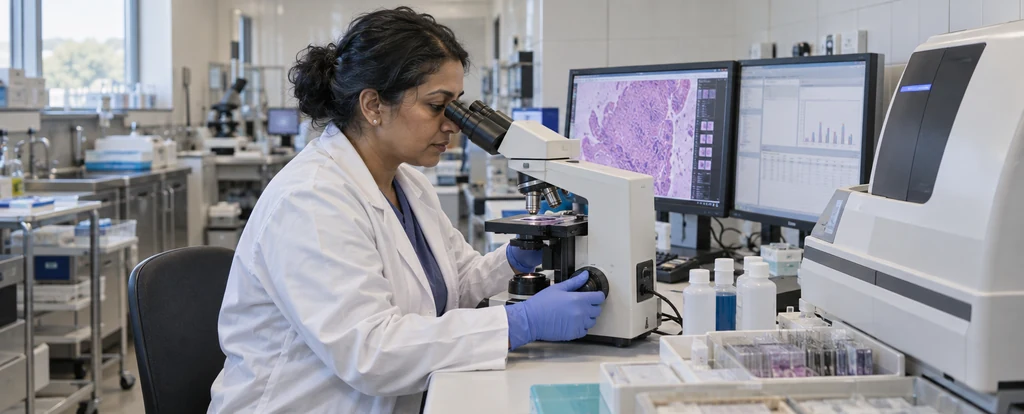
Most pathologists work in hospital laboratories or private pathology practices, reporting on samples sent by general practitioners, surgeons and emergency departments rather than seeing patients at the bedside. The specialty divides into anatomical pathology, haematology, chemical pathology, microbiology and forensic pathology, and the diagnosis is usually made at the microscope or on the analyser. About 2,800 people work as pathologists in Australia, and all of them hold medical registration as well as a specialist qualification.
How much do pathologists earn?
The median full-time salary for a pathologist is $218,400 per annum, before tax, up $46,200 since 2018.
What a pathologist earns depends heavily on the setting: a salaried staff specialist in a public hospital sits on a state enterprise agreement with defined increments, while a partner or contractor in private pathology earns from the practice's billing. Subspecialty, on-call responsibilities and rural or locum work also shift the figure. The median above covers full-time pathologists across public and private practice.
What does a pathologist do day to day?
The list below is what fills most weeks; the exact mix shifts with seniority and whatever stage the current work is at.
- Examining tissue biopsies under a microscope to identify cancer and other disease
- Interpreting blood films, biochemistry results and microbiology cultures
- Reporting frozen sections during surgery, where a surgeon needs an answer within about twenty minutes
- Performing autopsies to establish the cause of death
- Reviewing laboratory quality control, test validation and accreditation before results are released
What skills do pathologists need?
Employers look for clinical assessment and treatment, laboratory analysis, data analysis, backed by Laboratory information systems fluency and strong attention to detail.
Specialist skills
- Clinical assessment and treatment
- Laboratory analysis
- Data analysis
- Regulatory compliance
Software and tools
- Laboratory information systems
- Digital pathology scanners
- Light microscopes
- Immunohistochemistry platforms
- Next-generation sequencing instruments
General skills
- Attention to detail
- Problem solving
- Written communication
Is the job growing?
About 2,800 people work as pathologists in Australia, and employment is projected to grow 33% over the decade to 2035. That's very strong growth. Few roles in Australia are expanding this fast, and it points to solid demand for years to come.
How do you become a pathologist?
Here's the path most pathologists take, step by step.
- 1Complete a medical degree
Entry is through a five or six year undergraduate medical course or a graduate medical degree, which takes four years after a first degree. Both routes include supervised clinical placements, and both are competitive on academic results and an aptitude test.
- 2Finish internship and gain general registration
A one year internship in a hospital, usually with rotations through medicine, surgery and emergency, leads to general registration with AHPRA.
- 3Work as a resident medical officer
Two or three prevocational years build broad clinical experience and are usually spent in hospital rotations. This is also the pool pathology training selects from, so references and term choices matter.
- 4Complete RCPA specialist training
The Royal College of Pathologists of Australasia runs a five year training program in accredited laboratories, covering a core specialty plus subspecialty rotations, with written and practical examinations along the way.
- 5Attain fellowship and specialist registration
Fellowship of the RCPA, with specialist registration through AHPRA, allows independent reporting. Many pathologists then take a fellowship year overseas or in a subspecialty before settling into a permanent post.
Ready to apply as a pathologist?
Whether you're working toward becoming a pathologist or already are one and want a hand with the next step (sharpening your resume for ATS screening, tightening your cover letter, or knowing what you'll actually be asked at interview), here are examples grounded in this specific role, not generic templates.
What jobs can a pathologist move to?
None of the roles pathologists typically move into pay more than the role itself. Haematologist is the closest match. If a bigger salary is the goal, moving up into a senior or principal position within the role is usually the faster route than moving sideways.
| Move to | Typical pay change | Overlap | Retraining |
|---|---|---|---|
| Haematologist A pathologist's diagnostic and laboratory expertise transfers to haematology, with specialist physician training required. | −$10,400 | 22% | requalify |
| Clinical Immunologist and Allergist Pathology training in laboratory medicine supports a move into clinical immunology, though specialist physician training is needed. | −$10,400 | 19% | requalify |
Moves are chosen from Jobs and Skills Australia's Data on Occupation Mobility, which follows income tax records between 2011-12 and 2020-21, together with entry requirements and skill overlap. A known move is one people were seen making in that data. Pay change compares median full-time pay for the two roles.
Who works as a pathologist?
The typical pathologist is 43 years old; 64% are women, 67% work full-time, and full-timers average 44 hours a week.
- 43
- Median age
- 64%
- Female share
- 67%
- Full-time
- +4h
- vs all-jobs avg
What's it like being a pathologist?
The working week runs on specimen volume: slides, cultures and urgent requests arrive continuously and have to be reported within agreed turnaround times, so the day is a queue of diagnostic problems rather than a schedule of appointments. The pressure comes from being the last check on someone else's treatment decision, and from carrying an on-call roster for frozen sections and urgent blood work. It suits people who enjoy sustained detective work, are content with long stretches of solo concentration, and like being the specialist other doctors turn to for an answer.
What people like
- You make the diagnosis. A surgeon sends a biopsy, and the report that comes back determines whether an operation goes ahead. Few specialties give one person that much influence over a decision.
- Every case is a different problem. The specimen on the microscope could be anything from a routine skin lesion to a rare tumour, so the intellectual work changes from hour to hour.
- Close work with treating teams. Multidisciplinary meetings put you in the room with oncologists, surgeons and radiologists, explaining how the diagnosis shapes the treatment plan.
- A laboratory timetable. Unlike procedural specialties, pathology is mostly a daytime laboratory job, and rosters are relatively predictable apart from on-call.
What people find hard
- Reporting targets apply to everything. Turnaround times are measured for every specimen, so a busy week puts pressure on the whole reporting queue and backlog takes time to clear.
- Long hours at the microscope. Sustained concentration through a day of reporting is tiring, and the work is done sitting still rather than moving around a ward.
- Almost no ongoing patient contact. You rarely meet the person whose sample you are reporting, and follow-up comes through the file rather than a consultation.
- Autopsy work is part of the job. Anatomical and forensic pathologists perform autopsies, including coronial cases, and the material can be confronting even for people who chose the specialty.
Based on our synthesis of professional-body surveys and public accounts of the role, not first-person verified reviews.
Which industries employ pathologists?
Health Care and Social Assistance employs the largest share of pathologists.
Top employing industries
- 1Health Care and Social Assistance
Ranked by employment share; the source doesn't publish an exact percentage per industry.
| Bachelor degree | 38.3% | |
|---|---|---|
| Postgraduate | 31.7% | |
| Certificate III/IV | 8.8% | |
| Year 12 or below | 8.2% | |
| Diploma / Advanced Diploma | 6.5% |
Will AI replace pathologists?
AI is a working tool in the pathology laboratory rather than a replacement for the pathologist. Digital scanners, automated analysers and machine learning triage already sort slides and flag abnormal results, which shifts the work toward verification, quality assurance and the harder diagnostic calls. Autopsy work and discussions with treating clinicians remain largely untouched.
Share of typical working time by exposure level
- Reporting histology and cytology slidesDigital scanners and AI triage tools can pre-screen slides and flag suspicious regions, but the pathologist still makes the diagnosis and signs the report.40%moderate
- Interpreting blood films and laboratory resultsAnalysers and algorithms flag abnormal results automatically, which speeds up sorting but not the clinical interpretation behind the comment on the report.25%moderate
- Multidisciplinary meetings and clinician consultationsExplaining what a report means for a particular patient happens in conversation with surgeons, oncologists and general practitioners.20%low
- Autopsies and death investigationEstablishing a cause of death involves dissection, medical history and discussion with coronial staff, none of which is automated.15%low
Moves least exposed to AI
These career moves from pathologist work are rated low for AI exposure:
- Haematologist
Some skill overlap (22%), requalify to get there, and a low automation-risk profile.
- Clinical Immunologist and Allergist
Some skill overlap (19%), requalify to get there, and a low automation-risk profile.
Common questions about becoming a pathologist
Straight answers to the questions people ask most.
How much do pathologists earn?
Pathologists earn a median of $218,400 per year before tax, with salaried hospital specialists toward the lower end and private practice partners at the upper end. Subspecialty, on-call duties and location all affect where an individual sits.
How do you become a pathologist?
You need a medical degree, an internship, general registration with AHPRA, and then five years of specialist training with the Royal College of Pathologists of Australasia. Selection into training is competitive and generally happens after two or three years of hospital work as a resident medical officer.
Are pathologists in demand in Australia?
Pathologists are currently in shortage nationally, and employment is projected to grow 33% over the decade to 2035 over the decade to 2035. The workforce is small, so a vacancy in a particular subspecialty or region can take a long time to fill.
Will AI replace pathologists?
No, but it is changing how the work is done. Digital scanners and machine learning tools triage slides and flag abnormalities, which speeds up screening, while the diagnostic call and the signed report remain the pathologist's responsibility. Autopsy work and consultations with treating clinicians are the least affected.
What can a pathologist move into?
A move into haematology builds on the blood and bone marrow diagnosis pathologists already do, though it means completing physician training and requalifying. Clinical immunology follows a similar route and leans on the laboratory side of the work. Many pathologists stay in the specialty and become partners or directors of a private pathology practice, which is often where earnings grow.
Do pathologists see patients?
Most do not, and the work happens in a laboratory rather than a consulting room, though clinical haematologists, immunologists and microbiologists do see patients and advise treating teams. Pathologists in multidisciplinary meetings explain findings directly to the doctors making treatment decisions.
Related roles
- Haematologist
- Clinical Immunologist and Allergist
- Resident Medical Officer
- Medical Laboratory Scientist
- Clinical Pharmacologist
- Clinical Coder
Not sure this is you? Take the career quiz and get a ranked shortlist of roles that fit how you like to work.