Pedorthist
Pedorthists design and fit footwear and orthotic devices that improve how the foot works and ease pain, which helps people stay on their feet and avoid complications such as diabetic foot ulcers.
- Median salary*
- $72,800
4.4%vs last year, before tax
- People employed*
- 600
0.0%vs last year
- Projected growth*
- +12%
to 2035
- AI exposure*
- Moderate
- automation risk
- Average hours*
- 38/wk
−2h vs all jobs
- Shortage status*
- Not in shortage
national
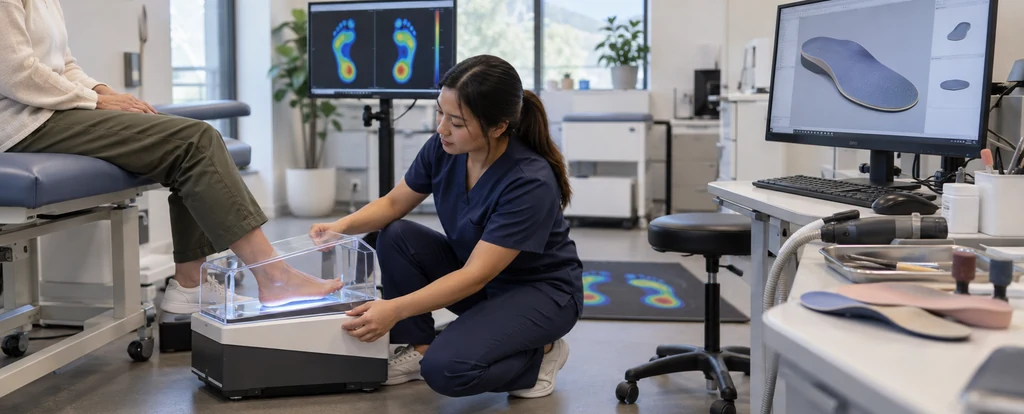
Pedorthists work in private clinics, hospitals, footwear retail businesses and sports settings, usually alongside podiatrists, orthotists and physiotherapists. What sets the role apart is the footwear: a podiatrist diagnoses and treats conditions of the foot and lower limb, while a pedorthist concentrates on the device itself, from the initial assessment and casting through to the finished orthosis or modified shoe. Many clients have diabetes, arthritis or a sports injury, and the fitting often continues over years as their feet change.
How much do pedorthists earn?
The median full-time salary for a pedorthist is $72,800 per annum, before tax, up $15,400 since 2018.
Where you work shapes the figure more than anything else: private clinics and retail footwear businesses set their own rates, while hospital and community health roles sit under an enterprise agreement. Experience, the range of devices you can fit and whether you hold a formal pedorthic qualification all move it. Pay also tends to grow with a steady client base and with complex diabetes and sports work, where a well-fitted device makes the biggest difference.
What does a pedorthist do day to day?
The list below is what fills most weeks; the exact mix shifts with seniority and whatever stage the current work is at.
- Assessing foot and lower limb biomechanics and gait
- Casting or scanning feet for custom devices
- Designing and prescribing custom foot orthoses
- Modifying and fitting therapeutic footwear
- Educating clients on foot care and injury prevention
What skills do pedorthists need?
Employers look for clinical assessment and treatment, patient care and support, care planning and coordination, backed by 3D foot scanner fluency and strong attention to detail.
Specialist skills
- Clinical assessment and treatment
- Patient care and support
- Care planning and coordination
Software and tools
- 3D foot scanner
- CAD/CAM orthotic design software
- pressure mapping system
- grinding and finishing tools
General skills
- Attention to detail
- Written communication
- Problem solving
- Empathy and interpersonal care
Is the job growing?
About 600 people work as pedorthists in Australia, and employment is projected to grow 12% over the decade to 2035. That's healthy, above-average growth, and the role should stay in solid demand.
How do you become a pedorthist?
Here's the path most pedorthists take, step by step.
- 1Finish Year 12 or a footwear-related qualification
There is no single prerequisite. Some pedorthists come from retail footwear, some from footwear manufacturing or an orthotic technician role, and some start after a health science degree.
- 2Complete a Certificate IV in custom-made footwear or an orthotic technician qualification
This covers casting and scanning, CAD design, materials, grinding and finishing. It is often studied while working, so you build bench skills and clinical exposure at the same time.
- 3Add the clinical side
Short courses and supervised practice in lower limb assessment, gait and diabetic foot care are what let you work with clients rather than only with devices. Around 34% of the current workforce holds Certificate III/IV as their highest qualification, so vocational training is a common route in.
- 4Build supervised fitting experience
Fitting judgement comes from volume: seeing how a device behaves over weeks of real walking, and learning when to adjust the orthosis rather than the shoe.
- 5Check the registration and membership rules that apply to you
Pedorthists are not registered nationally in Australia, so requirements come from employers and from any professional association you join. Rules and titles vary between states and territories.
Ready to apply as a pedorthist?
Whether you're working toward becoming a pedorthist or already are one and want a hand with the next step (sharpening your resume for ATS screening, tightening your cover letter, or knowing what you'll actually be asked at interview), here are examples grounded in this specific role, not generic templates.
What jobs can a pedorthist move to?
Moving into Prosthetist and Orthotist typically comes with the biggest pay rise, worth $27,200 a year more on average.
| Move to | Typical pay change | Overlap | Retraining |
|---|---|---|---|
| Prosthetist and Orthotist Pedorthists bring footwear and orthotic fitting experience to broader prosthetics and orthotics, though a degree and supervised practice are required. | +$27,200 | 41% | requalify |
Moves are chosen from Jobs and Skills Australia's Data on Occupation Mobility, which follows income tax records between 2011-12 and 2020-21, together with entry requirements and skill overlap. A known move is one people were seen making in that data. Pay change compares median full-time pay for the two roles.
Who works as a pedorthist?
The typical pedorthist is 42 years old; 52% are men, 72% work full-time, and full-timers average 38 hours a week.
- 42
- Median age
- 48%
- Female share
- 72%
- Full-time
- −2h
- vs all-jobs avg
What's it like being a pedorthist?
The week moves between the clinic and the workshop: assessing and fitting clients, then casting, designing, grinding and finishing devices at the bench. It suits someone who likes precision with their hands and a slow, cumulative kind of progress, because a good fit is judged over weeks of walking rather than in the appointment. The pressure comes from the clients who are hardest to help, particularly people with diabetes or nerve damage, where a poor fit has real consequences.
What people like
- You see the difference quickly. A client who arrived limping often notices the change within days of a well-fitted orthosis or a shoe that finally accommodates their foot.
- Hands-on and precise. Measuring, scanning, shaping and finishing give the work a workshop rhythm that balances the time spent talking with clients.
- Relationships that last years. Diabetes and arthritis clients come back as their feet change, so you get to know the person and their history rather than treating a single episode.
- A small field with room to specialise. Pedorthists can narrow into diabetic footwear, sports, paediatrics or complex footwear modification, and that focus tends to shape the work and the pay.
What people find hard
- It is a small field. Vacancies are spread thinly across the country, so you may need to travel, relocate or combine fitting work with retail or technician duties to stay in the job.
- Devices do not always work first time. Orthoses and modified shoes often need adjustment, and you are the one who has to explain why the first fit was not the answer.
- Paperwork and funding schemes. Diabetes footwear programs, private health funds and NDIS claims all generate forms and approvals that take time away from the bench and the client.
- A day split across clinic and workshop. You are on your feet for most of it, moving between appointments and machinery, dust, adhesives and finishing tools.
Based on our synthesis of professional-body surveys and public accounts of the role, not first-person verified reviews.
Which industries employ pedorthists?
Health care and social assistance employs the largest share of pedorthists, followed by Retail trade.
Top employing industries
- 1Health care and social assistance
- 2Retail trade
- 3Manufacturing
- 4Sports and recreation
Ranked by employment share; the source doesn't publish an exact percentage per industry.
| Certificate III/IV | 34% | |
|---|---|---|
| Diploma / Advanced Diploma | 26% | |
| Bachelor degree | 20% | |
| Year 12 or below | 20% |
Will AI replace pedorthists?
AI exposure here is moderate, and it sits almost entirely on the design and fabrication side. 3D scanning and CAD/CAM software have already replaced much of the plaster casting and hand-carving that defined the trade, making devices faster and more consistent to produce. What stays manual is the part that decides whether a device works: reading how someone walks, judging pressure on a foot with reduced sensation, and adjusting a shoe or orthosis on the spot.
Share of typical working time by exposure level
- CAD design of custom orthosesSoftware shapes the orthosis and sends the file to a mill, replacing much of the plaster work and hand-carving that used to take up whole days.30%high
- 3D scanning and measuring feetA scanner captures the foot shape in seconds, but you still decide where to add or relieve volume based on how the client stands and walks.25%moderate
- Fitting, adjusting and modifying footwearWhether a shoe or orthosis is comfortable across a working day can only be judged in person, and the fix is usually made by hand at the bench.25%low
- Client assessment and foot care educationChecking sensation in a diabetic foot, watching a gait and explaining a daily care routine to a worried client depends on conversation and clinical judgement.20%low
Common questions about becoming a pedorthist
Straight answers to the questions people ask most.
How much does a pedorthist earn?
Full-time pedorthists earn a median of $72,800 per year before tax. The setting matters most: private clinics and retail footwear businesses set their own rates, while hospital and community health roles follow an enterprise agreement. A formal pedorthic qualification and a steady client base both tend to lift what you earn.
How do you become a pedorthist in Australia?
Most people come through a Certificate IV in custom-made footwear or an orthotic technician qualification, then add clinical training in lower limb assessment and diabetic foot care under supervision. There is no national registration, so employers and professional associations set their own expectations. Experience matters more than the exact entry point, and many pedorthists start in footwear retail or manufacturing.
Are pedorthists in demand?
Pedorthists are currently not in shortage. Employment is projected to grow 12% over the decade to 2035 over the decade to 2035, and in a field this small that means openings come from retirement and turnover as much as from new roles. Look across clinics, hospitals, footwear businesses and sports settings rather than limiting your search to one employer type.
Will AI replace pedorthists?
No, but parts of the job are changing. Scanning and CAD/CAM software now handle much of the measuring and carving that was once done by hand, and they speed up design considerably. Judging how a device behaves on a real foot, modifying it on the spot and working with a worried client still happen in person.
What is the difference between a pedorthist and a podiatrist?
A podiatrist diagnoses and treats conditions of the foot, ankle and lower limb, and can perform procedures such as nail surgery. A pedorthist focuses on the device: assessing the foot, then designing, making and fitting orthoses and therapeutic footwear. The two often work together on the same client, with the podiatrist referring footwear needs on.
What can a pedorthist move into?
Experienced pedorthists can requalify as prosthetists and orthotists, which means a degree and supervised practice, and the pay difference is $27,200 more. Orthotic and prosthetic technicians and massage therapists move into pedorthic fitting from the other direction, bringing device-making or hands-on assessment skills. Some pedorthists stay in fitting and go on to run their own clinic or footwear business, which is often where earnings grow.
Related roles
- Prosthetist and Orthotist
- Orthotic and Prosthetic Technician
- Massage Therapist
- Midwife
- Play Therapist
- Chiropractor
Not sure this is you? Take the career quiz and get a ranked shortlist of roles that fit how you like to work.