Tanker Driver
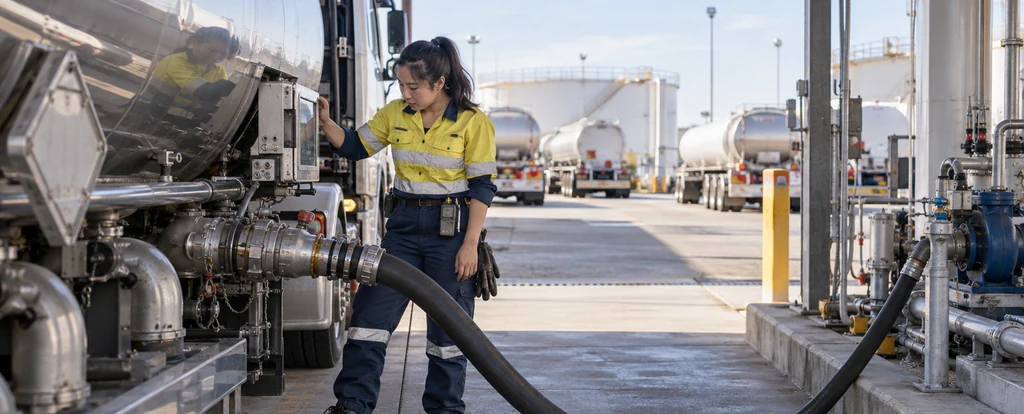
Tanker drivers move bulk liquids and gases by road, carrying fuel, chemicals, milk and LPG between terminals, depots and customers.
- Median salary*
- $85,800
3.9%vs last year, before tax
- People employed
- 3,300
0.0%vs last year
- Projected growth*
- +4%
to 2035
- AI exposure*
- Moderate
- automation risk
- Average hours*
- 45/wk
+5h vs all jobs
- Shortage status*
- In shortage
national
Tanker drivers work from depots and terminals, carrying fuel, chemicals, food-grade liquids such as milk, and gases including LPG. What sets the job apart from general truck driving is the load: liquids shift as you drive and need pumps, meters and hoses rather than a forklift at each end, and many loads are classified as dangerous goods. Fuel distributors, chemical and gas companies, and food processors are the main employers, and drivers often deal directly with customers at service stations, farms and industrial sites.
How much do tanker drivers earn?
The median full-time salary for a tanker driver is $85,800 per annum, before tax, up $17,800 since 2018.
Pay depends heavily on what you carry and who you work for. Dangerous goods and fuel work usually pays above general freight, and night, weekend and away-from-home rosters add loadings on top of a base rate, while enterprise agreements at large carriers set rates and penalties. A dangerous goods endorsement and experience with more demanding loads are the levers you control.
What does a tanker driver do day to day?
The list below is what fills most weeks; the exact mix shifts with seniority and whatever stage the current work is at.
- Inspecting the tanker, hoses, valves and safety equipment before each trip
- Loading and unloading bulk liquids using pumps, meters and couplings
- Driving on scheduled routes while keeping to fatigue management rules
- Monitoring tank pressure and temperature and setting the correct dangerous goods placards
- Completing delivery paperwork and keeping emergency response information current
What skills do tanker drivers need?
Employers look for driving and transport operations, plant and equipment operation, backed by Electronic work diary fluency and strong safety and compliance awareness.
Specialist skills
- Driving and transport operations
- Plant and equipment operation
Software and tools
- Electronic work diary
- Telematics and GPS fleet systems
- On-board tanker monitoring systems
- Dangerous goods placarding systems
- Digital delivery and signature capture apps
General skills
- Safety and compliance awareness
- Attention to detail
- Time and deadline management
- Problem solving
- Customer service
Is the job growing?
About 3,300 people work as tanker drivers in Australia, and employment is projected to grow 4% over the decade to 2035. That's modest growth: demand is steady rather than booming.
How do you become a tanker driver?
Here's the path most tanker drivers take, step by step.
- 1Get a heavy vehicle licence
You need a car licence first, then an HR or HC licence through a registered training provider, which involves theory, practical training and a competency assessment. Many drivers spend time on rigid trucks before moving to semi-trailers.
- 2Add a dangerous goods endorsement
Once you hold a heavy vehicle licence, complete dangerous goods driver training and apply to your state or territory licensing authority for the endorsement. The training covers placarding, load segregation and emergency procedures, and it is required before you can carry most tanker loads. Requirements differ by state.
- 3Pass the medical and background checks
Tanker work usually requires a current commercial medical, and some loads also need a police check or a site induction. Fuel and chemical customers often add their own inductions and drug and alcohol testing on top.
- 4Learn the equipment on the job
Most employers train new tanker drivers on their own fleet, covering pump and meter operation, hose handling and spill response. This stage is paid, and it is where you learn the products and the sites you will visit.
- 5Specialise as you gain experience
With time on the road you can move to more specialised loads such as fuel, LPG or chemicals, which carry more responsibility for load integrity, compliance and emergency planning.
Ready to apply as a tanker driver?
Whether you're working toward becoming a tanker driver or already are one and want a hand with the next step (sharpening your resume for ATS screening, tightening your cover letter, or knowing what you'll actually be asked at interview), here are examples grounded in this specific role, not generic templates.
What jobs can a tanker driver move to?
Moving into Driving Instructor typically comes with the biggest pay rise, worth $29,800 a year more on average.
| Move to | Typical pay change | Overlap | Retraining |
|---|---|---|---|
| Driving Instructor Tanker driver's road craft and vehicle control suit driver training, though a certificate in driving instruction is required. | +$29,800 | 33% | reskill |
| Truck Driver Tanker driver's bulk liquid handling and road safety carry into general freight, with a short course for different vehicle configurations. | +$16,100 | 47% | short course |
| Bus Driver Tanker driver's heavy vehicle experience and road safety suit passenger transport, but a passenger endorsement and reskilling are required. | +$7,500 | 44% | reskill |
| Tow Truck Driver Tanker driver's heavy vehicle control and safety awareness transfer to recovery work, though tow truck operators need to learn recovery techniques. | −$15,600 | 83% | minimal |
Moves are chosen from Jobs and Skills Australia's Data on Occupation Mobility, which follows income tax records between 2011-12 and 2020-21, together with entry requirements and skill overlap. A known move is one people were seen making in that data. Pay change compares median full-time pay for the two roles.
Who works as a tanker driver?
The typical tanker driver is 52 years old; 96% are men, 89% work full-time, and full-timers average 45 hours a week.
- 52
- Median age
- 4%
- Female share
- 89%
- Full-time
- +5h
- vs all-jobs avg
What's it like being a tanker driver?
The job has a steady rhythm: early starts, a fixed run or a rotating roster, and long stretches of driving broken up by loading and unloading. Much of the pressure comes from time, because deliveries are scheduled and terminals want you in and out promptly, and from the attention that dangerous goods demand. Drivers who are comfortable working alone, take care with equipment and don't mind routine tend to settle into it well.
What people like
- Running your own shift. Most of the day is yours to manage, with the truck, the route and the paperwork in your hands and a dispatcher on the radio rather than beside you.
- Equipment you get to know properly. Pumps, meters, valves and couplings each behave differently, and experienced drivers take pride in loading and unloading cleanly and safely.
- Work that keeps moving. Fuel, chemicals, milk and gas have to be delivered regardless of how the economy is going, and much of the work runs on regular routes with familiar customers.
- Covering ground and meeting regulars. Runs can take you across long distances, and drivers often build working relationships with the same depot and site staff over years.
What people find hard
- Long hours and early starts. Shifts often begin before dawn and include nights, weekends and time away from home, and fatigue rules shape how the day can be planned.
- A load that never sits still. Liquid shifts as you brake and turn, so a full tanker handles differently from an empty one, and a mistake at a loading bay can spill product or damage equipment.
- Compliance and paperwork. Dangerous goods rules, medicals, fatigue records and site inductions add administration to a job that is otherwise hands-on.
- Weather and waiting. You load and unload in whatever the weather is doing, and delays at terminals or customer sites are simply part of the day.
Based on our synthesis of professional-body surveys and public accounts of the role, not first-person verified reviews.
Which industries employ tanker drivers?
Transport, Postal and Warehousing employs the largest share of tanker drivers, followed by Construction.
Top employing industries
- 1Transport, Postal and Warehousing
- 2Construction
- 3Manufacturing
- 4Electricity, Gas, Water and Waste Services
- 5Mining
Ranked by employment share; the source doesn't publish an exact percentage per industry.
| Certificate III/IV | 34% | |
|---|---|---|
| Diploma / Advanced Diploma | 26% | |
| Bachelor degree | 20% | |
| Year 12 or below | 20% |
Will AI replace tanker drivers?
This is a moderately exposed job. Dispatch software, telematics and tanker monitoring now handle route planning, scheduling and much of the delivery paperwork, and they track load, pressure and location automatically. The driving itself, and the physical work of loading and unloading liquids and gases at live sites, remains with the driver.
Share of typical working time by exposure level
- Driving and manoeuvring a loaded tankerJudging braking distances with a shifting load, reversing into tight terminal bays and reading traffic are still the driver's job, and telematics records the trip rather than driving it.45%low
- Loading and unloading through pumps, meters and couplingsConnecting hoses, watching the meter and stopping the flow at the right point is hands-on work that monitoring systems can observe but not perform.25%low
- Route planning and schedulingDispatch software now builds runs around delivery windows, driver hours and fuel use, leaving the driver to follow the plan and flag problems as they arise.15%high
- Delivery documentation and compliance recordsDigital delivery apps and electronic work diaries capture signatures, times and load details automatically, though the driver still signs off on placarding and the accuracy of the paperwork.15%moderate
Moves least exposed to AI
These career moves from tanker driver work are rated low for AI exposure:
- Tow Truck Driver
High skill overlap (83%), little retraining to get there, and a low automation-risk profile.
- Driving Instructor
Some skill overlap (33%), reskill to get there, and a low automation-risk profile.
Common questions about becoming a tanker driver
Straight answers to the questions people ask most.
How much do tanker drivers earn?
Tanker drivers earn a median of $85,800 per year before tax. Pay varies with the products you carry, your endorsement level and the roster, and dangerous goods, fuel and night work usually sit above general freight rates.
How do you become a tanker driver?
You need a heavy vehicle licence, a dangerous goods endorsement and a current commercial medical before most employers will put you in a tanker. From there, employers train you on their own pumps, meters and sites, so experience on rigid trucks or semi-trailers is the usual way in.
Are tanker drivers in demand?
Tanker drivers are currently in shortage nationally, and employment is projected to grow 4% over the decade to 2035 over the decade to 2035. For someone looking for work, holding the licence and endorsement matters more than the headline number, because employers need drivers who can carry dangerous goods without extra training.
Will AI and automation replace tanker drivers?
AI is changing parts of the job rather than replacing the driving. Route planning, scheduling and delivery paperwork are increasingly handled by dispatch and fleet software and by tanker monitoring systems, while loading, unloading and the judgement needed in traffic still sit with the driver.
What jobs can a tanker driver move into?
General truck driving is a common move because it uses the same heavy vehicle licence and carries no dangerous goods requirements. Driver training pays $29,800 more than tanker driving and suits experienced drivers, though it needs a certificate in driving instruction. Tow truck work draws on the same heavy vehicle handling and pays $15,600 less.
Do you need a dangerous goods licence to drive a tanker?
For most tanker loads, yes. Carrying fuel, LPG or chemicals requires a dangerous goods endorsement on your heavy vehicle licence, which means specific training and an application to your state or territory authority, and the rules differ between states. Some loads, such as food-grade milk, don't need the endorsement, though employers still set their own requirements.
Related roles
Not sure this is you? Take the career quiz and get a ranked shortlist of roles that fit how you like to work.