Agricultural Engineer
Agricultural engineers apply engineering design to farming, planning the machinery, irrigation and rural structures that help producers grow more with less.
- Median salary*
- $104,000
4.2%vs last year, before tax
- People employed
- 130
30.0%vs last year
- Projected growth
- +23%
to 2035
- AI exposure*
- Moderate
- automation risk
- Average hours
- 43/wk
+3h vs all jobs
- Shortage status
- In shortage
national
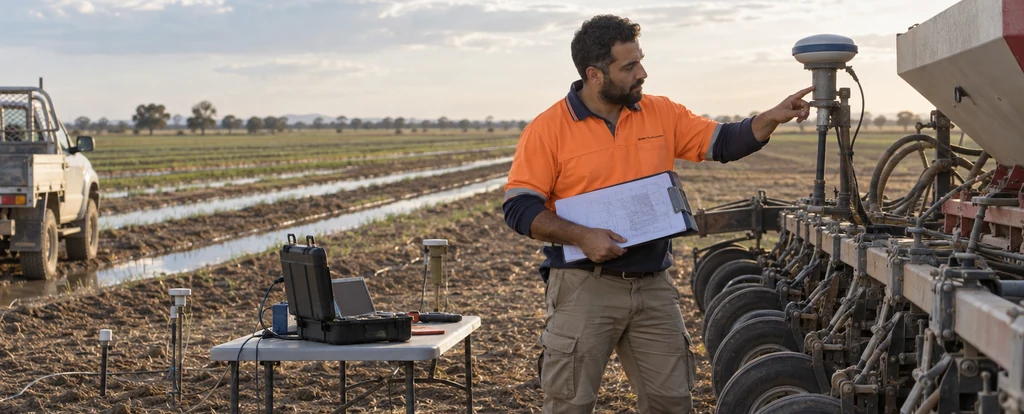
Agricultural engineers work where engineering meets agriculture: harvest machinery, irrigation and drainage systems, grain storage, livestock facilities and farm water supply. The role sits close to civil and mechanical engineering but keeps its focus on soil, water, crops and the working calendar of a farm. Most work for machinery manufacturers, irrigation and agtech firms, engineering consultancies or government agencies, splitting the week between an office, a workshop and a paddock.
How much do agricultural engineers earn?
The median full-time salary for an agricultural engineer is $104,000 per annum, before tax, up $21,900 since 2018.
What you earn depends more on the employer and sector than the title, with large agribusiness and mining-adjacent projects paying more than small regional consultancies or government agencies. Chartered status through Engineers Australia and a track record of leading projects are the two things that move pay most reliably. Remote and regional site work often carries allowances on top of base salary.
What does an agricultural engineer do day to day?
The list below is what fills most weeks; the exact mix shifts with seniority and whatever stage the current work is at.
- Designing and testing farm machinery and equipment, from seeding rigs to grain handling systems
- Planning irrigation, drainage and water storage for farms and rural districts
- Inspecting sites and running field trials to see how a design performs in real conditions
- Managing projects from concept and costing through to installation and commissioning
- Advising growers and landholders on environmental compliance and sustainable land use
What skills do agricultural engineers need?
Employers look for engineering design and analysis, cAD and technical drawing, project engineering and delivery, backed by AutoCAD fluency and strong problem solving.
Specialist skills
- Engineering design and analysis
- CAD and technical drawing
- Project engineering and delivery
- Field inspection and testing
- Environmental assessment
- Project management
Software and tools
- AutoCAD
- SolidWorks
- ArcGIS
- MATLAB
- SCADA systems
General skills
- Problem solving
Is the job growing?
About 130 people work as agricultural engineers in Australia, and employment is projected to grow 23% over the decade to 2035. That's very strong growth. Few roles in Australia are expanding this fast, and it points to solid demand for years to come.
How do you become an agricultural engineer?
Here's the path most agricultural engineers take, step by step.
- 1Build the maths and physics base at school
Year 12 maths, including calculus, and physics are the usual preparation for an engineering degree, and most university courses assume them.
- 2Complete an accredited engineering degree
A four-year Bachelor of Engineering (Honours) is the standard entry. Some universities offer agricultural engineering directly, while others let you start in civil, mechanical or mechatronic engineering and specialise later through electives. Look for a course accredited by Engineers Australia.
- 3Get farm or industry experience while you study
Vacation work with a machinery manufacturer, irrigation supplier, agtech company or consultancy builds the practical knowledge that separates agricultural engineers from generalists, and often leads to a graduate offer.
- 4Work toward Chartered status
After graduating, you generally work under supervision for around four to five years, then apply to Engineers Australia for Chartered Professional Engineer status. Registration is not required to practise in most states, but Chartered status is widely expected in consulting.
- 5Enter through a technician role if you are changing careers
Some people come to agricultural engineering from irrigation design, machinery or surveying, working as a technician while completing an engineering degree part time. It takes longer, but the practical background is valued by employers.
Ready to apply as an agricultural engineer?
Whether you're working toward becoming an agricultural engineer or already are one and want a hand with the next step (sharpening your resume for ATS screening, tightening your cover letter, or knowing what you'll actually be asked at interview), here are examples grounded in this specific role, not generic templates.
What jobs can an agricultural engineer move to?
Moving into Environmental Engineer typically comes with the biggest pay rise, worth $33,700 a year more on average.
| Move to | Typical pay change | Overlap | Retraining |
|---|---|---|---|
| Environmental Engineer Agricultural engineers understand land and water resource management, which carries into environmental engineering work. | +$33,700 | 64% | minimal |
| Electrical Engineer Agricultural engineers working with machinery automation bring relevant electrical knowledge to electrical engineering roles. | +$28,800 | 70% | minimal |
| Civil Engineer Agricultural engineers design rural infrastructure, a skill set that transfers to civil engineering projects. | +$11,300 | 70% | minimal |
| Water Engineer Agricultural engineers bring expertise in irrigation and rural water systems to water engineering roles. | +$7,800 | 90% | minimal |
Moves are chosen from Jobs and Skills Australia's Data on Occupation Mobility, which follows income tax records between 2011-12 and 2020-21, together with entry requirements and skill overlap. A known move is one people were seen making in that data. Pay change compares median full-time pay for the two roles.
Who works as an agricultural engineer?
The typical agricultural engineer is 45 years old; 94% are men, 80% work full-time, and full-timers average 43 hours a week.
- 45
- Median age
- 6%
- Female share
- 80%
- Full-time
- +3h
- vs all-jobs avg
What's it like being an agricultural engineer?
The job moves between the desk and the paddock, with design work interrupted by site visits, commissioning and the occasional problem on a machine that has to run tomorrow. The pressure comes from the calendar: irrigation, sowing and harvest windows do not shift because a drawing is late. It suits people who like solving physical problems and are happy to spend time with growers, dealers and contractors rather than only with other engineers.
What people like
- Design work and fieldwork in the same week. You can spend Monday modelling a pump system and Thursday standing in the paddock it will serve, which keeps the engineering grounded.
- Seeing a system run. Irrigation layouts, grain handling lines and machinery upgrades either work in the field or they don't, and the feedback is immediate.
- Water efficiency matters here. Improving how a farm captures, stores and applies water is one of the more tangible ways to make a difference in Australian agriculture.
- A small field with long relationships. There are not many agricultural engineers, so growers, dealers and suppliers tend to know who you are and come back to you.
What people find hard
- Travel to remote sites. Farm sites are often hours from the office, and commissioning or harvest work can mean days away in heat and dust.
- Seasonal deadlines. Designs have to be finished before sowing, harvest or the irrigation season starts, and that date does not move for anyone.
- Budgets set at the farm gate. Projects depend on commodity prices and seasonal income, so a good idea can be deferred for a year when the season turns.
- Few employers in any one region. Because the occupation is small, you may need to move, travel regularly or work remotely to stay in the specialisation.
Based on our synthesis of professional-body surveys and public accounts of the role, not first-person verified reviews.
Which industries employ agricultural engineers?
Agriculture, Forestry and Fishing employs the largest share of agricultural engineers, followed by Manufacturing.
Top employing industries
- 1Agriculture, Forestry and Fishing
- 2Manufacturing
- 3Professional, Scientific and Technical Services
Ranked by employment share; the source doesn't publish an exact percentage per industry.
| Bachelor degree | 31% | |
|---|---|---|
| Certificate III/IV | 24.6% | |
| Postgraduate | 20.6% | |
| Year 12 or below | 18.2% | |
| Diploma / Advanced Diploma | 5.6% |
Will AI replace agricultural engineers?
Agricultural engineering sits in the middle: the design and analysis side is increasingly shaped by software, while the field and grower side is not. CAD, simulation and farm data platforms mean a design that once took weeks to iterate can be tested in a day. What software cannot do is tell you whether a machine or a system will suit the paddock it is going into, which is where a good part of the engineer's time still goes.
Share of typical working time by exposure level
- Design and draftingCAD and simulation tools now handle much of the first-pass geometry and stress checking, so more of the engineer's time goes into setting the constraints and verifying the result.30%high
- Monitoring and irrigation control systemsSensor networks and automated controllers manage routine scheduling on their own, but someone still has to decide what the system is being asked to optimise for.25%moderate
- Site assessment and field trialsJudging soil, drainage, slope and machinery access on a working farm still needs a person on site with a spade and a conversation with the grower.25%low
- Project delivery and grower adviceCosting, scheduling and compliance paperwork are increasingly software-assisted, but agreeing a final design depends on reading how the farm business actually runs.20%moderate
Moves least exposed to AI
These career moves from agricultural engineer work are rated low for AI exposure:
- Civil Engineer
High skill overlap (70%), little retraining to get there, and a low automation-risk profile.
Common questions about becoming an agricultural engineer
Straight answers to the questions people ask most.
How much do agricultural engineers earn?
Agricultural engineers earn $104,000 per annum, before tax at the middle of the range, working an average of 43 hours a week full time. Pay rises with experience, Chartered status and the sector you work in, with consulting firms and large agribusiness projects generally ahead of small regional employers.
How do you become an agricultural engineer?
The usual route is a four-year engineering degree accredited by Engineers Australia, ideally with vacation work in machinery, irrigation or agtech. Many engineers qualify through civil, mechanical or mechatronic degrees and specialise in agricultural systems later. Chartered status is then earned after several years of supervised practice.
Are agricultural engineers in demand?
Agricultural engineers are currently in shortage nationally and employment is projected to grow 23% over the decade to 2035 over the decade to 2035. The occupation is small, so the number of advertised roles in any one city or region is limited, and being willing to relocate or travel widens your options considerably.
Will AI replace agricultural engineers?
Not the job as a whole, because the design and analysis side is far more exposed than the field side. CAD, simulation and farm data platforms speed up the modelling and let you test far more options before anything is built. Deciding what suits a particular paddock, soil type and farm business still comes down to being there.
What can agricultural engineers move into?
The closest moves are into water engineering, environmental engineering and civil engineering, which share the same grounding in hydraulics, structures and project delivery. Moving to environmental engineering typically comes with a pay difference of $33,700 more a year, and water engineering $7,800 more. Experienced engineers also often set up their own consulting practice, which is frequently where earnings grow.
Do agricultural engineers need to be registered?
Registration is not mandatory to work as an engineer in most Australian states, but Chartered status through Engineers Australia is expected in consulting and in many government roles. Some states are moving toward registration for engineers whose work carries public safety risk, so it pays to check the rules where you intend to work.
Related roles
- Water Engineer
- Environmental Engineer
- Civil Engineer
- Electrical Engineer
- Engineering Technologist
- Irrigation Designer
Not sure this is you? Take the career quiz and get a ranked shortlist of roles that fit how you like to work.