Agricultural Machinery Operator
Agricultural machinery operators drive and maintain the tractors, harvesters and sprayers that keep sowing, spraying and harvest work on schedule.
- Median salary*
- $75,400
3.7%vs last year, before tax
- People employed
- 9,300
0.0%vs last year
- Projected growth
- +4%
to 2035
- AI exposure*
- Moderate
- automation risk
- Average hours
- 48/wk
+8h vs all jobs
- Shortage status
- Not in shortage
national
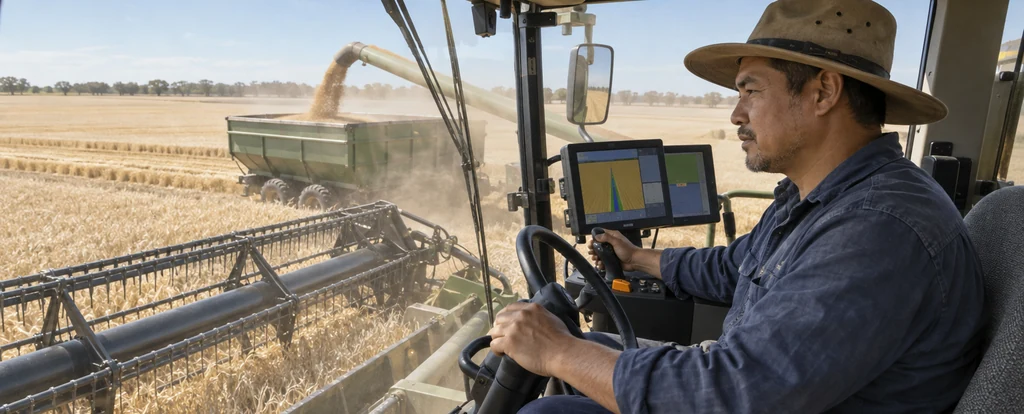
Agricultural machinery operators run the tractors, harvesters, sprayers and other mobile plant that carry out field work on farms and stations. They differ from farm workers by specialising in the machines rather than the livestock and general property work, though on smaller properties the two roles often blend. The work is outdoors and seasonal, with the longest days falling in sowing, spraying and harvest, and most of it sits in broadacre cropping and mixed farming, with a smaller share in councils and other public land management.
How much do agricultural machinery operators earn?
The median full-time salary for an agricultural machinery operator is $75,400 per annum, before tax, up $15,600 since 2018.
What you earn depends heavily on the enterprise and the season, because broadacre cropping operations pay for the long hours that sowing and harvest demand, and overtime or penalty rates may apply under the relevant award. The machinery you can operate matters too, since an experienced harvester or sprayer operator with current licences and several seasons behind them is worth more than someone still learning on a chaser bin. Full-time weeks average 48 hours across the year, so a fair share of annual earnings comes from that seasonal push rather than a steady weekly rate.
What does an agricultural machinery operator do day to day?
The list below is what fills most weeks; the exact mix shifts with seniority and whatever stage the current work is at.
- Driving tractors, harvesters and sprayers through sowing, spraying, cultivating and harvest work
- Attaching, adjusting and calibrating implements such as ploughs, seeders, balers and trailers
- Setting up guidance and precision agriculture systems so passes stay straight and inputs land where they should
- Servicing machinery between runs, greasing bearings, changing filters and getting minor breakdowns going again
- Carting grain, fodder, produce and equipment around the property and on to storage or market
What skills do agricultural machinery operators need?
Employers look for plant and equipment operation, worksite safety management, installation and maintenance, backed by John Deere Operations Center fluency and strong problem solving.
Specialist skills
- Plant and equipment operation
- Worksite safety management
- Installation and maintenance
- Hand and power tool work
- Driving and transport operations
- Operations management
Software and tools
- John Deere Operations Center
- Trimble GFX guidance display
- Climate FieldView
- CLAAS Telematics
- Raven autosteer
General skills
- Problem solving
- Physical stamina and dexterity
Is the job growing?
About 9,300 people work as agricultural machinery operators in Australia, and employment is projected to grow 4% over the decade to 2035. That's modest growth: demand is steady rather than booming.
How do you become an agricultural machinery operator?
Here's the path most agricultural machinery operators take, step by step.
- 1Get a start as a farm hand or machinery assistant
There is no formal entry requirement, and Year 12 or below is what most people in the job currently hold (58% of the workforce). Starting as a hand or offsider on a cropping property is paid work and is how most operators learn to run implements under someone experienced.
- 2Sort out the driving and operating licences you need
A car licence is the minimum, and a heavy vehicle licence opens up the truck work that goes with carting grain and moving equipment. Some machinery, such as certain cranes and elevated work platforms, needs a high risk work licence, and the rules vary by state, so check what applies where you are working.
- 3Add a qualification if you want to move up
A Certificate III in Agriculture (AHC30122), often done as a traineeship while you work, covers machinery operation, safety and maintenance and is well regarded by larger employers. Manufacturer training on guidance and precision agriculture systems is shorter and increasingly asked for.
- 4Build seasons of experience on bigger machinery
Most operators move up by proving themselves on one machine and then taking on the next, moving from chaser bin or tractor work to sprayers and headers. Each season on a new machine is what employers actually read on a resume.
Ready to apply as an agricultural machinery operator?
Whether you're working toward becoming an agricultural machinery operator or already are one and want a hand with the next step (sharpening your resume for ATS screening, tightening your cover letter, or knowing what you'll actually be asked at interview), here are examples grounded in this specific role, not generic templates.
What jobs can an agricultural machinery operator move to?
Moving into Earthmoving Plant Operator typically comes with the biggest pay rise, worth $27,600 a year more on average.
| Move to | Typical pay change | Overlap | Retraining |
|---|---|---|---|
| Earthmoving Plant Operator Skills with hydraulics and heavy plant controls carry across, though an earthmoving ticket is required.Known move | +$27,600 | 32% | reskill |
| Truck Driver Agricultural machinery operators already handle heavy vehicles and field logistics, so moving to truck driving builds on that with a heavy vehicle licence.Known move | +$26,500 | 15% | reskill |
| Motor Mechanic Mechanical skills from servicing farm machinery help, but becoming a motor mechanic needs an automotive apprenticeship.Known move | +$8,900 | 52% | requalify |
| Machine Operator Experience with hydraulics, controls and routine maintenance transfers to fixed plant, though a manufacturing ticket may be needed.Known move | +$5,400 | 25% | reskill |
| Farmer Machinery and crop knowledge supports moving into farm management, but business planning and financial skills need further development.Known move | −$20,800 | 23% | reskill |
Moves are chosen from Jobs and Skills Australia's Data on Occupation Mobility, which follows income tax records between 2011-12 and 2020-21, together with entry requirements and skill overlap. A known move is one people were seen making in that data. Pay change compares median full-time pay for the two roles.
Who works as an agricultural machinery operator?
The typical agricultural machinery operator is 41 years old; 91% are men, 81% work full-time, and full-timers average 48 hours a week.
- 41
- Median age
- 9%
- Female share
- 81%
- Full-time
- +8h
- vs all-jobs avg
What's it like being an agricultural machinery operator?
The job runs to the farming calendar rather than a standard week. Sowing, spraying and harvest bring long days and tight windows, while the quieter months go to servicing, repairs and preparation, so the work suits someone who likes a clear task and can accept the pace shifting with the weather. Much of it is done alone or in a small team, often a long way from town.
What people like
- The season sets the pace. Sowing and harvest have obvious deadlines, and the pressure is about getting the paddock done before the weather turns rather than about office politics. Many operators like knowing exactly what the day is for.
- Machines that reward attention. Learning a new tractor, sprayer or header properly takes time, and small adjustments to settings can change how a whole run goes. The feedback is immediate and visible in the paddock.
- Outdoor, independent work. Most of the day is spent outside, often on your own with the two-way radio for company. If you prefer working with your hands and being responsible for your own machine, that suits.
- A finished job you can see. At the end of a run, the paddock shows the result. That visible progress is one of the satisfactions of the work.
What people find hard
- Long days in the busy season. Full-time weeks average 48 hours across the year, and during harvest or a spraying window the days can stretch well beyond that. The work is weather-dependent, so a rain delay means the schedule compresses rather than disappears.
- Breakdowns at the worst possible time. Machines tend to fail when they are being pushed hardest, and a header stopped in the middle of harvest costs money by the hour. Fixing it quickly, often in the heat or dust, is part of the job.
- Weather decides the plan. Wind rules out spraying, rain stops harvest and heat limits how long you can work. Plans made the night before are frequently rewritten by morning.
- Remote locations and small teams. Many of these jobs are on properties well away from town, which makes for long commutes to work, limited services nearby and a small circle of colleagues.
Based on our synthesis of professional-body surveys and public accounts of the role, not first-person verified reviews.
Which industries employ agricultural machinery operators?
Agriculture, Forestry and Fishing employs the largest share of agricultural machinery operators, followed by Public Administration and Safety.
Top employing industries
- 1Agriculture, Forestry and Fishing
- 2Public Administration and Safety
Ranked by employment share; the source doesn't publish an exact percentage per industry.
| Year 12 or below | 58.1% | |
|---|---|---|
| Certificate III/IV | 27.6% | |
| Diploma / Advanced Diploma | 4.7% | |
| Bachelor degree | 3.9% | |
| Postgraduate | 0.8% |
Will AI replace agricultural machinery operators?
This is a moderate-exposure job. Guidance, autosteer and mapping software already do much of the driving and record keeping, so the tasks built around steering straight and logging inputs are changing quickly. What keeps the role grounded is that someone still has to set the machine up for the paddock, judge conditions the sensors do not handle well and get a broken header running again mid-harvest.
Share of typical working time by exposure level
- Driving and controlling machinery through sowing, spraying and harvestAutosteer handles most of the wheel work, but the operator still manages headlands, obstacles, sloping ground and turns at the end of a run.35%low
- Servicing, greasing and repairing machineryDiagnostic software points to a fault code, yet replacing a bearing on a header in a paddock at night is still hands-on work with hand and power tools.30%low
- Setting up and calibrating implements and guidance systemsSoftware can suggest rates and overlap, but matching a seeder or sprayer to the paddock and the crop still takes an experienced eye.20%moderate
- Recording yields, inputs and field mapsClimate FieldView and similar platforms capture yield and application data as the machine works, so the operator mainly checks and passes it on rather than writing it up.15%high
Common questions about becoming an agricultural machinery operator
Straight answers to the questions people ask most.
How much do agricultural machinery operators earn?
The median is $75,400 per annum, before tax. It is a midpoint rather than a starting rate, and what you actually take home depends on the season, the machinery you are licenced to run and how many hours you work during sowing and harvest.
How do you become an agricultural machinery operator?
Most people start as a farm hand or offsider on a cropping property and learn the machinery on the job, because there is no formal entry requirement. A heavy vehicle licence helps, a Certificate III in Agriculture (AHC30122) is well regarded by larger employers, and manufacturer training in precision agriculture is increasingly asked for.
Are agricultural machinery operators in demand?
Agricultural machinery operators are currently not in shortage, and employment is projected to grow 4% over the decade to 2035. Those figures describe the decade rather than any single year, and for someone starting out the practical point is that work concentrates in cropping regions and comes and goes with the season, so a licence and a couple of seasons of experience do most of the convincing.
Will automation and AI replace agricultural machinery operators?
Guidance and autosteer already drive the machine across much of a paddock, and mapping tools now record yields and inputs automatically, so the parts of the job that involve steering straight lines and writing things down are genuinely exposed. What stays with the operator is setting up and calibrating equipment, reading ground and crop conditions, diagnosing faults and fixing breakdowns in the middle of harvest, which is why the role sits at moderate exposure rather than being automated away.
What can agricultural machinery operators move into?
Truck driving pays $26,500 more and builds on the heavy vehicle handling and field logistics the job already involves, once you hold the right licence. Earthmoving plant operation pays $27,600 more and uses the same hydraulic and control skills, though it needs its own licence and site experience. Moving into fixed plant as a machine operator pays $5,400 more and trades the seasonal rush for a steadier roster.
Do you need a licence to operate farm machinery?
You need a heavy vehicle licence to drive trucks and machinery on public roads, and some equipment such as certain cranes requires a high risk work licence. On private property the requirements are looser, but employers increasingly ask for the qualifications anyway, and the rules vary by state so it is worth checking before you apply.
Related roles
Not sure this is you? Take the career quiz and get a ranked shortlist of roles that fit how you like to work.