Cardiothoracic Surgeon
Cardiothoracic surgeons operate on the heart, lungs and chest wall to repair damage that medication and less invasive procedures cannot fix.
- Median salary*
- $218,400
3.7%vs last year, before tax
- People employed
- 170
15.0%vs last year
- Projected growth
- +33.1%
to 2035
- AI exposure*
- Low
- automation risk
- Average hours
- 51/wk
+11h vs all jobs
- Shortage status
- In shortage
national
Cardiothoracic surgeons operate on the heart, lungs, oesophagus and chest wall, working in public and private hospitals where their week mixes theatre lists, outpatient clinics, ward rounds and intensive care. The job is distinct from cardiology, which manages heart disease with medication and stenting, and from general surgery: the operations are long, the margin for error is small, and patients sometimes arrive as emergencies. Almost all work as salaried specialists in teaching hospitals or as visiting medical officers, and entry runs through a medical degree and the Royal Australasian College of Surgeons.
How much do cardiothoracic surgeons earn?
The median full-time salary for a cardiothoracic surgeon is $218,400 per annum, before tax, up $46,700 since 2018.
Most cardiothoracic surgeons are salaried specialists in public hospitals, where pay is set by the state enterprise agreement and rises with years of service and the amount of on-call work taken on. Private practice works differently: surgeons bill per procedure and receive a share of the fee, so earnings track case volume and complexity rather than a fixed scale. A mix of public sessions and private lists is common, and it is that mix, more than location, that moves total pay.
What does a cardiothoracic surgeon do day to day?
The list below is what fills most weeks; the exact mix shifts with seniority and whatever stage the current work is at.
- Assessing patients referred with heart, lung and chest conditions, and deciding whether an operation will help
- Performing coronary artery bypass grafting, valve repair and replacement, and surgery on the aorta
- Operating on the lungs, oesophagus and chest wall, often to remove cancer
- Managing patients in intensive care in the days after surgery, alongside the cardiac ICU team
- Leading the theatre team through the operation and coordinating care with cardiologists, oncologists and registrars
What skills do cardiothoracic surgeons need?
Employers look for patient care and support, clinical assessment and treatment, backed by Epic fluency and strong problem solving.
Specialist skills
- Patient care and support
- Clinical assessment and treatment
Software and tools
- Epic
- Cerner
- Sectra PACS
- da Vinci Surgical System
General skills
- Problem solving
- Attention to detail
- Written communication
- People leadership
- Time and deadline management
Is the job growing?
About 170 people work as cardiothoracic surgeons in Australia, and employment is projected to grow 33.1% over the decade to 2035. That's very strong growth. Few roles in Australia are expanding this fast, and it points to solid demand for years to come.
How do you become a cardiothoracic surgeon?
Here's the path most cardiothoracic surgeons take, step by step.
- 1Complete a medical degree
An undergraduate or graduate entry medical degree, usually four to six years, is the starting point, followed by registration with the Medical Board of Australia through AHPRA.
- 2Work as an intern and resident medical officer
A supervised intern year plus several years of prevocational hospital posts build the surgical experience, logbook and references that selection panels look for.
- 3Win a place in cardiothoracic surgical training
Selection into the Royal Australasian College of Surgeons cardiothoracic surgical training program is competitive and normally follows a few years of hospital work; the program itself takes several years, rotating through adult cardiac, thoracic and often paediatric units.
- 4Complete fellowship and specialist registration
Passing the college fellowship requirements leads to specialist registration with the Medical Board of Australia, which is what allows independent operating.
- 5Consider a subspecialty fellowship
Many surgeons then complete a further one to two year fellowship in an area such as aortic surgery, transplantation or minimally invasive techniques, in Australia or overseas, before taking up a consultant post.
Ready to apply as a cardiothoracic surgeon?
Whether you're working toward becoming a cardiothoracic surgeon or already are one and want a hand with the next step (sharpening your resume for ATS screening, tightening your cover letter, or knowing what you'll actually be asked at interview), here are examples grounded in this specific role, not generic templates.
What jobs can a cardiothoracic surgeon move to?
We don't list lateral moves for cardiothoracic surgeons: leaving means a full new qualification rather than a career move, and the realistic routes in are covered under how to become one.
Who works as a cardiothoracic surgeon?
The typical cardiothoracic surgeon is 49 years old; 89% are men, 90% work full-time, and full-timers average 51 hours a week.
- 49
- Median age
- 11%
- Female share
- 90%
- Full-time
- +11h
- vs all-jobs avg
What's it like being a cardiothoracic surgeon?
The week is built around theatre days, with clinics, ward rounds and on-call time fitted in between, and full-time surgeons average about 51 hours. Operations can run for most of a day, and emergencies such as a torn aorta or a stab wound to the chest arrive without warning, so the schedule rarely stays fixed. It suits people who like working with their hands under pressure and are willing to commit to a decision before every detail is known.
What people like
- The result is visible within hours. A bypass graft or a replaced valve changes a patient's circulation on the table, and most are awake and talking the next day.
- The work is genuinely manual. Cardiothoracic surgery is one of the specialties where hands decide the outcome, from judging a calcified aorta by feel to stitching a graft under time pressure.
- Small teams that know each other. A cardiac theatre runs with the same perfusionists, anaesthetists and nurses for years, so trust and shorthand build up in a way that larger units do not allow.
- Variety across the chest. The same week can bring a lung cancer resection, a mitral valve repair and a chest wall reconstruction, each with its own anatomy and technique.
What people find hard
- Long hours and interrupted nights. Full-time surgeons average about 51 hours a week, and an on-call night can turn into an emergency operation that runs until morning.
- Patients can deteriorate quickly. A patient who looks stable in recovery can bleed or develop an arrhythmia within hours, and the responsibility for spotting it sits with the surgeon.
- A long training pathway. The medical degree, hospital years and competitive selection mean a surgeon is well into their career before operating independently, and selection can take more than one attempt.
- Few posts, spread across the capital cities. Training positions and consultant appointments are limited and concentrated in the larger teaching hospitals, so moving cities or states is often part of the path.
Based on our synthesis of professional-body surveys and public accounts of the role, not first-person verified reviews.
Which industries employ cardiothoracic surgeons?
Health Care and Social Assistance employs the largest share of cardiothoracic surgeons.
Top employing industries
- 1Health Care and Social Assistance
Ranked by employment share; the source doesn't publish an exact percentage per industry.
| Postgraduate | 62% | |
|---|---|---|
| Bachelor degree | 37.4% | |
| Diploma / Advanced Diploma | 0% | |
| Certificate III/IV | 0% |
Will AI replace cardiothoracic surgeons?
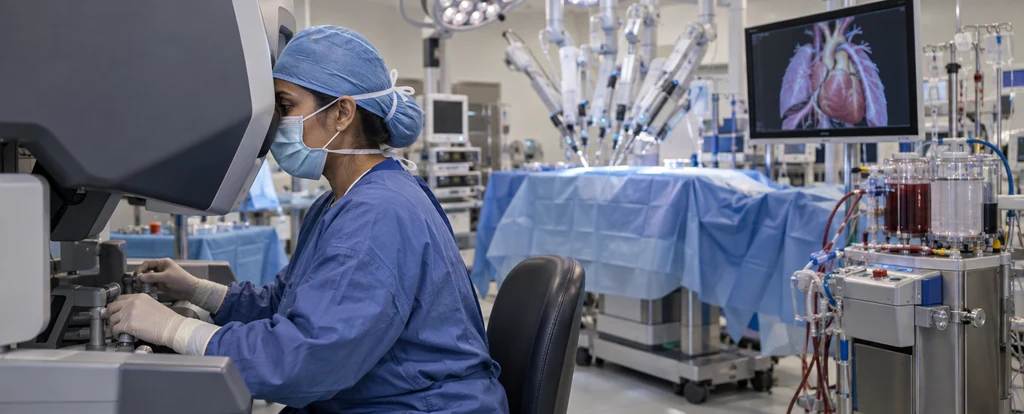
Cardiothoracic surgery sits at the low end of AI exposure, because the core of the job is operating by hand inside a living chest, where tissue quality and bleeding decide the next move in real time. Imaging software and surgical planning tools assist before and during some procedures, and robotic platforms such as the da Vinci system are used for selected cases, but the surgeon still controls the instruments and makes every judgement call. The parts most affected are the paperwork and planning around the operation.
Share of typical working time by exposure level
- Operating on the heart and great vesselsBypass grafting, valve replacement and aortic repair are done by hand, with the surgeon reading tissue and flow as the operation unfolds.35%low
- Postoperative and intensive care managementDecisions about bleeding, heart rhythm and ventilation in the first days after surgery are made at the bedside and adjusted minute by minute.30%low
- Preoperative assessment and planningCT, echocardiography and Sectra PACS images are reviewed to plan an approach; software can segment anatomy and flag risk, but choosing the operation stays with the surgeon.20%moderate
- Documentation, operating lists and team coordinationOperative notes, discharge summaries and theatre scheduling in Epic or Cerner are increasingly drafted or automated, which shortens the administrative load rather than the operating.15%high
Common questions about becoming a cardiothoracic surgeon
Straight answers to the questions people ask most.
How much does a cardiothoracic surgeon earn?
Cardiothoracic surgeons earn a median of $218,400 per annum, before tax. That is a national median for full-time work rather than a starting rate: public hospital pay follows the state enterprise agreement and years of service, while private fee-for-service work can lift total earnings above it.
How do you become a cardiothoracic surgeon?
Start with a medical degree and registration with the Medical Board of Australia through AHPRA, then work as an intern and resident medical officer for several years. Selection into the Royal Australasian College of Surgeons cardiothoracic surgical training program is competitive, and the program takes years of rotations through cardiac, thoracic and paediatric units before fellowship and specialist registration.
Are cardiothoracic surgeons in demand?
Cardiothoracic surgeons are currently in shortage nationally and employment is projected to grow 33.1% over the decade to 2035. About 170 people work in the specialty nationally, so training places and consultant appointments are limited and tend to sit in the larger teaching hospitals, which for a new entrant matters more than the overall demand picture.
Will AI replace cardiothoracic surgeons?
No. Operating inside a living chest is hands-on work, and the surgeon's judgement of tissue, bleeding and flow in real time is not something software takes over. AI does change the work around the operation: it helps segment scans, flag risk before surgery and draft documentation, which trims paperwork rather than surgery.
What can a cardiothoracic surgeon move into?
Most come through a resident medical officer role first, building general hospital experience and basic surgical skills, and that move brings $114,400 more in pay. The usual progression from there is a senior hospital appointment, often alongside private practice, which is where earnings typically grow. Some later narrow into paediatric cardiac surgery or lung transplantation.
How many hours do cardiothoracic surgeons work?
Full-time cardiothoracic surgeons average about 51 hours a week. Theatre lists give the week its shape, but emergency aortic dissections and chest trauma arrive at any hour, so on-call weeks run longer than the average suggests.
Related roles
- Resident Medical Officer
- Vascular Surgeon
- Paediatric Surgeon
- Radiation Oncologist
- Plastic Surgeon
- Ear, Nose and Throat Surgeon
Not sure this is you? Take the career quiz and get a ranked shortlist of roles that fit how you like to work.