Paediatric Surgeon
Paediatric surgeons operate on babies, children and teenagers to correct congenital conditions, injuries and tumours.
- Median salary*
- $218,400
3.8%vs last year, before tax
- People employed
- 130
30.0%vs last year
- Projected growth
- +33.1%
to 2035
- AI exposure*
- Low
- automation risk
- Average hours
- 45/wk
+5h vs all jobs
- Shortage status
- In shortage
national
Paediatric surgeons work in tertiary children's hospitals, where they treat conditions that range from a newborn's congenital abnormality to an adolescent's sports injury. What sets the specialty apart from adult surgery is the size of the patient and the range of ages: the same surgeon may repair a hernia in a premature baby in the morning and remove a tumour from a teenager in the afternoon. Most work in public hospital teams alongside neonatologists, paediatric anaesthetists and nurses, with some also running private consulting practices.
How much do paediatric surgeons earn?
The median full-time salary for a paediatric surgeon is $218,400 per annum, before tax, up $45,100 since 2018.
Public hospital surgeons are paid under state enterprise agreements, so pay moves with your seniority level, the on-call and recall loadings you carry, and whether you work full time. Income from private practice depends on your fee schedule and case mix rather than a set scale. Subspecialty matters too, since fetal and neonatal work concentrates in the tertiary children's hospitals.
What does a paediatric surgeon do day to day?
The list below is what fills most weeks; the exact mix shifts with seniority and whatever stage the current work is at.
- Assessing newborns and children referred with a surgical problem
- Operating in elective theatre lists and on emergency cases
- Reviewing imaging, pathology and antenatal referrals before deciding on surgery
- Explaining procedures, risks and consent with parents and carers
- Supervising registrars and taking a turn on the after-hours on-call roster
What skills do paediatric surgeons need?
Employers look for patient care and support, clinical assessment and treatment, backed by da Vinci robotic surgical system fluency and strong problem solving.
Specialist skills
- Patient care and support
- Clinical assessment and treatment
Software and tools
- da Vinci robotic surgical system
- PACS imaging systems
- Electronic medical records (Epic)
- Theatre management systems
General skills
- Problem solving
- Written communication
- Attention to detail
- People leadership
- Time and deadline management
- Empathy and interpersonal care
Is the job growing?
About 130 people work as paediatric surgeons in Australia, and employment is projected to grow 33.1% over the decade to 2035. That's very strong growth. Few roles in Australia are expanding this fast, and it points to solid demand for years to come.
How do you become a paediatric surgeon?
Here's the path most paediatric surgeons take, step by step.
- 1Complete a medical degree
An accredited medical degree takes four to six years, depending on whether you enter as an undergraduate or as a graduate. Clinical placements in paediatrics and surgery are where most people first test whether they want to work with children.
- 2Finish internship and prevocational hospital years
A supervised internship year leads to general registration with AHPRA, then a few years as a resident medical officer rotating through paediatrics, surgery and intensive care. This is the period when you build references and apply for surgical training.
- 3Enter the Royal Australasian College of Surgeons training program
Selection is competitive and usually requires several years of hospital experience, research or a higher degree. The early years of the program cover general surgery before trainees move into specialty streams.
- 4Complete paediatric surgery training
Specialty training runs across tertiary children's hospitals and covers neonatal, general and urological surgery in children. Many trainees interrupt training for a research year or an overseas fellowship to broaden their operating experience.
- 5Register as a specialist
Fellowship of the Royal Australasian College of Surgeons and specialist registration with AHPRA are what allow independent practice. A further subspecialty fellowship in areas such as neonatal or oncological surgery is common before taking a consultant post.
Ready to apply as a paediatric surgeon?
Whether you're working toward becoming a paediatric surgeon or already are one and want a hand with the next step (sharpening your resume for ATS screening, tightening your cover letter, or knowing what you'll actually be asked at interview), here are examples grounded in this specific role, not generic templates.
What jobs can a paediatric surgeon move to?
We don't list lateral moves for paediatric surgeons: leaving means a full new qualification rather than a career move, and the realistic routes in are covered under how to become one.
Who works as a paediatric surgeon?
The typical paediatric surgeon is 41 years old; 63% are men, 88% work full-time, and full-timers average 45 hours a week.
- 41
- Median age
- 37%
- Female share
- 88%
- Full-time
- +5h
- vs all-jobs avg
What's it like being a paediatric surgeon?
The week mixes fixed theatre lists, outpatient clinics and ward rounds, with an on-call roster that can pull you into the operating suite at any hour for a newborn emergency. The emotional weight sits in the conversations with parents as much as in the theatre, because a decision about a very small patient affects a whole family for decades. Surgeons who stay in it tend to like the mix of intricate technical work and long relationships with families, and are comfortable making decisions with incomplete information.
What people like
- Children heal well and the results last. Correcting a congenital defect in a newborn can give that child a normal life, and you see the outcome at follow-up appointments years later.
- A small specialty with close colleagues. With so few paediatric surgeons in the country, the referral network is tight and you tend to know the people you call for a second opinion.
- Wide variety across ages and conditions. A single week can cover neonatal bowel surgery, a childhood cancer resection and an adolescent trauma case, so the work rarely becomes routine.
- Long relationships with families. Children with complex conditions often return for staged procedures, so you follow a family from infancy well into school age.
What people find hard
- Emergencies ignore your schedule. A baby with a twisted bowel or a blocked airway needs theatre now, which can mean leaving a clinic or turning up at 3am on your on-call night.
- Delivering difficult news to parents. Consent conversations about a serious diagnosis, a poor prognosis or a complication are a regular part of the job and carry their own weight.
- A long, competitive training path. Selection into surgical training is demanding, fellowships often mean relocating, and the years of lower pay stretch well past those of many other careers.
- Very little margin for error. Small anatomy and fragile patients mean technique, documentation and audit all get close attention, and the hours in theatre can be long.
Based on our synthesis of professional-body surveys and public accounts of the role, not first-person verified reviews.
Which industries employ paediatric surgeons?
Health Care and Social Assistance employs the largest share of paediatric surgeons.
Top employing industries
- 1Health Care and Social Assistance
Ranked by employment share; the source doesn't publish an exact percentage per industry.
| Postgraduate | 59.2% | |
|---|---|---|
| Bachelor degree | 33.6% | |
| Diploma / Advanced Diploma | 0% | |
| Certificate III/IV | 0% |
Will AI replace paediatric surgeons?
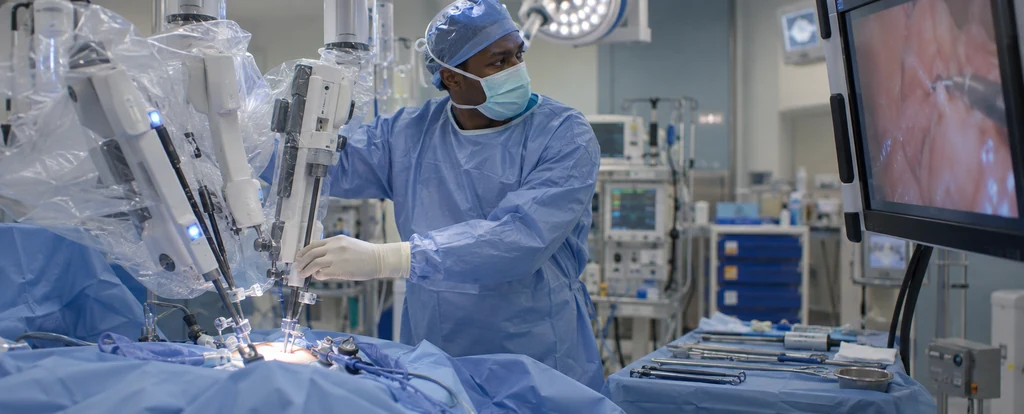
Paediatric surgery is one of the least exposed medical roles, because the work is a physical operation on a small patient whose anatomy differs from one case to the next. Robotic systems such as the da Vinci platform, 3D-printed models and PACS imaging support planning and precision, but the surgeon drives them and decides what happens next. Imaging analysis and record keeping are the parts most affected so far.
Share of typical working time by exposure level
- Operating in theatreRepairing a congenital diaphragmatic hernia or a twisted bowel in a newborn depends on decisions made in the moment about tissue that imaging cannot fully show.45%low
- Clinic and family consultationsExplaining a diagnosis and a staged plan to parents, and taking consent for surgery, stays with the surgeon who will do the operation.20%low
- Reviewing imaging and test resultsSoftware now flags and segments CT and MRI scans and helps build 3D models for planning, but the surgeon still decides what the images mean for this child.20%moderate
- Records, rostering and theatre schedulingEpic documentation, discharge summaries and theatre list scheduling are already partly automated, which saves time on administration but leaves the clinical entries to be written.15%high
Common questions about becoming a paediatric surgeon
Straight answers to the questions people ask most.
How much does a paediatric surgeon earn?
Paediatric surgeons earn a median of $218,400 per annum, before tax. What moves that figure is whether you work in the public system under an enterprise agreement or in private practice, plus your seniority and on-call load. The published figure is a guide rather than a starting salary.
How do you become a paediatric surgeon in Australia?
You complete a medical degree, an internship and several years of hospital work, then gain selection into the Royal Australasian College of Surgeons training program. Paediatric surgical training follows, mostly in tertiary children's hospitals, ending in fellowship and specialist registration with AHPRA. From the start of the medical degree to a consultant post usually takes well over a decade.
Are paediatric surgeons in demand in Australia?
Paediatric surgeons are currently in shortage nationally, and employment is projected to grow 33.1% over the decade to 2035. Because the specialty trains only a small number of surgeons each year, vacancies in children's hospitals can be hard to fill even when overall numbers look steady. If you are considering it, expect to be mobile about where you train and where you take your first consultant role.
Will AI replace paediatric surgeons?
No, and the exposure here is low, because the core of the job is a physical operation on a very small patient whose anatomy rarely matches the textbook. Robotic platforms such as the da Vinci system, 3D-printed models and PACS imaging help with planning and precision, but the surgeon still drives them and decides what to do. The parts most affected so far are imaging analysis, record keeping and theatre scheduling.
What can paediatric surgeons move into?
Both resident medical officers and general surgeons move into paediatric surgery, usually after completing a paediatric surgical fellowship. Resident medical officers bring general hospital training and patient care skills, and earn $114,400 more once they specialise, while general surgeons bring operative skill and anatomical knowledge and earn $15,300 more.
Do paediatric surgeons work long hours?
Full-time paediatric surgeons average about 45 hours a week, and that sits alongside an on-call roster covering nights and weekends. Emergency neonatal surgery means the hours are not fully predictable. Many surgeons later balance public hospital lists with private consulting to gain more control over their week.
Related roles
- Resident Medical Officer
- Surgeon
- Vascular Surgeon
- Cardiothoracic Surgeon
- Radiation Oncologist
- Plastic Surgeon
Not sure this is you? Take the career quiz and get a ranked shortlist of roles that fit how you like to work.