Fast Food Cook
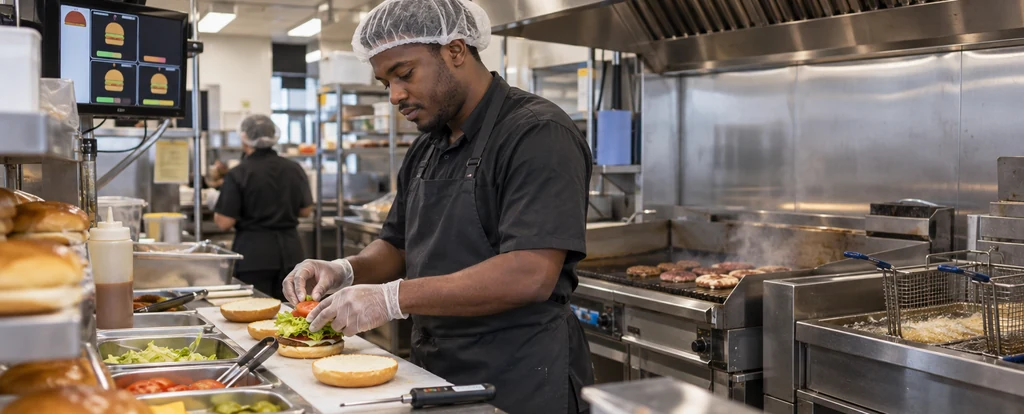
Fast food cooks prepare and cook the set menu items at a takeaway or quick service outlet, keeping orders moving through the lunch and dinner rush.
- Median salary
- $50,800
3.5%vs last year, before tax
- People employed
- 48,800
0.2%vs last year
- Projected growth
- +7.1%
to 2035
- AI exposure*
- Moderate
- automation risk
- Average hours
- 44/wk
+4h vs all jobs
- Shortage status*
- Not in shortage
national
Fast food cooks work in quick service restaurants and takeaway outlets, cooking burgers, chips, fried chicken and wraps to order. It is a narrower version of what a cook does in a restaurant kitchen: recipes, portion sizes and cooking times are set by head office or the owner, so consistency and speed matter more than creativity. Most fast food cooks are trained on the job, and many work casual shifts around school or study.
How much do fast food cooks earn?
The median full-time salary for a fast food cook is $50,800 per annum, before tax, up $10,800 since 2018.
Most fast food cooks are paid under the Fast Food Industry Award or an enterprise agreement, which sets rates by classification, with junior rates for workers under 21 and penalty rates for evenings, weekends and public holidays. Casual staff are paid a loading instead of paid leave, and taking on supervisor or cook-in-charge duties moves you to a higher classification. Rates also vary between franchise groups and independent outlets, and by how many hours you can get on the roster.
What does a fast food cook do day to day?
The list below is what fills most weeks; the exact mix shifts with seniority and whatever stage the current work is at.
- Working a station such as the fryer, griddle or assembly bench through a busy lunch or dinner rush
- Cooking burgers, chips, fried chicken and other menu items to set times and temperatures
- Wrapping, bagging and handing over orders so they leave the counter hot and complete
- Restocking buns, sauces, lettuce and frozen items, and telling the shift supervisor when something is running low
- Cleaning the fryers, griddle and prep surfaces and checking fridge and food temperatures during the shift
What skills do fast food cooks need?
Employers look for food preparation and cooking, food safety and hygiene, operations management, backed by Commercial deep fryer fluency and strong attention to detail.
Specialist skills
- Food preparation and cooking
- Food safety and hygiene
- Operations management
- Cleaning and grounds maintenance
Software and tools
- Commercial deep fryer
- Flat-top griddle
- Point-of-sale (POS) system
- Food probe thermometer
- Kitchen order display system
General skills
- Attention to detail
- Customer service
- Time and deadline management
Is the job growing?
About 48,800 people work as fast food cooks in Australia, and employment is projected to grow 7.1% over the decade to 2035. That's modest growth: demand is steady rather than booming.
How do you become a fast food cook?
Here's the path most fast food cooks take, step by step.
- 1Get a casual or part-time job in a fast food outlet
This is how nearly everyone starts. Outlets train new staff station by station, so you can begin with no experience and no qualification, usually from around 14 or 15 under your state's rules on junior employment.
- 2Complete food safety training
Food handlers in most states must have food safety skills and knowledge, which is covered by a short Food Handler course or the outlet's own induction. It is a requirement rather than a qualification, but it is what lets you work unsupervised on the line.
- 3Learn every station and take on shift duties
Rotating through fryer, grill, assembly and closing shifts builds the experience supervisors look for when they appoint shift leaders. That range of experience is also what the next employer asks about.
- 4Consider a Certificate III in Commercial Cookery for a restaurant move
Restaurant cook and chef roles expect this qualification, usually completed as an apprenticeship over about three years. Some TAFE colleges run it as a traineeship while you keep working in a kitchen.
Ready to apply as a fast food cook?
Whether you're working toward becoming a fast food cook or already are one and want a hand with the next step (sharpening your resume for ATS screening, tightening your cover letter, or knowing what you'll actually be asked at interview), here are examples grounded in this specific role, not generic templates.
What jobs can a fast food cook move to?
Moving into Barista typically comes with the biggest pay rise, worth $27,200 a year more on average.
| Move to | Typical pay change | Overlap | Retraining |
|---|---|---|---|
| Barista Fast food cooks bring hospitality speed and customer service, moving to barista roles with reskilling in coffee making.Known move | +$27,200 | 40% | reskill |
| Cook Fast food cooks bring quick food preparation and kitchen hygiene skills, moving to cook roles with a short course.Known move | +$23,700 | 53% | short course |
| Bakery Assistant Fast food cooks bring food preparation and portioning skills, moving to bakery assistant roles with minimal retraining. | +$21,000 | 78% | minimal |
Moves are chosen from Jobs and Skills Australia's Data on Occupation Mobility, which follows income tax records between 2011-12 and 2020-21, together with entry requirements and skill overlap. A known move is one people were seen making in that data. Pay change compares median full-time pay for the two roles.
Who works as a fast food cook?
The typical fast food cook is 18 years old; 70% are men, 16% work full-time, and full-timers average 44 hours a week.
- 18
- Median age
- 30%
- Female share
- 16%
- Full-time
- +4h
- vs all-jobs avg
What's it like being a fast food cook?
Shifts are built around the meal rushes, so the work swings between quiet prep and a half-hour stretch where every order arrives at once. The menu rarely changes, which makes the job quick to learn and repetitive once you have, and the kitchen is hot, loud and shared with a young crew. People who like a fast team, clear tasks and a shift that ends when they clock off tend to do well in it.
What people like
- The shift moves quickly. During a rush there is no time to be bored, and the queue of orders gives the whole crew a shared target to clear.
- You can learn the whole kitchen in weeks. Because the menu and equipment are standard, a new starter can be competent on most stations within a few weeks and then pick up similar shifts elsewhere.
- Training happens on the job. No qualification is needed to start, so it suits a first job or work that fits around school, TAFE or university.
- The shift ends when you clock off. Unlike salaried kitchen roles that stretch with the day's prep, a fast food shift has a set start and finish.
What people find hard
- The menu gets repetitive. Once you know the items, most shifts are the same food cooked the same way, hundreds of times.
- Rush periods are relentless. Orders can arrive faster than the line clears them, and slow down and the whole crew falls behind.
- Heat, oil and noise. Standing at a fryer for a full shift in a hot kitchen, with timers, alarms and tills going, is tiring in a physical way.
- Evenings, weekends and public holidays. Outlets trade when most people are off, so rosters lean on nights and weekends, and public holidays are among the busiest days.
Based on our synthesis of professional-body surveys and public accounts of the role, not first-person verified reviews.
Which industries employ fast food cooks?
Accommodation and Food Services employs the largest share of fast food cooks.
Top employing industries
- 1Accommodation and Food Services
Ranked by employment share; the source doesn't publish an exact percentage per industry.
| Year 12 or below | 78% | |
|---|---|---|
| Certificate III/IV | 8.1% | |
| Bachelor degree | 4.7% | |
| Diploma / Advanced Diploma | 4.7% | |
| Postgraduate | 1.8% |
Will AI replace fast food cooks?
Fast food cooking sits at moderate exposure: the menu is standardised and much of the ordering and timing has already moved to screens and automated equipment, but the cooking, assembling and cleaning are still done by hand. Self-order kiosks and kitchen display systems change how orders arrive rather than who makes them. The role is more likely to be reshaped, with fewer people covering more stations, than removed.
Share of typical working time by exposure level
- Cooking on the fryer and griddleTimers and automatic lift fryers handle part of the timing, but someone still loads baskets, watches colour and texture, and pulls food at the right moment.30%moderate
- Prep, portioning and stockChopping, portioning and restocking follow set quantities, and stock systems flag what to reorder, though the physical work stays manual.25%moderate
- Cleaning and food safety checksScrubbing fryers, mopping floors and probing food temperatures are hands-on tasks that no equipment in a standard outlet does for you.25%low
- Assembling and packaging ordersBuilding a standard burger or bagging a combo follows a fixed sequence that kitchen display systems already step the cook through.20%high
Moves least exposed to AI
These career moves from fast food cook work are rated low for AI exposure:
- Cook
Solid skill overlap (53%), short course to get there, and a low automation-risk profile.
- Barista
Solid skill overlap (40%), reskill to get there, and a low automation-risk profile.
Common questions about becoming a fast food cook
Straight answers to the questions people ask most.
How much do fast food cooks earn?
Fast food cooks earn a median of $50,800 per year before tax, based on full-time workers. Award classification, junior rates and penalty rates for evenings and weekends all shift that number, so treat it as a guide for the role rather than a figure for one particular job.
Do you need a qualification to become a fast food cook?
No. Almost all fast food cooks learn on the job, and outlets hire with no certificate required. Food safety training is usually part of induction, and a qualification only becomes useful if you later want to move into restaurant cooking.
Are fast food cooks in demand?
This role is currently not in shortage, and employment is projected to grow 7.1% over the decade to 2035. Work is spread across thousands of outlets nationally, so the more useful check is what is advertising shifts in your area.
Will AI or automation replace fast food cooks?
Exposure is moderate. Self-order kiosks, kitchen display screens and automatic cooking timers already handle order taking and part of the timing, but someone still loads the fryers, assembles burgers, judges when food is cooked and cleans the line. The tasks most exposed are the fixed sequences, such as building a standard burger or packaging a combo.
What jobs can a fast food cook move into?
Experience on the line transfers well. Moving to a cook role in a restaurant kitchen usually needs a Certificate III in Commercial Cookery and pays $23,700 more more, bakery assistant work uses similar preparation and portioning skills with minimal retraining and pays $21,000 more more, and barista work needs coffee training and pays $27,200 more more.
What are the hours like?
Outlets trade late and every day, so rosters include evenings, weekends and public holidays, often in shifts of four to eight hours. Part-time and casual hours are common and suit study, while full-time fast food cooks average 44 hours a week.
Related roles
Not sure this is you? Take the career quiz and get a ranked shortlist of roles that fit how you like to work.