Bakery Assistant
Bakery assistants prepare, bake and finish bread, cakes and pastries, then keep the shelves stocked and the counter moving.
- Median salary
- $71,800
4.1%vs last year, before tax
- People employed
- 3,400
0.0%vs last year
- Projected growth
- +4.3%
to 2035
- AI exposure*
- Moderate
- automation risk
- Average hours
- 39/wk
−1h vs all jobs
- Shortage status*
- Not in shortage
national
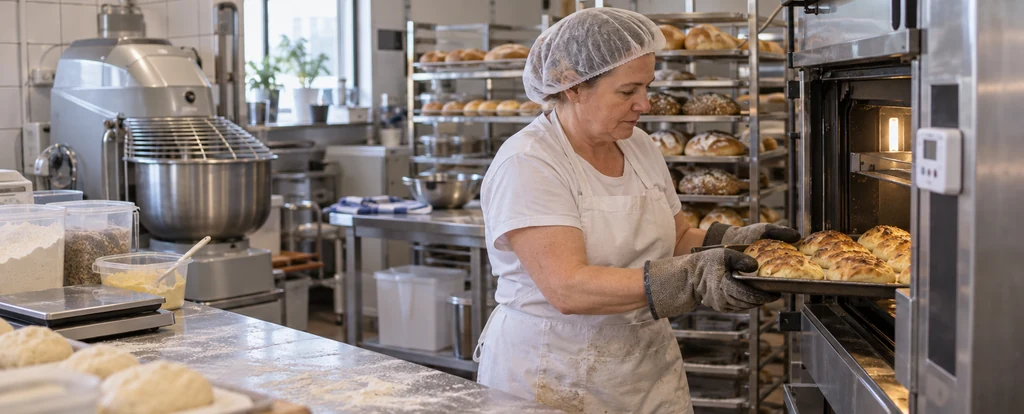
Most bakery assistants work in supermarket bakeries, independent bakeries and cafes, where production and counter service sit in the same small team. The role is often the way into the trade: you learn dough handling, oven work and food safety on the job, without needing a qualification to start. It differs from a baker, who is trade-qualified and responsible for recipes, fermentation and the quality of the bake.
How much do bakery assistants earn?
The median full-time salary for a bakery assistant is $71,800 per annum, before tax, up $15,000 since 2018.
Pay is set mainly by the retail or food award covering the business, with junior rates for workers under 21 and penalty rates for early mornings, nights, weekends and public holidays. Casual staff usually receive a loading instead of paid leave, which lifts the hourly rate but makes weekly income less predictable. Supermarket bakeries and larger production sites often pay above the award and can offer steadier full-time rosters.
What does a bakery assistant do day to day?
The list below is what fills most weeks; the exact mix shifts with seniority and whatever stage the current work is at.
- Mixing and portioning dough, batters and fillings for the day's production plan
- Loading ovens, watching bake times and finishing bread, rolls and pastries
- Serving customers over the counter and packing orders
- Cleaning benches, trays, mixers and display cabinets through the shift
- Checking deliveries, dating stock and rotating products so older items sell first
What skills do bakery assistants need?
Employers look for food preparation and cooking, food safety and hygiene, cleaning and grounds maintenance, backed by Commercial ovens fluency and strong customer service.
Specialist skills
- Food preparation and cooking
- Food safety and hygiene
- Cleaning and grounds maintenance
- Inventory management
- Operations management
Software and tools
- Commercial ovens
- Dough mixers
- Point of sale (POS) systems
- Digital scales
- Bakery trays and moulds
General skills
- Customer service
- Attention to detail
Is the job growing?
About 3,400 people work as bakery assistants in Australia, and employment is projected to grow 4.3% over the decade to 2035. That's modest growth: demand is steady rather than booming.
How do you become a bakery assistant?
Here's the path most bakery assistants take, step by step.
- 1Complete a food safety course
A short food handler course, often a few hours online, covers hygiene, temperature control and safe storage, and many employers ask for it before you start.
- 2Apply for entry-level jobs
Supermarket bakeries, independent bakeries, cafes and hotels hire without formal qualifications, usually asking only for Year 10 or Year 12 and availability for early shifts.
- 3Learn production on the job
You'll be trained on mixing, scaling, shaping, oven work, finishing and counter service, and some employers put staff through a Food Safety Supervisor certificate.
- 4Take on more of the bake
Once you can run a section unsupervised, you might manage production for a shift, order stock or supervise other assistants, which is where some bakeries start paying above the base rate.
- 5Consider a baking apprenticeship
A Certificate III in Baking (FBP30521), usually three years and paid, is the trade qualification that turns bakery assistant work into a baker's role.
Ready to apply as a bakery assistant?
Whether you're working toward becoming a bakery assistant or already are one and want a hand with the next step (sharpening your resume for ATS screening, tightening your cover letter, or knowing what you'll actually be asked at interview), here are examples grounded in this specific role, not generic templates.
What jobs can a bakery assistant move to?
Moving into Barista typically comes with the biggest pay rise, worth $6,200 a year more on average.
| Move to | Typical pay change | Overlap | Retraining |
|---|---|---|---|
| Barista Counter service and food handling transfer to coffee making, with a barista course covering espresso and milk preparation.Known move | +$6,200 | 36% | reskill |
| Cook Portioning, food safety and kitchen routines carry across, and a cookery qualification opens broader commercial kitchen work.Known move | +$2,700 | 40% | reskill |
| Baker Bakery assistants already handle dough, trays and food safety, so a baking apprenticeship builds trade skills on that foundation.Known move | +$1,900 | 43% | requalify |
| Pastry Chef Pastrycook training extends the bakery assistant's food preparation and presentation skills into finished pastries, cakes and desserts.Known move | +$1,900 | 32% | requalify |
Moves are chosen from Jobs and Skills Australia's Data on Occupation Mobility, which follows income tax records between 2011-12 and 2020-21, together with entry requirements and skill overlap. A known move is one people were seen making in that data. Pay change compares median full-time pay for the two roles.
Who works as a bakery assistant?
The typical bakery assistant is 30 years old; 65% are women, 30% work full-time, and full-timers average 39 hours a week.
- 30
- Median age
- 65%
- Female share
- 30%
- Full-time
- −1h
- vs all-jobs avg
What's it like being a bakery assistant?
The day usually starts before dawn, because the bake has to be ready when the shop opens. Shifts are physical and steady: mixing, lifting trays, standing for hours, serving a breakfast rush and cleaning down at the end. People who like an early finish, clear tasks and seeing a full tray come out of the oven tend to settle into it quickly.
What people like
- The work has a visible result. You start with flour and finish with bread on the shelf, and each morning's batch shows you how it went.
- Early starts, early finish. Most bakeries bake before opening, so shifts often end in the early afternoon and leave the rest of the day free.
- A way in without a qualification. Most employers train new staff on the job, which makes this one of the more accessible entries into food production and retail.
- Small, close-knit teams. Bakeries run with a handful of people per shift, so you work alongside the same few colleagues and learn the whole process rather than one station.
What people find hard
- Very early starts. A 4am start is normal in many bakeries, and getting up at that hour every day wears people down more than the work itself.
- Heat, flour and repetition. Standing near ovens and repeating the same mix and shape hundreds of times is hard on feet, wrists and back.
- Casual and part-time rosters. A lot of the work is casual or part time, so weekly hours move around and income is harder to plan.
- Quiet patches still need work. Mid-afternoon in a small bakery can be slow, but the cleaning, dating and restocking still have to be finished before you leave.
Based on our synthesis of professional-body surveys and public accounts of the role, not first-person verified reviews.
Which industries employ bakery assistants?
Retail Trade employs the largest share of bakery assistants, followed by Manufacturing.
Top employing industries
- 1Retail Trade
- 2Manufacturing
Ranked by employment share; the source doesn't publish an exact percentage per industry.
| Year 12 or below | 67.5% | |
|---|---|---|
| Certificate III/IV | 12.9% | |
| Bachelor degree | 7.6% | |
| Diploma / Advanced Diploma | 5.2% | |
| Postgraduate | 2.6% |
Will AI replace bakery assistants?
Bakery assistant work sits in the middle: large plant bakeries automate mixing, dividing and baking, while small retail bakeries still do most of it by hand. Ordering, rostering and stock control are increasingly run through software, which changes how the work is organised rather than who does it. Shaping dough, finishing products, serving customers and keeping food safe remain physical, hands-on tasks.
Share of typical working time by exposure level
- Baking and finishing bread, cakes and pastriesConveyor and programmable deck ovens hold temperature and timing, but loading trays, checking colour and hand-finishing glazes and fillings still fall to the assistant.30%moderate
- Preparing dough, batters and fillingsSpiral mixers and automatic dividers speed up bulk dough, though weighing, judging texture and adjusting for a humid day are still done by hand.25%low
- Serving customers at the counterSelf-serve screens and POS systems handle simple transactions, but allergen questions, custom orders and a busy morning queue need a person.25%moderate
- Cleaning equipment and rotating stockCleaning ovens, mixers and cabinets is hands-on, and stock rotation depends on someone checking dates and quality on the shelf rather than trusting the system.20%low
Moves least exposed to AI
These career moves from bakery assistant work are rated low for AI exposure:
- Pastry Chef
Some skill overlap (32%), requalify to get there, and a low automation-risk profile.
- Cook
Solid skill overlap (40%), reskill to get there, and a low automation-risk profile.
- Barista
Some skill overlap (36%), reskill to get there, and a low automation-risk profile.
Common questions about becoming a bakery assistant
Straight answers to the questions people ask most.
How much do bakery assistants earn?
Full-time bakery assistants earn a median of $71,800 per year before tax. Much of the work is casual or part-time, so weekly earnings move with the roster, and penalty rates for early, weekend and holiday shifts lift the hourly rate.
How do you become a bakery assistant?
Most people finish a short food handler course and apply directly to a bakery, supermarket or cafe. No qualification is required for the entry role, and employers train new staff on mixing, oven work and counter service. A Certificate III in Baking (FBP30521) apprenticeship is the next step if you want the trade behind it.
Are bakery assistants in demand?
Bakery assistants are currently not in shortage, and employment is projected to grow 4.3% over the decade to 2035. Because the occupation is small, new positions are spread thinly around the country and staff turnover accounts for many of the openings. Being available for early starts and weekend shifts helps when you apply.
Will AI or automation replace bakery assistants?
Partly. Large plant bakeries already use automated mixers, dividers and conveyor ovens, which cuts the number of hands needed for bulk production. In retail bakeries the shaping, finishing, counter service and food safety checks still need a person, so the job changes more than it disappears.
What can a bakery assistant move into?
Many move into trade-qualified baking through a Certificate III in Baking apprenticeship, which pays $1,900 more at the median and builds on the dough handling and food safety they already know. Pastry chef training is another route, extending the same preparation skills into cakes and desserts. A short barista course suits anyone who would rather work the counter and the coffee machine.
What are the hours like?
Shifts usually start before dawn, often between 4am and 6am, so the shelves are full when the shop opens, and full-time hours average about 39 a week. Weekend and public holiday work is standard because bakeries trade every day. Supermarket and larger production bakeries sometimes run later shifts, so it's worth asking about start times before you accept a role.
Related roles
Not sure this is you? Take the career quiz and get a ranked shortlist of roles that fit how you like to work.