Fingerprint Expert
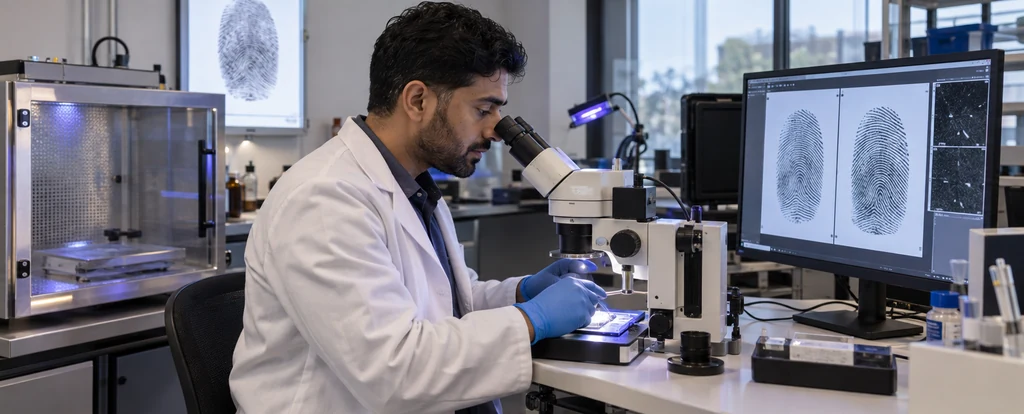
Fingerprint experts recover and compare the prints left at crime scenes, and their findings identify people and hold up as evidence in court.
- Median salary*
- $93,600
3.9%vs last year, before tax
- People employed*
- 400
0.0%vs last year
- Projected growth*
- +3%
to 2035
- AI exposure*
- Moderate
- automation risk
- Average hours*
- 38/wk
−2h vs all jobs
- Shortage status*
- Not in shortage
national
Fingerprint experts recover, enhance and compare the latent prints left on evidence and at crime scenes, working mainly in police forensic services and government laboratories. The role sits close to forensic science but specialises in identification: deciding whether a print came from a particular person and being able to defend that conclusion. Most of the week is spent at a comparison bench or inside an automated identification system, with callouts to scenes mixed in.
How much do fingerprint experts earn?
The median full-time salary for a fingerprint expert is $93,600 per annum, before tax, up $19,400 since 2018.
Most fingerprint experts work for state police services or government laboratories, so pay follows a public sector classification and enterprise agreement rather than individual negotiation. Shift work, on-call attendance at crime scenes and promotion to a higher classification are what move it, and the scales differ between states and territories. Laboratory, defence and Commonwealth roles sit on their own agreements again.
What does a fingerprint expert do day to day?
The list below is what fills most weeks; the exact mix shifts with seniority and whatever stage the current work is at.
- Recovering latent prints at crime scenes and from seized items, using powders, fuming and forensic light sources
- Enhancing faint or partial prints in the laboratory so the ridge detail is clear enough to compare
- Coding and searching prints through the national automated fingerprint identification system
- Comparing a latent print with known specimens and documenting the points of agreement
- Preparing expert statements and giving evidence when a case reaches court
What skills do fingerprint experts need?
Employers look for regulatory compliance, data analysis, backed by NEC AFIS fluency and strong attention to detail.
Specialist skills
- Regulatory compliance
- Data analysis
Software and tools
- NEC AFIS
- Adobe Photoshop
- Forensic light sources
- Cyanoacrylate fuming chambers
- Forensic comparison software
General skills
- Attention to detail
- Problem solving
- Written communication
- Presenting and data storytelling
- Time and deadline management
Is the job growing?
About 400 people work as fingerprint experts in Australia, and employment is projected to grow 3% over the decade to 2035. That's modest growth: demand is steady rather than booming.
How do you become a fingerprint expert?
Here's the path most fingerprint experts take, step by step.
- 1Complete a relevant degree
Forensic science, biomedical science, chemistry or another laboratory science is the usual entry point, and 52% of fingerprint experts hold a bachelor degree. A diploma in laboratory technology can get you into a related technical role, though you would need further study for a fingerprint position.
- 2Apply to a forensic service or laboratory
Vacancies are advertised by state and territory police services, government forensic laboratories and some Commonwealth agencies. Selection includes police and security checks, and many examiners start in an exhibits or laboratory role before specialising.
- 3Complete in-house fingerprint training
Training covers print comparison, chemical enhancement and database searching, and runs for several months to a few years of supervised casework before you examine cases independently. Proficiency testing continues throughout your career.
- 4Qualify as an expert witness
You build the court side of the job by preparing statements under supervision and then giving evidence yourself. Explaining a comparison clearly, and handling cross-examination, is part of the qualification in practice.
- 5Add postgraduate study to broaden
A graduate certificate or masters in forensic science supports moves into other evidence disciplines or into laboratory leadership, and 26% of the current workforce holds a postgraduate qualification.
Ready to apply as a fingerprint expert?
Whether you're working toward becoming a fingerprint expert or already are one and want a hand with the next step (sharpening your resume for ATS screening, tightening your cover letter, or knowing what you'll actually be asked at interview), here are examples grounded in this specific role, not generic templates.
What jobs can a fingerprint expert move to?
Moving into Police Officer typically comes with the biggest pay rise, worth $39,500 a year more on average.
| Move to | Typical pay change | Overlap | Retraining |
|---|---|---|---|
| Police Officer Fingerprint experts can move into policing, bringing forensic evidence knowledge to investigations; police training and sworn duties require reskilling. | +$39,500 | 18% | reskill |
| Customs Officer Identity and document examination skills transfer to customs work, where officers inspect travellers and goods; a short course covers powers and procedures. | +$3,200 | 60% | short course |
| Forensic Scientist Fingerprint experts can broaden into forensic science, carrying evidence analysis and court reporting; other forensic disciplines need further training. | +$2,100 | 45% | reskill |
| Fraud Analyst Analytical pattern matching and evidence gathering transfer to fraud analysis; a short course builds financial crime and investigation knowledge. | −$7,800 | 53% | short course |
Moves are chosen from Jobs and Skills Australia's Data on Occupation Mobility, which follows income tax records between 2011-12 and 2020-21, together with entry requirements and skill overlap. A known move is one people were seen making in that data. Pay change compares median full-time pay for the two roles.
Who works as a fingerprint expert?
The typical fingerprint expert is 40 years old; 55% are women, 85% work full-time, and full-timers average 38 hours a week.
- 40
- Median age
- 55%
- Female share
- 85%
- Full-time
- −2h
- vs all-jobs avg
What's it like being a fingerprint expert?
The job is methodical and largely laboratory based, with occasional crime scene attendance and a steady background of court deadlines. Cases are reviewed by a second examiner, so your reasoning has to be documented well enough for someone else to follow and for a barrister to test. It suits people who like detail, are patient with repetition, and are comfortable defending a judgement they made months earlier.
What people like
- Turning a partial print into a match. A smudged latent that looks like nothing under the light can still carry enough ridge detail to identify someone, and getting there takes patience and a careful eye.
- Following a case from scene to court. You may attend the scene, do the enhancement work, make the comparison and then explain it in the witness box, which keeps the whole chain in view.
- A small field with deep expertise. Few people nationally do this work, so the specialist knowledge is genuinely rare and experienced examiners are the ones others turn to.
- Clear standards and second checks. Methods are documented and conclusions are verified by another examiner, so you know when the work has been done properly rather than guessing.
What people find hard
- Cross-examination in court. Barristers test the limits of print comparison, including past errors in the discipline, and you need to stay precise under pressure.
- Distressing case material. The work involves homicide, assault and child exploitation material, and the images stay with you longer than the case file does.
- Long stretches of database work. Much of the week is coding and searching prints that never match, which is repetitive even though the occasional hit depends on it.
- Few openings and slow recruitment. This is a very small occupation, so positions appear when someone retires or moves on, and recruitment rounds can take months and may require relocating.
Based on our synthesis of professional-body surveys and public accounts of the role, not first-person verified reviews.
Which industries employ fingerprint experts?
Police services employs the largest share of fingerprint experts, followed by Forensic science laboratories.
Top employing industries
- 1Police services
- 2Forensic science laboratories
- 3Government administration
- 4Defence and security
Ranked by employment share; the source doesn't publish an exact percentage per industry.
| Bachelor degree | 52% | |
|---|---|---|
| Postgraduate | 26% | |
| Diploma / Advanced Diploma | 13% | |
| Other | 9% |
Will AI replace fingerprint experts?
Automated fingerprint identification systems have already reshaped this job, and comparison software now ranks candidate prints and scores similarity faster than any examiner could. The decision that two prints match is still made by a person who documents the ridge detail and defends it under cross-examination, which is what keeps exposure at a moderate level. Recovery and enhancement work at scenes remains hands-on.
Share of typical working time by exposure level
- Comparing latent prints with known specimensAlgorithms shortlist candidates and flag likely matches, but an examiner confirms the ridge detail and writes the conclusion.30%moderate
- Recovering and enhancing prints at scenes and in the labPowders, cyanoacrylate fuming and forensic light sources depend on a person choosing the method for the surface and reading the result.25%low
- Reporting and giving evidence in courtStatements and testimony set out the examiner's own reasoning, including the limits of the comparison, and cannot be delegated to software.25%low
- Coding and searching the fingerprint databasePrint coding and searching are largely automated, so the examiner's time goes to reviewing and verifying what the system returns.20%high
Common questions about becoming a fingerprint expert
Straight answers to the questions people ask most.
How much do fingerprint experts earn?
Fingerprint experts earn $93,600 per year before tax. The figure is set by public sector classification and enterprise agreements rather than negotiation, so shift work, crime scene callouts and higher classifications are what move it, and pay differs between states and territories.
How do you become a fingerprint expert?
Most people enter with a science degree, then apply to a police forensic service or government laboratory and complete in-house training in comparison, enhancement and database searching. It usually takes a couple of years of supervised casework before you examine and report on cases on your own.
Are fingerprint experts in demand?
Fingerprint experts are currently not in shortage, and employment is projected to grow 3% over the decade to 2035. The occupation is small, around 400 people, so openings mostly come from retirements and staff moving on rather than growth, and vacancies can appear in one state at a time.
Will AI replace fingerprint experts?
Not outright, but automated identification systems already handle much of the searching and ranking that examiners once did by hand. Software returns candidate lists and scores, while an examiner still decides whether two prints match, documents the reasoning and defends it in court. Recovery and enhancement work at scenes stays manual.
What jobs can a fingerprint expert move into?
Some move into broader forensic science work, where evidence analysis and court reporting carry over ($2,100 more), or into customs and border roles that rely on the same identity and document examination skills ($3,200 more). Others move into fraud analysis, where pattern matching and evidence gathering transfer with a short course ($7,800 less). Each move keeps the investigative thread while changing the setting.
Do you need to be a police officer to work as a fingerprint expert?
No. Most fingerprint experts are civilian employees of police services or government laboratories, and swearing an oath is not part of the job. Some examiners do come across from policing, bringing investigative and court experience before completing specialist fingerprint training.
Related roles
Not sure this is you? Take the career quiz and get a ranked shortlist of roles that fit how you like to work.