Forklift Operator
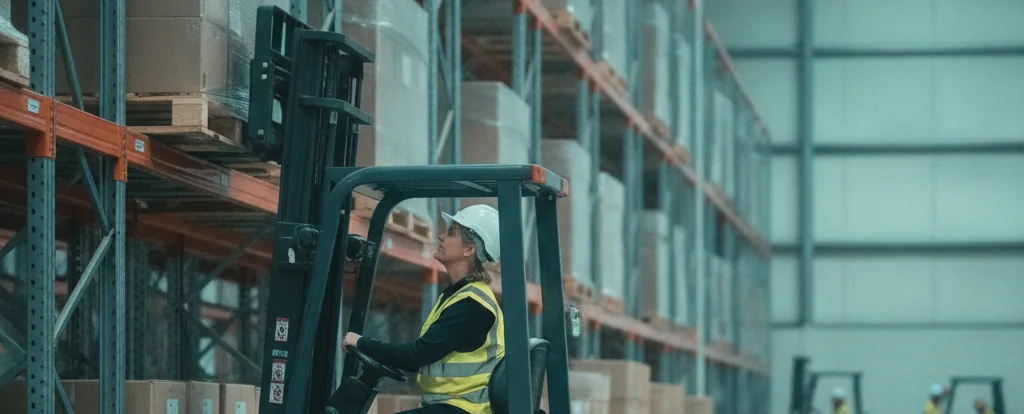
Forklift operators use a powered forklift to lift, stack and move pallets and other loads in warehouses, yards, factories and shipping terminals.
- Median salary
- $69,700
4.3%vs last year, before tax
- People employed
- 71,300
0.6%vs last year
- Projected growth
- +3.5%
to 2035
- AI exposure*
- Low
- automation risk
- Average hours
- 42/wk
+2h vs all jobs
- Shortage status
- Not in shortage
national
Forklift operators work wherever heavy or awkward goods need moving: distribution centres, factories, timber yards, produce markets and container terminals. The day is built around the machine rather than around picking and packing on foot, which is the main difference from a warehouse storeperson working the same aisles. The work requires a current High Risk Work Licence for the class of forklift, issued by the state or territory work health and safety regulator, and many operators add extra classes so they can move between counterbalance trucks, reach trucks and order pickers.
How much do forklift operators earn?
The median full-time salary for a forklift operator is $69,700 per annum, before tax, up $14,700 since 2018.
Shift patterns move pay more than anything else, since afternoon, night and weekend rosters usually attract loadings, and permanent roles include paid leave that a casual rate does not. The employer and its enterprise agreement matter too: manufacturing, wholesale and transport businesses set different rates for similar work, and operators who hold extra licence classes or work in high-volume distribution centres tend to sit above the middle of the range. Labour hire can pay well by the hour but with less certainty about hours from one week to the next.
What does a forklift operator do day to day?
The list below is what fills most weeks; the exact mix shifts with seniority and whatever stage the current work is at.
- Running pre-start checks on the forklift before the first pallet moves
- Loading and unloading trucks against a despatch schedule
- Stacking and retrieving pallets from racking, sometimes several levels up
- Scanning loads in and out so the warehouse system matches what is on the floor
- Reporting damaged racking, near misses or a fault with the machine
What skills do forklift operators need?
Employers look for plant and equipment operation, warehousing and despatch, inventory management, backed by Counterbalance Forklifts fluency and strong attention to detail.
Specialist skills
- Plant and equipment operation
- Warehousing and despatch
- Inventory management
- Worksite safety management
- Hand and power tool work
Software and tools
- Counterbalance Forklifts
- Reach Trucks
- Warehouse Management Systems (WMS)
- Hand Pallet Jacks
- Load Scanners (barcode/RFID)
General skills
- Attention to detail
Is the job growing?
About 71,300 people work as forklift operators in Australia, and employment is projected to grow 3.5% over the decade to 2035. That's modest growth: demand is steady rather than booming.
How do you become a forklift operator?
Here's the path most forklift operators take, step by step.
- 1Get the forklift licence
You must be at least 18 and complete training with a registered training organisation, usually a one or two day course followed by practical and written assessment, then lodge the licence with your state or territory work health and safety regulator. Licensing and renewal periods vary slightly between states, so check the rule where you live.
- 2Add the cards and classes your industry wants
A White Card is required before you work on a construction site, and an order picking forklift (LO) or reach truck class opens up more warehouse work. About 63% of forklift operators finished school at Year 12 or below, so no diploma or degree is expected.
- 3Get a start, often through labour hire
New operators usually pick up their first shifts through labour hire firms or casual warehouse work, because many employers want some seat time before they hire permanently. Turn up early, keep the machine clean and learn the site layout quickly.
- 4Broaden the machines and industries you can work in
Each extra class of plant, or a move into cold storage, timber, containers or manufacturing, widens the pool of employers you can work for. Short courses in warehouse or inventory systems help if you later want to step off the machine.
Ready to apply as a forklift operator?
Whether you're working toward becoming a forklift operator or already are one and want a hand with the next step (sharpening your resume for ATS screening, tightening your cover letter, or knowing what you'll actually be asked at interview), here are examples grounded in this specific role, not generic templates.
What jobs can a forklift operator move to?
Moving into Crane Operator typically comes with the biggest pay rise, worth $107,700 a year more on average.
| Move to | Typical pay change | Overlap | Retraining |
|---|---|---|---|
| Crane Operator Forklift operators move to crane operation, as both involve moving loads with plant, but a crane ticket is required.Known move | +$107,700 | 53% | short course |
| Truck Driver Forklift operators bring load handling and yard experience to truck driving, though a truck licence and on-road training are required.Known move | +$32,200 | 17% | reskill |
| Machine Operator Forklift operators move to machine operation, carrying material handling and production flow awareness into machine-specific training.Known move | +$11,100 | 29% | reskill |
| Warehouse Administrator Forklift operators bring warehouse flow knowledge to administrator roles, but need training in inventory systems and office procedures.Known move | +$500 | 33% | reskill |
| Warehouse Storeperson Forklift operators move into general storeperson roles, using load handling and stock movement skills across warehouse duties.Known move | −$600 | 53% | short course |
Moves are chosen from Jobs and Skills Australia's Data on Occupation Mobility, which follows income tax records between 2011-12 and 2020-21, together with entry requirements and skill overlap. A known move is one people were seen making in that data. Pay change compares median full-time pay for the two roles.
Who works as a forklift operator?
The typical forklift operator is 41 years old; 95% are men, 87% work full-time, and full-timers average 42 hours a week.
- 41
- Median age
- 5%
- Female share
- 87%
- Full-time
- +2h
- vs all-jobs avg
What's it like being a forklift operator?
The rhythm of the job is set by trucks and load sheets rather than by meetings, and most of it happens on the machine with short spells on foot to check a load or a docket. Full-time operators average about 42 hours a week, often across early, late or weekend rosters. It suits people who are patient and watchful and who are content to work to a schedule that someone else sets.
What people like
- The machine does the heavy work. The job is physical in the way that climbing on and off, checking loads and watching mirrors is physical, but you are not lifting cartons by hand for a whole shift.
- A shift with a clear finish. When the last truck is loaded and the racking is squared away, the job is done, which suits people who like to see what they have moved by the end of the day.
- Skills that travel between employers. A licence and a few years of experience are portable across warehouses, factories, yards and terminals, so work is rarely tied to one site.
- Being trusted to work on your own. Once you know the floor, much of the day is yours to sequence, with the supervisor checking the load sheet rather than standing over you.
What people find hard
- Deadlines set by trucks. A late delivery or a driver waiting at the dock compresses everything after it, and that pressure lands on the person on the forklift.
- Shared floor space. Pedestrians, pallet jacks and other forklifts use the same aisles, so you spend the day watching for people who may not be watching for you.
- Weather and cold stores. Outdoor yards mean rain, heat and wind, and cold storage adds a different discomfort to the same tasks.
- Repetition. The same lift, carry and reverse can repeat a hundred times in a shift, which some operators find steadying and others find numbing.
Based on our synthesis of professional-body surveys and public accounts of the role, not first-person verified reviews.
Which industries employ forklift operators?
Transport, Postal and Warehousing employs the largest share of forklift operators, followed by Manufacturing.
Top employing industries
- 1Transport, Postal and Warehousing
- 2Manufacturing
- 3Wholesale Trade
Ranked by employment share; the source doesn't publish an exact percentage per industry.
| Year 12 or below | 63.2% | |
|---|---|---|
| Certificate III/IV | 18.9% | |
| Diploma / Advanced Diploma | 5.5% | |
| Bachelor degree | 4.9% | |
| Postgraduate | 1.5% |
Will AI replace forklift operators?
Forklift operation is rated low for AI exposure because the core of the job is physically moving loads through busy, unpredictable spaces. Automated guided vehicles and automated storage and retrieval systems have taken over pallet movement in some large new distribution centres, and warehouse management software now decides much of the routing, but neither can load a mixed trailer or work safely around people who step into an aisle without looking.
Share of typical working time by exposure level
- Loading and unloading trucksTrailer loads arrive in mixed sizes and weights with a driver waiting, so a person still reads the load and sequences it.35%low
- Stacking and retrieving pallets in rackingAutomated storage handles some of this in large new warehouses, but most sites still have someone working the aisles around pedestrians and other machines.25%low
- Scanning loads and updating stock recordsWarehouse management systems already record most movements automatically, so scanning and matching the paperwork is the part of the job most easily absorbed by software.25%high
- Pre-start checks and machine careDaily checks on brakes, hydraulics, tyres and the mast are logged by the operator, and a fault spotted in the yard is what keeps the truck off the floor.15%low
Common questions about becoming a forklift operator
Straight answers to the questions people ask most.
How much does a forklift operator earn?
Forklift operators earn a median of $69,700 per year before tax. Pay moves with shift pattern, industry and the licence classes you hold rather than with time served alone, so night rosters and extra plant classes usually show up in the weekly figure.
How do I become a forklift operator?
You need a High Risk Work Licence for the class of forklift you will drive, which means a short training course, a practical and written assessment, and an application to your state or territory work health and safety regulator. You must be at least 18 to hold the licence, and no school certificate or degree is required. Most new operators then build hours through labour hire or casual warehouse work.
Are forklift operators in demand?
Forklift operators are currently not in shortage, and employment is projected to grow 3.5% over the decade to 2035. Because the workforce is large, the steady replacement of operators who leave matters more than growth for someone looking for work, and a current licence with more than one class keeps you in the running for the better shifts.
Will AI or automation replace forklift operators?
Forklift operation is rated low for AI exposure because most of the job is physically moving loads through spaces that people walk through. Automated guided vehicles and automated storage systems handle pallet movement in some large new distribution centres, and warehouse software increasingly decides where a load goes, but the system still needs a person to load a mixed trailer, deal with damaged or odd loads and watch the aisle.
What can a forklift operator move into?
Crane operation builds on the same load-moving skills and pays about $107,700 more, with a short course to add the crane licence on top of your forklift experience. Truck driving is another move, worth about $32,200 more, and it needs a heavy vehicle licence plus on-road training. Machine operation suits operators who want fixed production machinery rather than a mobile machine, at about $11,100 more.
Do forklift operators work shifts?
Yes, warehouses and yards run early, late and weekend rosters, especially distribution centres serving supermarkets and online orders. Permanent roles usually attract penalty rates for those hours, and rosters are often set weeks ahead.
Related roles
- Warehouse Storeperson
- Warehouse Administrator
- Machine Operator
- Truck Driver
- Crane Operator
- Warehouse Storeperson
Not sure this is you? Take the career quiz and get a ranked shortlist of roles that fit how you like to work.