Geologist
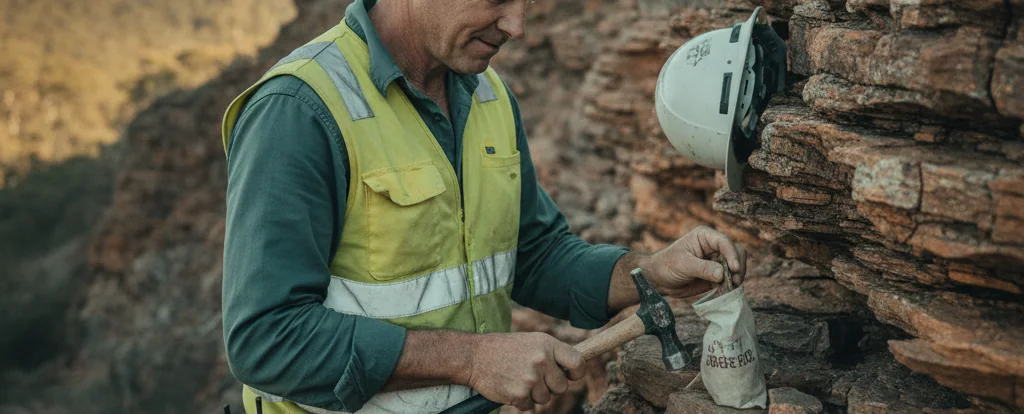
Geologists study the rock, soil and subsurface structure of the earth to work out where resources lie, how stable the ground is and what hazards it poses.
- Median salary
- $151,500
4.2%vs last year, before tax
- People employed
- 6,500
1.6%vs last year
- Projected growth
- +16.6%
to 2035
- AI exposure*
- Moderate
- automation risk
- Average hours
- 53/wk
+13h vs all jobs
- Shortage status
- In shortage
national
Geologists work in mineral and energy exploration, on mine sites, in environmental consulting and in geotechnical engineering, splitting their time between remote field work and an office or a laboratory. About 6,500 people work as geologists in Australia, and most hold a science degree with a geology major, with many adding honours or a postgraduate qualification before they sign off on a resource estimate. The role is often confused with hydrogeology, which deals specifically with groundwater rather than the full range of rock, mineral and structural work.
How much do geologists earn?
The median full-time salary for a geologist is $151,500 per annum, before tax, up $31,900 since 2018.
Pay is set by the sector and the commodity cycle. Mining and oil and gas companies generally pay more than environmental or geotechnical consulting, and a fly in, fly out roster with long swings usually carries a site allowance on top of the base salary. Registration as a professional geologist and a track record of signing off resource estimates both affect what you can command.
What does a geologist do day to day?
The list below is what fills most weeks; the exact mix shifts with seniority and whatever stage the current work is at.
- Logging drill core and chip samples at the rig, recording rock type, alteration and mineralisation as each metre comes up
- Mapping outcrops and structures in the field, then turning those notes into a geological map in ArcGIS
- Interpreting drill, seismic and geophysical data in modelling software such as Leapfrog Geo to build a three-dimensional picture of an ore body
- Writing technical reports and resource statements that meet the JORC Code, often from a site camp rather than an office
- Advising mining, energy or construction clients on ground conditions, hazards and where a resource is likely to sit
What skills do geologists need?
Employers look for field research and sampling, laboratory analysis, engineering design and analysis, backed by ArcGIS fluency and strong problem solving.
Specialist skills
- Field research and sampling
- Laboratory analysis
- Engineering design and analysis
- Environmental assessment
- Data analysis
Software and tools
- ArcGIS
- Leapfrog Geo
- Petrel
- Hand lens and geological hammer
- Core logging software
General skills
- Problem solving
- Written communication
Is the job growing?
About 6,500 people work as geologists in Australia, and employment is projected to grow 16.6% over the decade to 2035. That's healthy, above-average growth, and the role should stay in solid demand.
How do you become a geologist?
Here's the path most geologists take, step by step.
- 1Complete a science degree with a geology major
A three-year Bachelor of Science is the standard entry point, covering mineralogy, structural geology, sedimentology and geophysics. It is also the qualification you need before you can apply for professional registration.
- 2Add an honours year
A fourth year of research training is what most exploration, mining and consulting employers look for, and it is usually where you run your first independent field project from sampling through to write-up.
- 3Get field experience while you study
Vacation work with an exploration or mining company, or paid work as a field assistant or geology technician, gives you rig and camp experience before you graduate and often turns into a graduate offer.
- 4Specialise through postgraduate study if you want to
A masters in economic geology, hydrogeology or geophysics opens specialist roles. Postgraduate qualifications are common rather than required, with 38% of the current workforce holding one.
- 5Join a professional body and work towards registration
Membership of the Australian Institute of Geoscientists or AusIMM supports the documented experience you need for registration as a professional geologist, which is what clients and regulators expect when a resource estimate is signed off.
Ready to apply as a geologist?
Whether you're working toward becoming a geologist or already are one and want a hand with the next step (sharpening your resume for ATS screening, tightening your cover letter, or knowing what you'll actually be asked at interview), here are examples grounded in this specific role, not generic templates.
What jobs can a geologist move to?
None of the roles geologists typically move into pay more than the role itself. Hydrogeologist is the closest match. If a bigger salary is the goal, moving up into a senior or principal position within the role is usually the faster route than moving sideways.
| Move to | Typical pay change | Overlap | Retraining |
|---|---|---|---|
| Hydrogeologist Specialises in groundwater flow and aquifer assessment, using geological skills with further study in hydrogeology.Known move | +$0 | 61% | reskill |
| Geophysicist Interprets subsurface measurements and earth structure, moving into geophysics with additional training in geophysical methods.Known move | +$0 | 42% | reskill |
| Geotechnical Engineer Applies geological knowledge to ground investigation and slope stability, moving into geotechnical engineering, which usually requires an engineering qualification.Known move | −$36,200 | 28% | requalify |
| Environmental Scientist Applies earth science to environmental assessment and remediation, though a qualification in environmental science is typically required.Known move | −$49,900 | 67% | requalify |
Moves are chosen from Jobs and Skills Australia's Data on Occupation Mobility, which follows income tax records between 2011-12 and 2020-21, together with entry requirements and skill overlap. A known move is one people were seen making in that data. Pay change compares median full-time pay for the two roles.
Who works as a geologist?
The typical geologist is 40 years old; 74% are men, 83% work full-time, and full-timers average 53 hours a week.
- 40
- Median age
- 26%
- Female share
- 83%
- Full-time
- +13h
- vs all-jobs avg
What's it like being a geologist?
The job runs on field rotations. Geologists typically spend a block of weeks on a remote site or drill program, working long days and living in a camp, then return to an office or a home roster to interpret what they collected. Full-time geologists average 53 hours a week, and a field rotation stretches that further, so the work suits people who like solving a puzzle from incomplete evidence and do not mind being away from home.
What people like
- The field work is the job, not an add-on. Mapping an outcrop, reading a face of drill core or watching a hole come up gives you evidence no desk can supply, and the best days are spent outside working it out on the ground.
- You build a picture from scattered clues. A handful of samples, a geophysical image and a structural measurement have to add up to a story about what lies under the surface, and testing that story is the intellectual core of the work.
- Your interpretation feeds real decisions. When a drill hole confirms a target you picked, or a resource estimate you helped build is used to plan a mine, you can point to the consequence of your work.
- The setting changes with the project. One month you are in a Pilbara camp, the next you are at a desk in Perth or Brisbane running models, which suits people who find one location tedious.
What people find hard
- Long swings away from home. Fly in, fly out rosters and remote exploration programs mean weeks in a camp at a time, and the distance from family and friends is the part people find hardest to sustain long term.
- Exploration budgets follow the commodity cycle. When prices fall, exploration is one of the first budgets cut, so hiring slows and contracts end, then picks up again when prices recover. Job security depends on the cycle as much as on your performance.
- Reporting and data housekeeping. Resource statements that satisfy the JORC Code, drilling databases and validation checks take a substantial share of the week, and the work is detailed and unforgiving of errors.
- The physical conditions are rough. Heat, dust, mud and long days on your feet are routine in the field, and remote sites sit far from medical care or anything resembling a normal weekend.
Based on our synthesis of professional-body surveys and public accounts of the role, not first-person verified reviews.
Which industries employ geologists?
Mining employs the largest share of geologists, followed by Professional, Scientific and Technical Services.
Top employing industries
- 1Mining
- 2Professional, Scientific and Technical Services
Ranked by employment share; the source doesn't publish an exact percentage per industry.
| Bachelor degree | 58.6% | |
|---|---|---|
| Postgraduate | 37.6% | |
| Year 12 or below | 1.5% | |
| Diploma / Advanced Diploma | 1.1% | |
| Certificate III/IV | 0.4% |
Will AI replace geologists?
Geology sits in the middle. The data-heavy parts of the job, modelling, interpolation and the first pass over drill and geophysical results, are increasingly handled by software and machine learning, while the fieldwork and the call on what a deposit is worth stay with the geologist. Automated core scanning and remote sensing cut the time spent on routine description, but someone still has to interpret the numbers and sign off on the resource estimate.
Share of typical working time by exposure level
- Building and updating geological modelsLeapfrog Geo and similar packages do the interpolation and implicit modelling, so the work shifts towards choosing the inputs, testing domaining assumptions and checking the result against the drilling.30%high
- Field mapping and samplingWalking an outcrop with a hand lens and hammer, taking structural measurements and bagging samples still depends on being there and knowing what you are looking at.25%low
- Logging drill core and chip samplesHyperspectral scanners and core photography now record colour, alteration and mineralogy automatically, but a geologist still decides what the logged intervals mean for the model.25%moderate
- Writing resource statements and technical reportsDrafting tools speed up the write-up and data tables, but the JORC Code requires a named competent person to stand behind the figures and the reasoning.20%moderate
Common questions about becoming a geologist
Straight answers to the questions people ask most.
How much do geologists earn in Australia?
Geologists earn a median of $151,500 per year before tax. Mining, oil and gas roles generally sit above that figure, and consulting, government and environmental work often below it, with site allowances adding to remote rosters.
How do you become a geologist in Australia?
Start with a Bachelor of Science majoring in geology, then add an honours year, which most employers expect. Field work as a vacation student or field assistant gives you the camp and rig experience that makes a graduate application competitive.
Are geologists in demand in Australia?
Geologists are currently in shortage nationally, and employment is projected to grow 16.6% over the decade to 2035 over the decade. Because hiring moves with commodity prices and exploration budgets, it is worth checking which commodities and regions are active before you commit to a specialisation.
Will AI replace geologists?
Not the field or the judgement, but it is changing how the data is handled. Machine learning and automated core scanning speed up the first pass over drill and geophysical results, and modelling software does more of the interpolation that was once manual, yet someone still has to decide what a deposit is worth and sign off on the estimate.
What jobs can a geologist move into?
Hydrogeology is a common move, using the same geological base with further study in groundwater and pay that is about the same. Geotechnical engineering suits geologists drawn to ground conditions and slope stability, though it usually means completing an engineering qualification and typically $36,200 less in pay. Environmental science and geophysics are other directions with overlapping skills.
Do geologists have to work fly in, fly out?
Some do, particularly in exploration and mine geology, where rosters of two weeks on and one or two weeks off are common. Consulting, government and office-based modelling roles are usually residential, and many geologists move towards those as they get older.
Related roles
Not sure this is you? Take the career quiz and get a ranked shortlist of roles that fit how you like to work.