Handyman
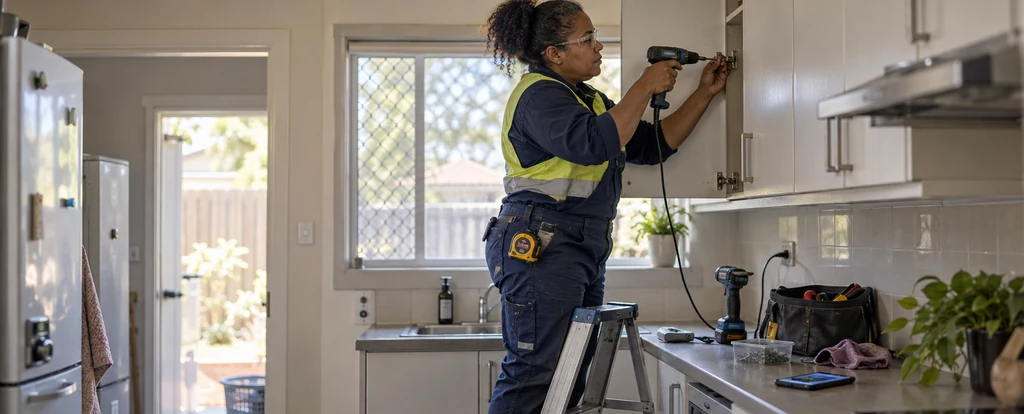
A handyman carries out the repairs and general maintenance that keep homes and small commercial properties in working order.
- Median salary
- $80,000
4.2%vs last year, before tax
- People employed
- 43,400
0.9%vs last year
- Projected growth
- +7.8%
to 2035
- AI exposure*
- Low
- automation risk
- Average hours
- 42/wk
+2h vs all jobs
- Shortage status*
- Not in shortage
national
Handymen work on residential and small commercial properties, doing short jobs for homeowners, real estate agents and property managers. The work covers carpentry, painting, tiling and minor installations, which is what separates it from the licensed trades: electrical and plumbing work has to go to a licensed electrician or plumber. A handyman often arranges those trades and then makes good after they have finished.
How much do handymans earn?
The median full-time salary for a handyman is $80,000 per annum, before tax, up $16,800 since 2018.
How much you earn depends heavily on whether you work for someone else or run your own business, since most handymen are sole traders who set their own rates and carry their own costs. Employees usually work under an award or enterprise agreement, with penalty rates for weekend call-outs that matter because urgent repairs often fall outside ordinary hours. Insurance work, real estate maintenance contracts and commercial clients tend to provide steadier income than one-off domestic jobs.
What does a handyman do day to day?
The list below is what fills most weeks; the exact mix shifts with seniority and whatever stage the current work is at.
- Repairing and maintaining doors, windows, locks and cabinetry
- Installing shelving, fixtures, fittings and appliances
- Patching, sanding and painting interior and exterior surfaces
- Assembling flat-pack furniture, equipment and outdoor structures
- Inspecting rental properties between tenancies and reporting defects to the owner or property manager
What skills do handymans need?
Employers look for hand and power tool work, installation and maintenance, worksite safety management, backed by ServiceM8 fluency and strong attention to detail.
Specialist skills
- Hand and power tool work
- Installation and maintenance
- Worksite safety management
- Quoting and estimating
Software and tools
- ServiceM8
- Tradify
- AroFlo
- Xero
General skills
- Attention to detail
- Problem solving
- Customer service
- Time and deadline management
Is the job growing?
About 43,400 people work as handymans in Australia, and employment is projected to grow 7.8% over the decade to 2035. That's modest growth: demand is steady rather than booming.
How do you become a handyman?
Here's the path most handymans take, step by step.
- 1Start with the practical skills you already have
Many handymen come from labouring, gardening, caretaking or property maintenance, where they picked up tool use and basic repairs on the job. If you are starting from scratch, a pre-apprenticeship or short TAFE course in building maintenance gives you a feel for the work before you commit to it.
- 2Get a qualification if you want one
There is no single handyman qualification. The most common credential among people already doing the work is a Certificate III/IV, held by about 39% of them, while a similar share learned on the job without a formal trade certificate. A Certificate III in a trade such as carpentry, or a Certificate IV in building and construction, is the usual formal background for those who have one.
- 3Sort out licences, clearances and insurance
A White Card is needed to work on construction sites, and a driver's licence matters because the job is mostly driving between small jobs. Real estate and commercial clients often ask for a police check, and if you work for yourself you will need public liability insurance and an ABN.
- 4Spend a few years with an employer or a franchise
Working for a property maintenance company, a retirement village or a franchise gives you paid experience, a steady supply of jobs and someone else handling the quoting and admin. It also shows you which jobs you are good at and which you would rather pass on.
- 5Decide whether to go out on your own
Most experienced handymen end up as sole traders, setting their own rates and choosing their own work. That step needs insurance, a booking system and enough local reputation to keep the calendar full, so it is easier after a few years of repeat clients.
Ready to apply as a handyman?
Whether you're working toward becoming a handyman or already are one and want a hand with the next step (sharpening your resume for ATS screening, tightening your cover letter, or knowing what you'll actually be asked at interview), here are examples grounded in this specific role, not generic templates.
What jobs can a handyman move to?
Moving into Maintenance Planner typically comes with the biggest pay rise, worth $19,800 a year more on average.
| Move to | Typical pay change | Overlap | Retraining |
|---|---|---|---|
| Maintenance Planner Maintenance planning uses handyman's practical knowledge, but requires reskilling in scheduling and coordination.Known move | +$19,800 | 3% | reskill |
| Carpenter Carpentry offers higher pay and uses handyman's construction skills, but a full apprenticeship is required.Known move | +$11,500 | 40% | requalify |
| Caretaker Handyman repair and maintenance skills transfer directly to caretaking, with some additional training in building systems.Known move | −$8,100 | 29% | reskill |
| Landscaper Landscaping builds on handyman's outdoor construction and planting skills, requiring a short course in landscape design.Known move | −$15,000 | 61% | short course |
| Gardener Handyman's tool skills and outdoor maintenance experience suit gardening work, though formal horticulture study may be needed.Known move | −$20,200 | 39% | reskill |
Moves are chosen from Jobs and Skills Australia's Data on Occupation Mobility, which follows income tax records between 2011-12 and 2020-21, together with entry requirements and skill overlap. A known move is one people were seen making in that data. Pay change compares median full-time pay for the two roles.
Who works as a handyman?
The typical handyman is 53 years old; 95% are men, 58% work full-time, and full-timers average 42 hours a week.
- 53
- Median age
- 5%
- Female share
- 58%
- Full-time
- +2h
- vs all-jobs avg
What's it like being a handyman?
The week is a run of short jobs, usually an hour or two each, with time in the van between them and quoting done in the evening. The pressure comes from jobs that turn out bigger than the quote, customers who want a fixed price before you have seen the problem, and the physical toll of ladders, kneeling and lifting. It suits people who like variety, prefer working alone and get satisfaction from finishing something visible in a single visit.
What people like
- A different job most days. One morning is a broken lock, the afternoon a flat-pack wardrobe and a patch of ceiling, which suits people who lose interest in repetition.
- You can see what you fixed. The result is visible at the end of the job, and the customer usually says so before you pack up.
- Working on your own. Most handymen work alone or with one offsider, setting their own pace and deciding which jobs to take on.
- Repeat clients build up. A good local reputation brings the same landlords and homeowners back, which means less time chasing new work.
What people find hard
- Quoting eats unpaid hours. You price jobs in the evening, and plenty of quotes never turn into work, especially when a cheaper quote wins on price alone.
- Jobs that grow once you start. Water damage behind a wall or a previous owner's shortcut can turn a two-hour job into two days, and customers do not always accept the revised cost easily.
- Travel and weather. Days are often spent driving between jobs that each take an hour, and outdoor work stops in heavy rain.
- It is hard on the body. Ladders, kneeling under sinks and lifting sheet material add up over a career, so technique and decent tools matter more than they seem to.
Based on our synthesis of professional-body surveys and public accounts of the role, not first-person verified reviews.
Which industries employ handymans?
Construction employs the largest share of handymans, followed by Accommodation and Food Services.
Top employing industries
- 1Construction
- 2Accommodation and Food Services
- 3Administrative and Support Services
Ranked by employment share; the source doesn't publish an exact percentage per industry.
| Certificate III/IV | 38.8% | |
|---|---|---|
| Year 12 or below | 38.6% | |
| Diploma / Advanced Diploma | 8.7% | |
| Bachelor degree | 7% | |
| Postgraduate | 2.1% |
Will AI replace handymans?
Handyman work has low exposure to AI and automation because almost all of it is physical and happens inside someone else's home. Quoting, invoicing and scheduling software is already part of the job, and AI makes those tasks quicker, but nothing on the market can assess a leaking shower recess or hang a door. The bigger influences on the work are material costs, how many households are renovating and how much repair the existing housing stock needs.
Share of typical working time by exposure level
- Hands-on repairs and installationsHanging doors, replacing tap washers, patching plaster and assembling furniture all need a person at the property with tools, and no current technology does that in an occupied home.50%low
- Working out what is actually wrongPhotos and video calls can give a rough idea before you arrive, but the real answer usually appears only once the wall is open or the fitting is off.25%moderate
- Quoting and booking jobsTools such as Tradify and AroFlo speed up quotes and scheduling, though the price still comes down to what you see when you get there.15%moderate
- Invoicing, receipts and adminSoftware can generate invoices, chase payment and reconcile the accounts, which is the most automatable part of the week.10%high
Common questions about becoming a handyman
Straight answers to the questions people ask most.
How much does a handyman earn?
$80,000 per year before tax is the median for full-time handymen, so half earn more and half less. Sole traders can set higher hourly rates but carry their own insurance, vehicle and tool costs, while employees often get penalty rates for after-hours call-outs and steadier work through a maintenance contract.
How do I become a handyman?
There is no single qualification for handyman work, though many people enter with a Certificate III in a trade or a Certificate IV in building and construction (CPC40120), and others learn on the job after labouring or gardening work. A White Card, a driver's licence and a police check cover most of the formal requirements. If you plan to work for yourself, you will also need public liability insurance and an ABN.
Are handymen in demand?
Handymen are currently not in shortage, and employment is projected to grow 7.8% over the decade to 2035. Most of the work comes from existing homes needing repair and upkeep, so demand tends to follow population growth and the age of the housing stock more than the new-build cycle.
Will AI replace handymen?
The physical work is hard to automate, so AI mostly changes the paperwork around the job. Quoting and job management software such as ServiceM8, Tradify and AroFlo can help draft quotes and schedule work from photos and notes, which saves time but does not do the repair. Judging what is actually wrong on site, and getting the customer's agreement to have you in their home, still comes down to the person standing there.
Do I need a licence to work as a handyman?
It depends on the state and the type of work. Electrical and plumbing work must go to a licensed electrician or plumber in every state, and some states require a building or tradesperson licence once a job passes a set value. Check the rules with the building authority in your state before quoting on larger jobs.
What other jobs can a handyman move into?
Maintenance planning and caretaking are common moves because both use the same practical knowledge of buildings and repairs. Maintenance planners earn about $19,800 more than handymen, with reskilling in scheduling and coordination software, while caretaking pays about $8,100 less than handyman work and often comes with set hours or on-site accommodation. Many handymen instead stay on the tools and build their own business, which is often where earnings grow.
Related roles
Not sure this is you? Take the career quiz and get a ranked shortlist of roles that fit how you like to work.