Builder's Labourer
Builder's labourers do the physical work that keeps a construction site moving, from preparing ground and mixing concrete to moving materials and clearing up after the trades.
- Median salary*
- $65,000
4.0%vs last year, before tax
- People employed
- 42,300
0.7%vs last year
- Projected growth
- +6.4%
to 2035
- AI exposure*
- Low
- automation risk
- Average hours
- 44/wk
+4h vs all jobs
- Shortage status*
- In shortage
national
Builder's labourers work on residential, commercial and civil sites, usually as part of a crew alongside carpenters, bricklayers and concreters. The role carries no trade qualification of its own, which is what separates it from a carpenter or a concreter, so most of what a new starter learns comes from the site and the people on it. About 42,300 people work as builder's labourers across residential builders, subcontractors and labour hire firms, and the work is outdoors in all weather.
How much do builder's labourers earn?
The median full-time salary for a builder's labourer is $65,000 per annum, before tax, up $13,600 since 2018.
Most sites pay under the Building and Construction General On-site Award, though large commercial and infrastructure projects often set higher rates through enterprise agreements. Casual loading, overtime, travel and site allowances can add a lot to a week's earnings, which is why casual labourers sometimes take home more than permanent ones in a busy period. Rates also vary by state and by whether the project is residential, commercial or civil.
What does a builder's labourer do day to day?
The list below is what fills most weeks; the exact mix shifts with seniority and whatever stage the current work is at.
- Loading and unloading materials from deliveries and moving them to where the trades need them
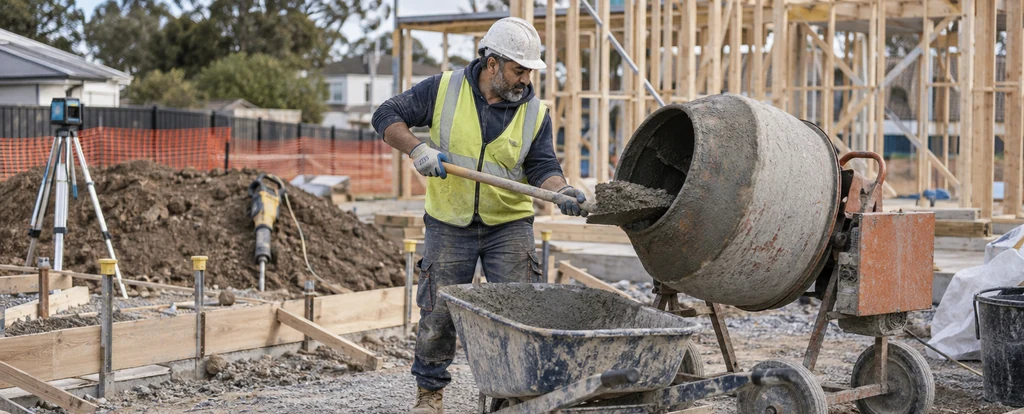
- Mixing and pouring concrete for footings, slabs and paths
- Digging trenches and footings by hand where a machine cannot reach
- Keeping the site clear, swept and safe, including fencing and signage
- Cutting and preparing timber, formwork and other materials, and handing tools up to the trades
What skills do builder's labourers need?
Employers look for hand and power tool work, worksite safety management, plant and equipment operation, backed by Concrete mixer fluency and strong physical stamina and dexterity.
Specialist skills
- Hand and power tool work
- Worksite safety management
- Plant and equipment operation
- Cleaning and grounds maintenance
- Installation and maintenance
- Inventory management
Software and tools
- Concrete mixer
- Jackhammer
- Wheelbarrow
- Laser level
General skills
- Physical stamina and dexterity
Is the job growing?
About 42,300 people work as builder's labourers in Australia, and employment is projected to grow 6.4% over the decade to 2035. That's modest growth: demand is steady rather than booming.
How do you become a builder's labourer?
Here's the path most builder's labourers take, step by step.
- 1Get your White Card
General construction induction training is required before you can work on a site anywhere in Australia, and the course usually takes about a day with a registered training organisation. The card itself is issued through the state or territory work health and safety regulator, so the process differs slightly depending on where you live.
- 2Start through labour hire or a builder's crew
Most labourers get their first job without a qualification, through a labour hire firm, a subcontractor or a builder they already know. Employers look for reliability, physical fitness and a clean safety record more than study, so turning up on time and lasting a full project counts for a lot.
- 3Add licences and qualifications that widen your options
Traffic control certification, working at heights and confined space courses, or a forklift or excavator licence open up more work and better rates on civil and commercial sites. These courses usually run for one or two days, and many employers will pay for them once you are established.
- 4Consider an apprenticeship if you want a trade
A Certificate III in Carpentry (CPC30220), Concreting or Bricklaying takes three to four years, is paid, and moves you from labouring rates to trade rates. Site experience helps you win a placement, and mature-age apprentices are common in construction.
- 5Move into supervision later
A diploma in building and construction, plus a builder's licence in your state, is the usual route into leading hand, site supervisor or construction manager roles. That step needs several years on site first, and licensing requirements vary by state.
Ready to apply as a builder's labourer?
Whether you're working toward becoming a builder's labourer or already are one and want a hand with the next step (sharpening your resume for ATS screening, tightening your cover letter, or knowing what you'll actually be asked at interview), here are examples grounded in this specific role, not generic templates.
What jobs can a builder's labourer move to?
Moving into Construction Manager typically comes with the biggest pay rise, worth $130,100 a year more on average.
| Move to | Typical pay change | Overlap | Retraining |
|---|---|---|---|
| Construction Manager Builder's labourers can progress to construction management, using site knowledge, but need a diploma in building and construction.Known move | +$130,100 | 9% | reskill |
| Concreter Builder's labourers bring formwork and pour experience to concreting, though formal trade training is required for certification.Known move | +$49,900 | 37% | reskill |
| Truck Driver Builder's labourers bring site fitness and load handling to truck driving, but need a heavy vehicle licence and on-road training.Known move | +$36,900 | 11% | reskill |
| Carpenter Builder's labourers bring material handling and site awareness to carpentry, but need a full apprenticeship to gain trade certification.Known move | +$26,500 | 19% | requalify |
| Civil Construction Labourer General labouring skills transfer directly to civil construction, with a short course adding traffic control and trenching tickets.Known move | +$2,600 | 57% | short course |
Moves are chosen from Jobs and Skills Australia's Data on Occupation Mobility, which follows income tax records between 2011-12 and 2020-21, together with entry requirements and skill overlap. A known move is one people were seen making in that data. Pay change compares median full-time pay for the two roles.
Who works as a builder's labourer?
The typical builder's labourer is 34 years old; 96% are men, 73% work full-time, and full-timers average 44 hours a week.
- 34
- Median age
- 4%
- Female share
- 73%
- Full-time
- +4h
- vs all-jobs avg
What's it like being a builder's labourer?
The job runs on a site timetable: an early start, a smoko break, and a day organised around whatever the trades need next. Full-time builder's labourers average about 44 hours a week, and overtime picks up when a pour or a deadline is close. It suits people who like working with their hands and do not mind being hot, dirty or wet by the end of the day.
What people like
- Progress you can see by knock-off. A day's labouring leaves a visible mark, whether that is a backfilled trench, a poured slab or a floor cleared and ready for the next trade.
- A way onto a site without a qualification. A White Card and a reliable pair of hands is often enough to start, which makes this one of the few entry points into construction that does not need years of study first.
- Work that keeps you physically fit. The job is manual by design, so labourers who stay with it tend to be strong and comfortable being on their feet all day.
- A clear route into a trade. Site experience and a reference from a builder can help you win a carpentry or concreting apprenticeship, and you get paid while you work out what you want to do.
What people find hard
- Weather stops work. Concrete cannot be poured in heavy rain and extreme heat slows everything down, so a wet week can mean lost hours and lost pay on a casual arrangement.
- The physical toll adds up. Repetitive lifting, wheelbarrow loads and jackhammer work wear on backs, knees and shoulders over a career, so technique and the right gear matter more than they seem to.
- Work moves with the project. Much of the work is casual or tied to a single build, so when a job finishes you may be looking for the next crew to join.
- Early starts and long commutes. Sites often start before 7am and move around the city, which can mean travelling a long way to a job that only lasts a few months.
Based on our synthesis of professional-body surveys and public accounts of the role, not first-person verified reviews.
Which industries employ builder's labourers?
Construction employs the largest share of builder's labourers.
Top employing industries
- 1Construction
Ranked by employment share; the source doesn't publish an exact percentage per industry.
| Year 12 or below | 55.4% | |
|---|---|---|
| Certificate III/IV | 28.1% | |
| Bachelor degree | 5.7% | |
| Diploma / Advanced Diploma | 5.2% | |
| Postgraduate | 1.1% |
Will AI replace builder's labourers?
Builder's labouring sits at the low end of AI exposure, because the work is physical and happens in a place that is different every day. Machines have taken over some of the heaviest digging and lifting, and site apps now handle delivery dockets, inductions and sign-in, but someone still has to shovel, mix, carry and clean. Those changes alter the pace of the job more than they alter who does it.
Share of typical working time by exposure level
- Mixing and pouring concreteScreeding machines and pump trucks speed up large pours, but barrowing, formwork and finishing around a house slab are still done by hand.30%low
- Moving and stacking materialsForklifts and telehandlers do the heavy lifting where there is room, but a tight site or an upper floor usually means carrying it in.25%low
- Sign-in, deliveries and site recordsDelivery tracking, induction records and daily site reports increasingly run through site management apps, which cuts the clipboard work but not the unloading.25%high
- Digging and trenchingGPS-guided excavators handle the bulk of the digging and setting out, though a labourer still works a shovel in the corners and around existing services.20%moderate
Common questions about becoming a builder's labourer
Straight answers to the questions people ask most.
How much do builder's labourers earn?
The median for full-time builder's labourers is $65,000 per year before tax. Casual loading, overtime and site allowances can lift that, and large commercial projects under enterprise agreements pay more than small residential jobs.
How do you become a builder's labourer?
You need a White Card before you can set foot on a site, and for most jobs that is the only formal requirement. Labour hire firms and builders hire on reliability and fitness, so a current card, a driver's licence and a couple of contacts on site do most of the work. A Certificate II in Construction (CPC20120) is a common starting point for school leavers who want some training behind them first.
Are builder's labourers in demand?
Builder's labourers are currently in shortage nationally. Employment across the occupation is projected to grow 6.4% over the decade to 2035, and the work itself starts and finishes with individual projects rather than following a set calendar. Labour hire firms and word of mouth on site fill most vacancies, so an up-to-date White Card and a good reference matter more than a formal qualification.
Will AI replace builder's labourers?
Not in the near term, because this is one of the least exposed jobs on a construction site and most of it happens in a physical place that changes every day. Site management apps have taken over delivery dockets and sign-in sheets, and GPS-guided excavators do more of the setting out, but shovelling, mixing, carrying and cleaning are still done by hand.
What can a builder's labourer move into?
Civil construction labouring is a close match, since general site skills carry across and the pay is $2,600 more, with a short traffic control or trenching course covering the difference. An apprenticeship in carpentry or concreting leads to trade rates, and a diploma in building and construction opens the way into site supervision. Going out on your own usually comes after a trade qualification rather than straight from labouring.
Do you need a licence to work as a builder's labourer?
The White Card is required for construction work in every state and territory, and it is issued after a short general construction induction course. Beyond that, licences are only needed for particular tasks, such as a forklift licence to operate one, a high risk work licence for rigging or scaffolding, or traffic control certification to work on roads. Which card or course applies varies slightly by state, so check with your state work health and safety regulator.
Related roles
- Carpenter
- Truck Driver
- Civil Construction Labourer
- Concreter
- Construction Manager
- Civil Construction Labourer
Not sure this is you? Take the career quiz and get a ranked shortlist of roles that fit how you like to work.