Leaflet Distributor
Leaflet distributors deliver printed flyers, catalogues and brochures to homes and businesses on set rounds, which is how many local retailers and real estate agencies reach a suburb.
- Median salary*
- $49,900
3.5%vs last year, before tax
- People employed
- 3,400
0.0%vs last year
- Projected growth
- +4.2%
to 2035
- AI exposure*
- High
- automation risk
- Average hours
- 38/wk
−2h vs all jobs
- Shortage status*
- Not in shortage
national
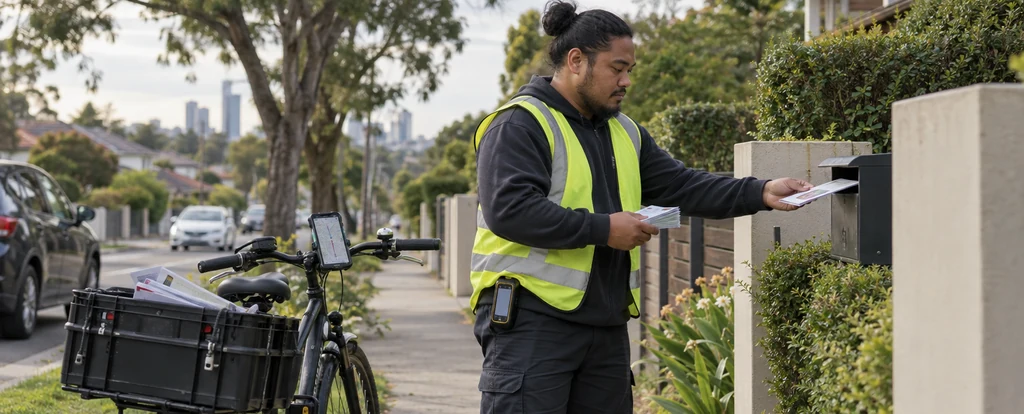
The work happens outdoors, on foot, by bicycle or from a car, usually in the early morning or late afternoon when letterboxes are clear. Most leaflet distributors are casual or part-time and paid per thousand leaflets delivered, and hiring usually runs through the distribution companies that retailers, real estate agencies and councils contract. It sits close to postal and delivery work, but the round is unaddressed advertising rather than mail, and no licence is needed for the job itself.
How much do leaflet distributors earn?
The median full-time salary for a leaflet distributor is $49,900 per annum, before tax, up $10,600 since 2018.
Pay is commonly set per thousand leaflets delivered, so a quiet campaign period or a new estate with long gaps between letterboxes lowers a week's earnings in a way an hourly rate would not. Casual employees receive a casual loading and penalty rates for weekend rounds, while subcontractors set their own rate and carry their own costs, including fuel on a driven round. For the same per-leaflet rate, a dense suburban round pays better per hour than acreage or rural areas.
What does a leaflet distributor do day to day?
The list below is what fills most weeks; the exact mix shifts with seniority and whatever stage the current work is at.
- Sorting leaflets and catalogues into bundles matched to each street
- Planning a route through the suburb, often with a route app on a phone
- Walking, cycling or driving the round and dropping material into letterboxes
- Recording completed drops with GPS-tagged photos or an in-app check-off
- Reporting missed streets, locked gates or problem letterboxes to the coordinator
What skills do leaflet distributors need?
Employers look for driving and transport operations, operations management, backed by Google Maps fluency and strong attention to detail.
Specialist skills
- Driving and transport operations
- Operations management
Software and tools
- Google Maps
- Route4Me
- Zeo Route Planner
- hand trolley
- bicycle
General skills
- Attention to detail
- Physical stamina and dexterity
- Customer service
- Time and deadline management
Is the job growing?
About 3,400 people work as leaflet distributors in Australia, and employment is projected to grow 4.2% over the decade to 2035. That's modest growth: demand is steady rather than booming.
How do you become a leaflet distributor?
Here's the path most leaflet distributors take, step by step.
- 1Apply to a distribution company
Most hiring goes through firms that hold the contracts for leaflet campaigns, and there are no formal entry requirements. Employers look for reliability across a whole round, physical fitness and availability in the early morning or late afternoon, and some councils and agencies hire distributors directly.
- 2Work out whether you are an employee or a subcontractor
Many distributors are engaged as subcontractors paid per thousand leaflets, which means invoicing the company and handling your own tax and super. Ask which arrangement applies before you start, because it changes your pay, insurance and leave.
- 3Sort out how you will cover the round
Walking rounds need little more than a hand trolley, and cycling rounds need panniers or a trailer. A driven round requires a current driver's licence and a registered vehicle, though the job itself has no licensing requirement.
- 4Learn the route tools and record-keeping
Companies issue their own app or use tools such as Zeo Route Planner and Route4Me to sequence streets and estimate times, and you will photograph or check off drops as proof of delivery. Getting comfortable with the app matters as much as knowing the streets.
- 5Build a record of complete rounds
Companies spot-check drops and track complaints, so consistent complete rounds lead to more work and better-paying areas. A good record is what turns casual rounds into a regular run.
Ready to apply as a leaflet distributor?
Whether you're working toward becoming a leaflet distributor or already are one and want a hand with the next step (sharpening your resume for ATS screening, tightening your cover letter, or knowing what you'll actually be asked at interview), here are examples grounded in this specific role, not generic templates.
What jobs can a leaflet distributor move to?
Moving into Delivery Driver typically comes with the biggest pay rise, worth $18,100 a year more on average.
| Move to | Typical pay change | Overlap | Retraining |
|---|---|---|---|
| Delivery Driver Delivering leaflets builds local route knowledge and reliable drop-off habits that carry into delivery driving, though a licence and vehicle are needed.Known move | +$18,100 | 40% | reskill |
| Retail Assistant Local area knowledge and dependable customer contact carry into retail assistant work, where sales and till training build on that experience.Known move | +$14,600 | 11% | reskill |
| Postal Delivery Officer Sorting and delivering leaflets on set rounds transfers directly to postal delivery work, with only minimal training in mail handling and equipment. | +$9,900 | 91% | minimal |
| Chauffeur Safe driving and punctual route completion transfer to chauffeur work, with a passenger licence and presentation standards adding to the role. | +$7,300 | 75% | short course |
| Taxi Driver Navigating neighbourhoods and handling deliveries prepares leaflet distributors for taxi driving, which needs passenger transport accreditation and local knowledge. | +$4,700 | 62% | short course |
Moves are chosen from Jobs and Skills Australia's Data on Occupation Mobility, which follows income tax records between 2011-12 and 2020-21, together with entry requirements and skill overlap. A known move is one people were seen making in that data. Pay change compares median full-time pay for the two roles.
Who works as a leaflet distributor?
The typical leaflet distributor is 41 years old; 62% are men, 6% work full-time, and full-timers average 38 hours a week.
- 41
- Median age
- 38%
- Female share
- 6%
- Full-time
- −2h
- vs all-jobs avg
What's it like being a leaflet distributor?
The job has a simple rhythm: collect the bundles, work the round, finish and report. It suits people who like being outdoors and moving, and who are content to work alone with a clear task and an early finish, but the pay is unpredictable from week to week and the round has to be finished whatever the weather does.
What people like
- Outdoors and physically active. The whole shift is spent walking, cycling or driving through streets rather than sitting at a desk, which is the main appeal for many people who take the work.
- Early finish and your own pace. A morning round is often done by lunchtime, and once you know the streets you can set a steady pace and get through it without supervision.
- Low barrier to entry. There are no qualifications or licences to arrange, so work can start within days for someone who needs income quickly or wants something to fit around study.
- You learn an area properly. Knowing the streets, the drop-off points and the fastest way between them is useful in delivery driving, postal work and any role that covers a local area.
What people find hard
- Earnings follow leaflet volume. Quiet campaign periods, public holidays and wet weeks all cut the number of leaflets available, and a slow month shows up directly in your pay.
- Weather, dogs and blocked letterboxes. Rounds run in heat, rain and wind, and wet leaflets or an unfriendly dog at the gate can slow a street considerably.
- Repetitive and solitary. You cover the same streets on a loop with little contact with anyone, which wears on people who prefer variety or company at work.
- Admin falls on you as a contractor. Subcontractors handle their own invoicing, tax, super and insurance, and there is no paid leave when a round is missed because you are sick.
Based on our synthesis of professional-body surveys and public accounts of the role, not first-person verified reviews.
Which industries employ leaflet distributors?
Transport, Postal and Warehousing employs the largest share of leaflet distributors, followed by Professional, Scientific and Technical Services.
Top employing industries
- 1Transport, Postal and Warehousing
- 2Professional, Scientific and Technical Services
- 3Manufacturing
Ranked by employment share; the source doesn't publish an exact percentage per industry.
| Year 12 or below | 60.9% | |
|---|---|---|
| Certificate III/IV | 13.3% | |
| Bachelor degree | 9.7% | |
| Diploma / Advanced Diploma | 6.5% | |
| Postgraduate | 4.2% |
Will AI replace leaflet distributors?
Leaflet distribution is highly exposed to AI and digital change, because the printed advertising it carries is shifting to digital channels and the coordinating parts of the job have already been automated. Route planning, drop tracking and proof of delivery now run through apps such as Zeo Route Planner and Route4Me, and companies can measure a round without a supervisor on the street. What stays manual is the physical delivery: walking the round, clearing letterboxes and sorting bundles.
Share of typical working time by exposure level
- Walking or riding the round and dropping leafletsWeather, dogs, locked gates and no junk mail signs all still need a person to judge them on the spot.45%low
- Sorting and bundling leaflets for each runBundles are counted and matched to individual streets so that each round can be completed in one pass.20%low
- Planning the route for a runRoute apps sequence streets and estimate walking times, so most of the planning is software-driven rather than learned by hand.20%high
- Recording drops and reporting completionGPS-tagged photos and in-app check-offs have replaced paper delivery sheets for most distribution companies.15%high
Common questions about becoming a leaflet distributor
Straight answers to the questions people ask most.
How much do leaflet distributors earn?
A leaflet distributor earns a median of $49,900 per year before tax, and many work casually or part-time, so actual earnings depend on how many leaflets they get through. Pay is commonly set per thousand leaflets, which means a dense suburban round pays better per hour than a spread-out one.
How do you become a leaflet distributor?
There are no formal entry requirements, and most people start by applying to a distribution company that holds the contracts for local campaigns. You will usually need to be physically fit, reliable across a whole round and available in the early morning or late afternoon. If you take the work as a subcontractor, you will also need an ABN.
Are leaflet distributors in demand?
Leaflet distributors are currently not in shortage, and employment is projected to grow 4.2% over the decade to 2035. Work is concentrated in the companies that hold the distribution contracts, so openings appear where those firms win campaigns rather than evenly across the country.
Will AI replace leaflet distributors?
The digital parts of the job are already automated, with route sequencing, drop tracking and proof-of-delivery records handled by apps. Someone still has to walk the round, but the printed campaigns themselves increasingly compete with digital advertising for the same marketing budgets.
What can a leaflet distributor move into?
Delivery driving is one route onward and pays $18,100 more, making use of the same local route knowledge, though a licence and vehicle are needed. Postal delivery work overlaps closely with leaflet rounds, sharing 91% of its tasks, and pays $9,900 more. Many experienced distributors stay in the field by taking on more rounds as subcontractors or building their own distribution business, and that is usually where earnings grow.
Do you need a licence to deliver leaflets?
No licence is required for the job itself, and walking or cycling rounds need nothing beyond a hand trolley or bike panniers. A driven round does require a current driver's licence and a registered vehicle, and moving into taxi or chauffeur work later means passenger transport accreditation through your state transport authority.
Related roles
Not sure this is you? Take the career quiz and get a ranked shortlist of roles that fit how you like to work.