Logging Plant Operator
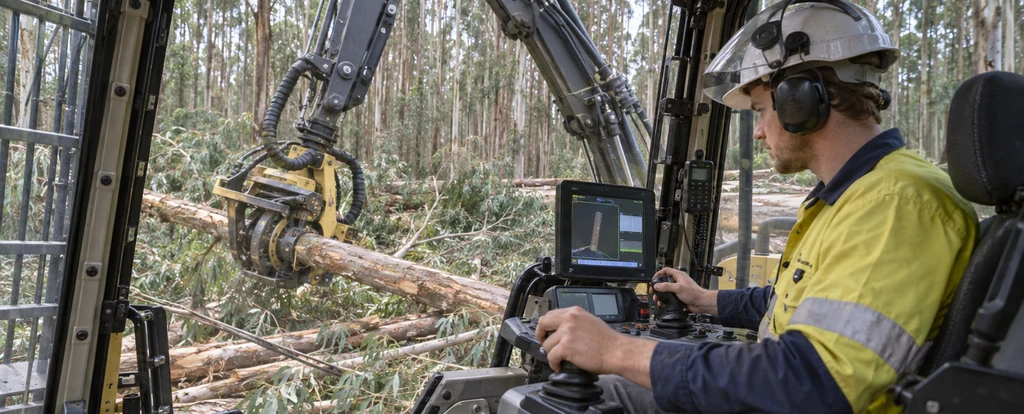
Logging plant operators run the harvesters, forwarders and skidders that cut trees and move timber out of the forest to sawmills and wood product manufacturers.
- Median salary*
- $75,400
3.9%vs last year, before tax
- People employed
- 1,200
0.0%vs last year
- Projected growth
- +4%
to 2035
- AI exposure*
- Low
- automation risk
- Average hours
- 52/wk
+12h vs all jobs
- Shortage status
- Not in shortage
national
The work happens in plantation and native forests, mostly in regional Australia, and operators spend their shift inside a machine cab rather than on the ground with a chainsaw. It is the first link in the timber supply chain, because what an operator cuts and extracts each day sets the volume that reaches the mill. Most logging plant operators work for forestry contractors who harvest on behalf of plantation owners or state forest agencies.
How much do logging plant operators earn?
The median full-time salary for a logging plant operator is $75,400 per annum, before tax, up $15,700 since 2018.
Pay depends heavily on whether you are a wage employee of a harvesting contractor or paid by the tonne as a contractor, because production rates reward fast, low-waste cutting. The machine you run matters too, with harvester and forwarder operators usually carrying more responsibility than those on basic skidder work. Remote crews on long rosters can attract site allowances that a permanent local crew does not, and wet weather can stop a contract operator's income for days at a time.
What does a logging plant operator do day to day?
The list below is what fills most weeks; the exact mix shifts with seniority and whatever stage the current work is at.
- Operating a harvester to fell, delimb and cut trees to the log lengths a mill has ordered
- Driving a forwarder to carry cut logs from the stump out to a roadside landing
- Checking tree lean, terrain and hazards before starting a cut, since a wrong call can drop a stem onto the machine or a crew member
- Servicing hydraulic, electrical and mechanical systems on the machines, often at the start or end of a shift
- Recording harvested volumes, log grades, machine hours and faults in the onboard computer
What skills do logging plant operators need?
Employers look for plant and equipment operation, worksite safety management, operations management, backed by John Deere TimberMatic fluency and strong safety and compliance awareness.
Specialist skills
- Plant and equipment operation
- Worksite safety management
- Operations management
- Field inspection and testing
Software and tools
- John Deere TimberMatic
- Ponsse Opti
- Komatsu MaxiXplorer
- GIS mapping software
- Two-way radio systems
General skills
- Safety and compliance awareness
- Problem solving
- Attention to detail
Is the job growing?
About 1,200 people work as logging plant operators in Australia, and employment is projected to grow 4% over the decade to 2035. That's modest growth: demand is steady rather than booming.
How do you become a logging plant operator?
Here's the path most logging plant operators take, step by step.
- 1Start on the ground in forestry
Most operators begin as forestry workers, chainsaw operators or offsiders on a harvesting crew. Employers use this time to judge whether you turn up, work safely and take direction before they hand you a machine.
- 2Build machine hours under supervision
You move onto a skidder or forwarder first, then a harvester, with an experienced operator watching how you read timber and terrain. Short courses in chainsaw operation, fire awareness and first aid usually sit alongside this stage.
- 3Complete a Certificate III in Forest Operations
This is the qualification most forestry employers recognise, covering machine operation, silviculture and safety. Around 31% of people in the job hold a certificate III or IV as their highest qualification.
- 4Get the licences and inductions
You need a car licence to reach remote coupes and often a heavy vehicle licence to shift machines between sites. Contractors also run their own site inductions, and some operations ask for a chainsaw or first aid certificate before you start.
- 5Move onto bigger machines or into contracting
From there you can take on a larger harvester, step into a leading hand role supervising a crew, or buy your own machine and harvest as a contractor. Contracting is a business decision as much as an operating one, because you carry the finance and the downtime yourself.
Ready to apply as a logging plant operator?
Whether you're working toward becoming a logging plant operator or already are one and want a hand with the next step (sharpening your resume for ATS screening, tightening your cover letter, or knowing what you'll actually be asked at interview), here are examples grounded in this specific role, not generic templates.
What jobs can a logging plant operator move to?
Moving into Earthmoving Plant Operator typically comes with the biggest pay rise, worth $27,600 a year more on average.
| Move to | Typical pay change | Overlap | Retraining |
|---|---|---|---|
| Earthmoving Plant Operator Operating heavy forestry machinery transfers to earthmoving plant, with a short course for civil construction attachments and site work.Known move | +$27,600 | 47% | short course |
| Truck Driver Logging plant operators move into truck driving using heavy vehicle and load handling skills, with retraining for road transport licensing.Known move | +$26,500 | 13% | reskill |
| Machine Operator General machinery operation experience transfers, though formal retraining is needed to adapt to forestry plant and safety systems.Known move | +$5,400 | 43% | reskill |
| Sawmill Operator Timber handling and machinery skills carry into sawmill operation, with a short course for fixed plant and processing equipment.Known move | +$100 | 45% | short course |
Moves are chosen from Jobs and Skills Australia's Data on Occupation Mobility, which follows income tax records between 2011-12 and 2020-21, together with entry requirements and skill overlap. A known move is one people were seen making in that data. Pay change compares median full-time pay for the two roles.
Who works as a logging plant operator?
The typical logging plant operator is 42 years old; 97% are men, 93% work full-time, and full-timers average 52 hours a week.
- 42
- Median age
- 3%
- Female share
- 93%
- Full-time
- +12h
- vs all-jobs avg
What's it like being a logging plant operator?
The rhythm is set by the forest and the weather: an early start, long hours in the cab, and days lost when it is too wet to work without chews and ruts in the soil. Full-time weeks average 52 hours, and the pressure comes from production targets, machine downtime and fatigue on long rosters. Operators who do well tend to be patient with machinery, comfortable on their own for long stretches, and careful about hazards they have seen hurt people.
What people like
- The day's work is visible. Logs you cut stack up at the landing by the end of a shift, so you can see what you got done rather than describing it in a report.
- Machine work rewards skill. Getting a harvester head to delimb cleanly, cut to length and stack without waste takes years to master, and experienced operators are valued for it.
- Long stretches without meetings. You work from your own cab with radio contact, making your own calls about how a stem comes down and where the machine goes next.
- Small crews with clear roles. A harvesting crew is a handful of people who know exactly what everyone else is doing, which suits people who prefer a tight team to a large workplace.
What people find hard
- Weather stops the work. Harvesting is shut down when the ground is too wet, and those lost days come off your production if you are paid by the tonne.
- Isolated and hard on the body. Coupes are often an hour or more from town, and the shifts bring noise, vibration, dust and heat even with a sealed cab.
- The safety stakes are high. Falling trees, rolling ground and fatigue are real risks, so fatigue management rules govern rosters and breaks rather than leaving them to the crew.
- Breakdowns in the middle of nowhere. Hydraulic failures and damaged cutting heads mean repairs in the bush, with production stopped while the crew waits.
Based on our synthesis of professional-body surveys and public accounts of the role, not first-person verified reviews.
Which industries employ logging plant operators?
Agriculture, Forestry and Fishing employs the largest share of logging plant operators, followed by Manufacturing.
Top employing industries
- 1Agriculture, Forestry and Fishing
- 2Manufacturing
Ranked by employment share; the source doesn't publish an exact percentage per industry.
| Year 12 or below | 61% | |
|---|---|---|
| Certificate III/IV | 31.3% | |
| Diploma / Advanced Diploma | 1.5% | |
| Bachelor degree | 0.7% | |
| Postgraduate | 0% |
Will AI replace logging plant operators?
This is a low-exposure role. The machines are already full of technology, from John Deere TimberMatic and Ponsse Opti measuring systems to the GIS mapping that plans a coupe before anyone drives in, but the operator still has to place a heavy machine on soft or steep ground beside a standing tree and decide how that tree comes down. Automation has changed the cutting instructions and the production records far more than it has changed who sits in the cab.
Share of typical working time by exposure level
- Felling and processing trees with the harvester headOnboard systems calculate log lengths and cut them to the mill's order, but the operator reads lean, tension and ground conditions and decides how each stem is taken down.30%moderate
- Moving the machine through the stand and extracting logsChoosing a route across soft ground, around retained trees and down a slope depends on feel and local knowledge, which GPS mapping informs rather than replaces.30%low
- Servicing, greasing and repairing the machine in the fieldFault codes point to the problem, but hydraulic hoses, track tension and worn cutting heads are still fixed by hand, often far from a workshop.25%low
- Recording volumes, grades and machine hoursMeasuring systems log stem volume and grade automatically and send production data back to the contractor, so this mostly means checking and correcting the file rather than writing it up.15%high
Common questions about becoming a logging plant operator
Straight answers to the questions people ask most.
How much do logging plant operators earn?
$75,400 per year before tax is the median for full-time logging plant operators. What you take home depends on whether you are employed or paid by the tonne, on the machine you run, and on how much wet weather stops harvest. Site allowances on remote rosters lift the figure for some crews.
How do you become a logging plant operator?
Most people start on the ground in forestry and work their way onto machines rather than entering straight into a harvester seat. A Certificate III in Forest Operations (FWP30122), chainsaw and first aid training, and a heavy vehicle licence for moving machinery are the usual credentials. Contractors generally want to see a safety record and a willingness to work long rosters before they train you up.
Are logging plant operators in demand?
Logging plant operators are currently not in shortage, and employment is projected to grow 4% over the decade to 2035. Work follows mill demand and plantation harvest schedules, so jobs cluster where there is active forestry and can be affected when a local mill closes or native forest harvesting changes. If you are entering the field, expect to travel to where the coupes are.
Will AI or automation replace logging plant operators?
The most exposed part of the job is the record keeping, since onboard measuring systems already log stem volume, grade and cutting instructions automatically. Positioning a machine on uneven ground beside a standing tree and handling timber under tension stay manual, because terrain and individual trees vary too much for current automation. The job is likely to keep changing around the software rather than disappearing.
What can logging plant operators move into?
Truck driving is a common step because heavy machinery and load handling skills carry across, with retraining for road transport licensing, and it pays $26,500 more. Earthmoving plant operating uses similar hydraulic skills on civil sites and pays $27,600 more, while sawmill operating keeps you in timber processing with pay $100 more. Experienced operators sometimes buy their own machine and harvest as contractors, which is often where earnings grow.
Where do logging plant operators work?
Most jobs are with harvesting contractors in the plantation regions of New South Wales, Victoria, Tasmania, Queensland and Western Australia, with smaller numbers in native forest operations. Crews usually drive from a depot to a coupe each day, which can mean an hour or more on the road before the shift starts. About 93% of logging plant operators work full time.
Related roles
- Truck Driver
- Earthmoving Plant Operator
- Sawmill Operator
- Machine Operator
- Forestry Worker
- Sawmill Operator
Not sure this is you? Take the career quiz and get a ranked shortlist of roles that fit how you like to work.