Marine Engine Driver
Marine engine drivers run and maintain the engines and mechanical systems that keep commercial vessels moving.
- Median salary*
- $98,800
3.8%vs last year, before tax
- People employed*
- 2,500
0.0%vs last year
- Projected growth*
- +3%
to 2035
- AI exposure*
- Low
- automation risk
- Average hours*
- 44/wk
+4h vs all jobs
- Shortage status*
- In shortage
national
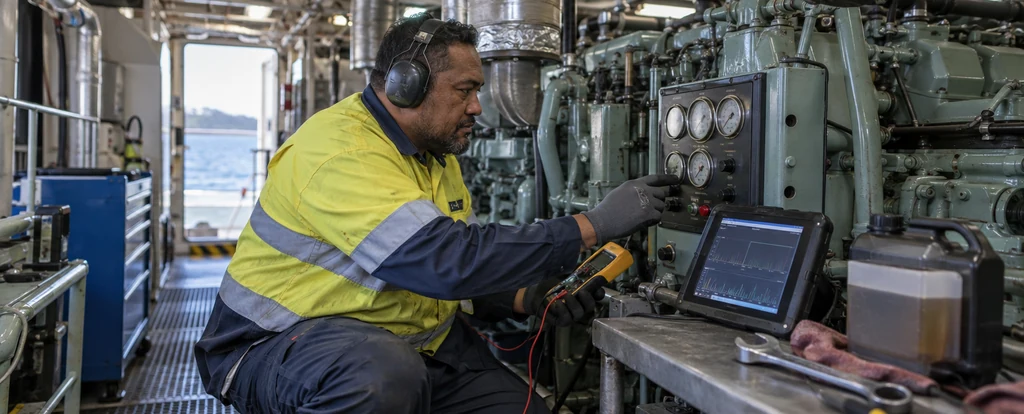
Marine engine drivers work in the engine rooms of ferries, tugs, barges, fishing boats and pilot vessels, keeping main engines, generators, pumps and cooling systems running. The job sits closer to a diesel mechanic at sea than to a marine engineer, who designs and oversees ship systems rather than operating them day to day. Most hold a certificate of competency issued by the Australian Maritime Safety Authority, which sets the size and power of the vessels they are allowed to work on.
How much do marine engine drivers earn?
The median full-time salary for a marine engine driver is $98,800 per annum, before tax, up $20,400 since 2018.
Pay rises with the grade of certificate of competency you hold, because a higher grade allows you to work on larger and more powerful vessels. Sector matters as well: defence, offshore and port operations generally pay above marine tourism and small charter work, and roster or away-from-home allowances add to the base rate. Enterprise agreements and shift penalties are common across the industry, so two drivers with the same certificate can be on noticeably different rates.
What does a marine engine driver do day to day?
The list below is what fills most weeks; the exact mix shifts with seniority and whatever stage the current work is at.
- Standing engine room watches on ferries, tugs or fishing vessels, watching temperatures, pressures and fuel use
- Carrying out scheduled servicing on diesel engines, generators, pumps and cooling systems
- Diagnosing faults with diagnostic software and a multimeter, then repairing them or arranging the repair
- Keeping fuel, lubricating oil, cooling water and bilge systems within their limits, including topping up and treating fuel
- Recording engine hours, defects and maintenance in the log so the vessel is ready for an AMSA survey
What skills do marine engine drivers need?
Employers look for installation and maintenance, plant and equipment operation, operations management, backed by Cummins INSITE fluency and strong safety and compliance awareness.
Specialist skills
- Installation and maintenance
- Plant and equipment operation
- Operations management
- Regulatory compliance
- Hand and power tool work
Software and tools
- Cummins INSITE
- Volvo Penta Diagnostic Tool
- Yanmar Diagnostic Software
- Multimeter
- Torque wrench
General skills
- Safety and compliance awareness
- Problem solving
- Attention to detail
Is the job growing?
About 2,500 people work as marine engine drivers in Australia, and employment is projected to grow 3% over the decade to 2035. That's modest growth: demand is steady rather than booming.
How do you become a marine engine driver?
Here's the path most marine engine drivers take, step by step.
- 1Get sea time or a trade behind you
Many marine engine drivers start as an engine room hand, deckhand or diesel mechanic. Sea time is what AMSA counts towards a certificate, and a diesel fitting background shortens the training because you already know engines.
- 2Complete a maritime operations qualification
A Certificate III in Maritime Operations (MAR30924) (Marine Engine Driver Grade 3 Near Coastal) is the usual starting qualification, delivered at TAFE or a registered training organisation and often by block release around work. It covers engine systems, safety and watchkeeping.
- 3Pass the AMSA assessment
AMSA issues the certificate of competency after you have logged the required sea service and passed written and oral exams. You normally start at Grade 3 near coastal and move up to Grade 2 and Grade 1 as your sea time and engine room experience accumulate.
- 4Keep the certificate and medicals current
Certificates are renewed on a cycle, and you need a current medical and survival and first aid training. Employers check these before they will put you on a vessel, so lapse dates are worth tracking.
Ready to apply as a marine engine driver?
Whether you're working toward becoming a marine engine driver or already are one and want a hand with the next step (sharpening your resume for ATS screening, tightening your cover letter, or knowing what you'll actually be asked at interview), here are examples grounded in this specific role, not generic templates.
What jobs can a marine engine driver move to?
Moving into Marine Surveyor typically comes with the biggest pay rise, worth $15,600 a year more on average.
| Move to | Typical pay change | Overlap | Retraining |
|---|---|---|---|
| Marine Surveyor A marine engine driver's knowledge of vessel systems suits marine surveying, but formal reskilling in survey standards is needed. | +$15,600 | 24% | reskill |
| Marine Engineer A marine engine driver's hands-on engine experience provides a foundation for marine engineering, though a diploma-level reskilling is required. | +$13,000 | 21% | reskill |
| Fishing Skipper A marine engine driver's vessel handling and engine maintenance skills transfer to skippering fishing boats, with minimal retraining for the certification. | −$5,200 | 63% | minimal |
| Vessel Traffic Service Operator A marine engine driver's sea experience and radio skills translate to shore-based vessel traffic monitoring, with reskilling in traffic systems. | −$10,400 | 25% | reskill |
Moves are chosen from Jobs and Skills Australia's Data on Occupation Mobility, which follows income tax records between 2011-12 and 2020-21, together with entry requirements and skill overlap. A known move is one people were seen making in that data. Pay change compares median full-time pay for the two roles.
Who works as a marine engine driver?
The typical marine engine driver is 48 years old; 95% are men, 90% work full-time, and full-timers average 44 hours a week.
- 48
- Median age
- 5%
- Female share
- 90%
- Full-time
- +4h
- vs all-jobs avg
What's it like being a marine engine driver?
The job has a clear rhythm: watchkeeping in a hot, noisy space, then a burst of activity when the vessel berths and something needs servicing or fixing. You are often the only person aboard who can diagnose a problem, so the work suits someone who is practical, methodical and comfortable making a call without a second opinion nearby. The trade-off is the roster, because evenings, weekends and time away from home are part of keeping vessels in service.
What people like
- Faults that make sense once you find them. An engine that is overheating because of a blocked raw water intake is a puzzle with a real answer, and sorting it before the vessel misses a sailing is satisfying in a way that is hard to match elsewhere.
- Working with your hands on real machinery. Most of the day is physical: spanners, torque wrenches, filters and oil, not spreadsheets. If you like knowing how a machine works and prefer fixing it to talking about it, the work fits.
- Responsibility that is easy to see. When the main engine starts and the ferry leaves the wharf, your work is what made that happen. That direct line between the job and the result appeals to a lot of drivers.
- Roster patterns that suit some people. Many vessels run week-on, week-off or shift rotations, which means long stretches at work followed by blocks of time off rather than a standard five-day week.
What people find hard
- Heat, noise and vibration. An engine room under load is loud enough to need hearing protection and hot enough to drain you over a long watch. It is not a comfortable office, and fatigue builds on busy days.
- Time away from home. Rotations, night sailings and call-outs at short notice are normal, and they are harder on family life than a shore-based trade with fixed hours.
- Survey and log paperwork. Maintenance records, defect reports and survey preparation are a real part of the job. Skipping them causes problems at inspection time, so they take hours you might rather spend on the tools.
- Being on call when something breaks. Breakdowns rarely happen at a convenient moment, and a vessel with a failed generator still needs to sail or be fixed where it sits.
Based on our synthesis of professional-body surveys and public accounts of the role, not first-person verified reviews.
Which industries employ marine engine drivers?
Water Transport employs the largest share of marine engine drivers, followed by Marine Tourism and Recreation.
Top employing industries
- 1Water Transport
- 2Marine Tourism and Recreation
- 3Commercial Fishing
- 4Port and Terminal Operations
- 5Defence
Ranked by employment share; the source doesn't publish an exact percentage per industry.
| Certificate III/IV | 34% | |
|---|---|---|
| Diploma / Advanced Diploma | 26% | |
| Bachelor degree | 20% | |
| Year 12 or below | 20% |
Will AI replace marine engine drivers?
Exposure to AI and automation is low. Most of the work happens in an engine room where someone has to be present to hear a change in note, spot a leak or feel abnormal vibration, and the repair itself is physical. Diagnostic software has made fault finding quicker and maintenance records easier to keep, but it supports the driver rather than replacing them.
Share of typical working time by exposure level
- Running the engine room watchGauges, alarms and a round of the space every half hour catch a rising temperature or a fuel leak that no sensor reports on its own.35%low
- Planned servicing and repairsReplacing injectors, impellers and filters, or pulling a head off a generator, is hands-on work that has to happen in the space where the engine sits.30%low
- Fault finding with diagnostic softwareManufacturer tools such as Cummins INSITE and Volvo Penta software read fault codes and live data, which narrows the search but still leaves you to work out what the readings mean.20%moderate
- Maintenance records and survey preparationPlanned maintenance systems and digital logbooks cut the paperwork, and AMSA survey evidence is increasingly submitted electronically.15%moderate
Common questions about becoming a marine engine driver
Straight answers to the questions people ask most.
How much do marine engine drivers earn?
Marine engine drivers earn $98,800 per year before tax on a full-time basis. That is a median figure, so half earn more and half earn less, and the grade of certificate you hold and the sector you work in shift it noticeably.
How do you become a marine engine driver?
You build sea time, complete a maritime operations qualification such as a Certificate III in Maritime Operations (MAR30924) (Marine Engine Driver Grade 3 Near Coastal), then pass the AMSA written and oral assessments for a certificate of competency. Starting as a deckhand, engine room hand or diesel mechanic is a common way in because the sea service counts.
Are marine engine drivers in demand?
Marine engine drivers are currently in shortage nationally, and employment is projected to grow 3% over the decade to 2035 over the decade to 2035. Because the workforce is small, vacancies tend to appear when someone retires or a new vessel enters service, and holding the certificate an employer needs matters more than the headline figure.
Will AI or automation replace marine engine drivers?
No. The exposure here is low because the work is physical and happens in a space where a person has to be present to hear, feel and smell a problem before it becomes a breakdown. Diagnostic software and planned maintenance systems have made fault finding faster and records easier to keep, but they inform the decision rather than turn the spanner.
What can marine engine drivers move into?
Some move into skippering fishing boats, where their vessel handling and engine skills carry across with minimal retraining and pay is around $5,200 less. Shore-based work monitoring vessel traffic uses the same sea experience and radio skills, and pays around $10,400 less, though it needs reskilling in traffic systems. A longer path is moving into marine engineering, which pays around $13,000 more and requires a diploma-level qualification.
Is the job a good fit for a diesel mechanic?
It can be, because the engine diagnostic and repair skills overlap closely and the adaptation to marine systems is usually a short course plus sea time. The bigger adjustment is the working environment: an engine room at sea is hotter, noisier and less forgiving than a workshop, and the rosters are different.
Related roles
Not sure this is you? Take the career quiz and get a ranked shortlist of roles that fit how you like to work.