Music Therapist
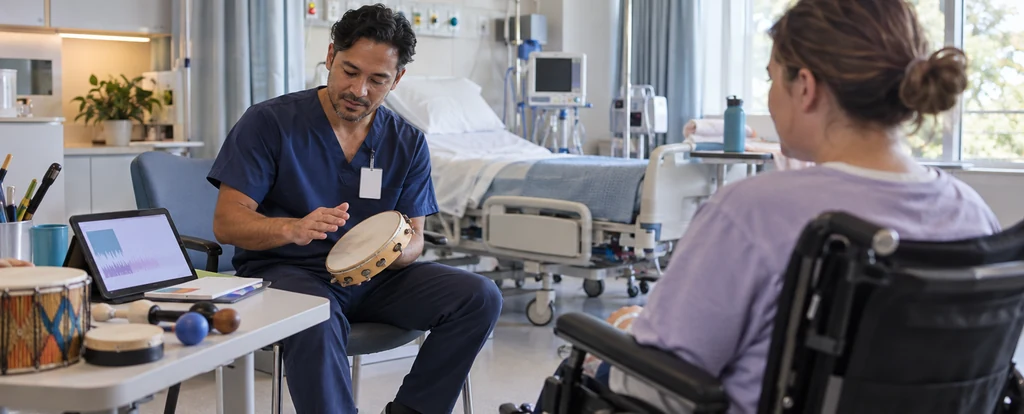
Music therapists use singing, instruments and improvisation to help people work towards physical, emotional and communication goals.
- Median salary*
- $80,600
4.4%vs last year, before tax
- People employed*
- 1,200
0.0%vs last year
- Projected growth
- +34%
to 2035
- AI exposure*
- Low
- automation risk
- Average hours*
- 38/wk
−2h vs all jobs
- Shortage status
- Not in shortage
national
Music therapists work in hospitals, aged care homes, disability services, mental health programs and schools, usually as part of a care team alongside nurses, allied health staff and support workers. What separates the role from music teaching is the goal: a session is planned around a client's clinical needs, such as regaining speech after a stroke or settling a person living with dementia, and the music is the means rather than the point. Most practitioners are registered with the Australian Music Therapy Association, and many work part time across more than one site.
How much do music therapists earn?
The median full-time salary for a music therapist is $80,600 per annum, before tax, up $17,000 since 2018.
Where you work shifts the figure more than experience does early on, because public hospital and health service roles sit under an award with defined clinical levels, while aged care, disability and community organisations set their own bands. Part-time work is common, so the annual figure is often for fewer than full-time hours, and private practice or NDIS fee-for-service work can pay well per session but brings gaps between referrals. Clinical specialisation, supervision responsibilities and years since registration are what move you up within a pay band.
What does a music therapist do day to day?
The list below is what fills most weeks; the exact mix shifts with seniority and whatever stage the current work is at.
- Assessing a new client's strengths and needs, often through a first session of singing or instrument playing rather than a formal test
- Planning and leading individual sessions, choosing songs and instruments to suit what the client can manage that day
- Running group sessions in an aged care home or rehabilitation ward, where participants join in as much as they are able
- Writing progress notes for the care team and contributing to hospital, NDIS or aged care reports
- Changing the plan mid-session when a client becomes distressed, tired or disengaged, and using that moment as part of the therapy
What skills do music therapists need?
Employers look for patient care and support, clinical assessment and treatment, care planning and coordination, backed by Electronic health records fluency and strong empathy and interpersonal care.
Specialist skills
- Patient care and support
- Clinical assessment and treatment
- Care planning and coordination
- Counselling and support work
- Rehabilitation and therapy
Software and tools
- Electronic health records
- Digital audio workstations
- Adaptive instruments
- Telehealth platforms
- Music notation software
General skills
- Empathy and interpersonal care
- Written communication
Is the job growing?
About 1,200 people work as music therapists in Australia, and employment is projected to grow 34% over the decade to 2035. That's very strong growth. Few roles in Australia are expanding this fast, and it points to solid demand for years to come.
How do you become a music therapist?
Here's the path most music therapists take, step by step.
- 1Build a foundation in music and human services
A bachelor degree in music is the usual starting point, ideally with some study in psychology, education, health or counselling. Practical skill on an instrument and a confident singing voice matter, because you will use them in front of clients from your first placement.
- 2Complete an accredited music therapy qualification
Most Australian courses accredited by the Australian Music Therapy Association are master's degrees of about two years full time, open to graduates of music or related degrees. They include supervised clinical placements in settings such as hospitals, aged care and disability services, which is where most students work out which client group suits them.
- 3Register as a Registered Music Therapist
Finishing an accredited course makes you eligible for registration with the Australian Music Therapy Association, and many employers and funding schemes expect it. Registration signals that your training included supervised clinical practice, which is what distinguishes you from a musician running recreational music activities.
- 4Get the checks clinical and community settings require
A Working with Children Check and a national police check are standard, and NDIS work usually needs a worker screening clearance. Requirements differ by state and by employer, so allow time for these before you apply.
Ready to apply as a music therapist?
Whether you're working toward becoming a music therapist or already are one and want a hand with the next step (sharpening your resume for ATS screening, tightening your cover letter, or knowing what you'll actually be asked at interview), here are examples grounded in this specific role, not generic templates.
What jobs can a music therapist move to?
Moving into Occupational Therapist typically comes with the biggest pay rise, worth $18,900 a year more on average.
| Move to | Typical pay change | Overlap | Retraining |
|---|---|---|---|
| Occupational Therapist Music therapist brings therapeutic relationship skills and client goal setting, but needs an occupational therapy qualification.Known move | +$18,900 | 43% | requalify |
| Play Therapist Music therapist can apply creative, play-based therapeutic techniques with children, needing only orientation to play therapy. | +$2,600 | 74% | minimal |
| Art Therapist Music therapist can transfer creative therapy and reflective practice to art therapy, needing only orientation to the art medium. | −$2,600 | 67% | minimal |
| Diversional Therapist Music therapist brings activity-based therapeutic skills to diversional therapy, but needs retraining in recreational program planning.Known move | −$6,000 | 33% | reskill |
Moves are chosen from Jobs and Skills Australia's Data on Occupation Mobility, which follows income tax records between 2011-12 and 2020-21, together with entry requirements and skill overlap. A known move is one people were seen making in that data. Pay change compares median full-time pay for the two roles.
Who works as a music therapist?
The typical music therapist is 42 years old; 85% are women, 55% work full-time, and full-timers average 38 hours a week.
- 42
- Median age
- 85%
- Female share
- 55%
- Full-time
- −2h
- vs all-jobs avg
What's it like being a music therapist?
The job has a steady rhythm of sessions, notes and planning, with variety coming from the clients rather than the setting. Much of the skill is in reading a room quickly and adapting, so therapists who enjoy live interaction and can stay calm when a session goes differently than planned tend to find it satisfying. The emotional load is real, particularly in palliative care, acute mental health and dementia units, and it is usually carried with regular clinical supervision.
What people like
- You see change in front of you. A person who has not spoken since a stroke sings a phrase, or a resident who is usually withdrawn joins a group for the first time. Progress is often small and specific, and you are there when it happens.
- The work is genuinely varied. A week might include a paediatric disability session, a memory support group and a rehabilitation ward, each needing different instruments, songs and pacing. That range suits people who like adapting rather than repeating a routine.
- Music is the working tool. Playing, singing and improvising are part of the job rather than a hobby kept for weekends, and your own musicianship keeps developing through the work. It does not mean performing for an audience.
- You work inside a care team. Goals are shared with nurses, occupational therapists, speech pathologists and support workers, so your sessions connect to a plan someone else is also working on. That collaboration gives the work structure and a sense of shared purpose.
What people find hard
- The profession is small. With about 1,200 people working as music therapists in Australia, permanent full-time positions are limited and many roles are part time, contract or split across two or three sites. Building a stable income can take a few years.
- Funding shapes what you can offer. Some clients get a set number of funded sessions, so therapy stops when the plan runs out or the funding year ends. Watching that happen to someone who was making progress is one of the harder parts of the job.
- Documentation takes real time. Progress notes, care plans and funding reports are part of every role, and they are usually written outside session hours. They matter for the client's care, but they are not why most people choose this work.
- You explain the job constantly. Many people hear 'music therapist' and picture a music teacher or an entertainer, so you end up describing your training and your clinical goals to families, referrers and even colleagues. It gets easier, but it never quite stops.
Based on our synthesis of professional-body surveys and public accounts of the role, not first-person verified reviews.
Which industries employ music therapists?
Hospitals employs the largest share of music therapists, followed by Aged care residential services.
Top employing industries
- 1Hospitals
- 2Aged care residential services
- 3Disability support services
- 4Mental health and substance abuse services
- 5Community health services
Ranked by employment share; the source doesn't publish an exact percentage per industry.
| Bachelor degree | 52% | |
|---|---|---|
| Postgraduate | 26% | |
| Diploma / Advanced Diploma | 13% | |
| Other | 9% |
Will AI replace music therapists?
Music therapy has low exposure to AI overall, because the core of the work is a live musical exchange between two people and the therapist's read of what is happening in the room. Technology already in use, such as recording tools, notation software, streaming services for repertoire and practice management systems for notes and bookings, handles preparation and administration rather than the therapy itself. It changes how quickly you can pull together resources, not who sits with the client.
Share of typical working time by exposure level
- Delivering individual and group sessionsSinging, playing and improvising with a client depends on real-time musical response, such as matching the tempo of someone with Parkinson's as they walk, which no system can do on your behalf.40%low
- Choosing repertoire and preparing session resourcesStreaming catalogues and arrangement software make it quicker to find a song in the right key or key signature, but you still decide what suits a client's history, culture and mood that day.25%moderate
- Assessing clients and setting therapy goalsStandardised assessment tools and templates can be scored or summarised automatically, while the judgement about what a client can realistically work towards comes from watching them across sessions.20%moderate
- Writing progress notes and funding reportsDraft notes, care plan summaries and NDIS progress reports can be generated from session records, which saves time, though the clinical detail that makes them accurate still comes from you.15%high
Common questions about becoming a music therapist
Straight answers to the questions people ask most.
How much do music therapists earn in Australia?
The median full-time music therapist earns $80,600 per annum, before tax, though pay varies with the sector you work in and how many hours you pick up. Public health roles follow award classifications, while aged care, disability and private practice set their own rates.
How do you become a music therapist?
Most people complete a music degree, then a master's in music therapy accredited by the Australian Music Therapy Association, which takes about two years full time and includes supervised clinical placements. Registration as a Registered Music Therapist follows, and it is what most employers and funding schemes look for.
Are music therapists in demand in Australia?
Music therapists are currently not in shortage, and employment is projected to grow 34% over the decade to 2035. The occupation is small, so even a sizeable percentage change means a limited number of new positions each year, and many openings appear when therapists change settings or leave the workforce. Recent graduates often start with part-time or contract work across several sites before landing a permanent role.
Will AI replace music therapists?
AI has low exposure in this job, because the therapy depends on a live relationship and on improvising in response to a person in the room. Playlist generators, recording software and practice management systems can help with planning, resources and notes, but they cannot notice that a client has stopped breathing deeply or is about to cry.
Can music therapists move into other careers?
Play therapy is one move across, since the creative, child-centred approach overlaps with music therapy and needs only orientation to the medium, and pay differs by $2,600 more. Occupational therapy shares the goal setting and therapeutic relationship skills but needs a full occupational therapy qualification, and it pays $18,900 more. Many experienced therapists also build a private practice or contract directly to NDIS participants, which is often where earnings grow.
Related roles
- Occupational Therapist
- Play Therapist
- Art Therapist
- Diversional Therapist
- Aged Care Worker
- Disability Support Worker
Not sure this is you? Take the career quiz and get a ranked shortlist of roles that fit how you like to work.