Photo Lab Technician
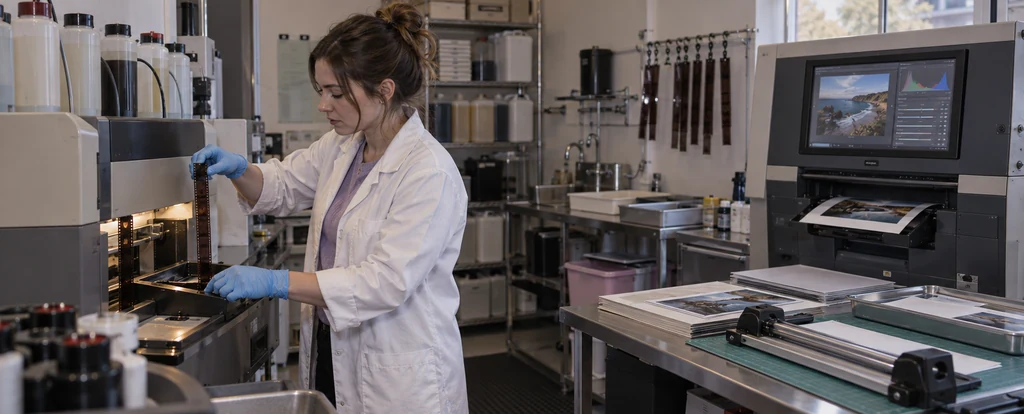
Photo lab technicians turn customers' film and digital files into finished prints, enlargements and photo products.
- Median salary
- $73,100
4.4%vs last year, before tax
- People employed
- 1,300
0.0%vs last year
- Projected growth
- +4.9%
to 2035
- AI exposure*
- High
- automation risk
- Average hours
- 39/wk
−1h vs all jobs
- Shortage status
- Not in shortage
national
Most work in retail photo counters, professional labs or the imaging rooms of print businesses, running film processors, digital minilabs and wide-format printers. What separates the job from photography is that the picture has already been taken: the technician's skill sits in colour, density and the physical finish. Volumes have moved from film developing to digital printing, canvas, photo books and restoration, so the machines and the counter matter more than the darkroom once did.
How much do photo lab technicians earn?
The median full-time salary for a photo lab technician is $73,100 per annum, before tax, up $15,500 since 2018.
Where the lab sits decides the pay: retail photo counters usually fall under a retail award with weekend and evening penalty rates, while professional labs and print businesses often pay under the graphics and printing award, where the classification depends on the machines and processes you run. In small labs, rates are often set by the owner rather than by a formal classification. Peak periods such as school photo season and December are where weekly earnings move most, because of the extra hours rather than a higher rate.
What does a photo lab technician do day to day?
The list below is what fills most weeks; the exact mix shifts with seniority and whatever stage the current work is at.
- Developing exposed film and inspecting negatives for density, scratches and dust
- Running digital minilabs and wide-format printers to produce prints, canvas and photo books
- Adjusting colour, density and contrast so the print matches what the customer expects
- Cutting, mounting and finishing prints, albums and frames
- Topping up chemistry and calibrating printers, which is what keeps colour consistent across a run
What skills do photo lab technicians need?
Employers look for plant and equipment operation, craft and handmade production, inventory management, backed by Adobe Photoshop fluency and strong attention to detail.
Specialist skills
- Plant and equipment operation
- Craft and handmade production
- Inventory management
Software and tools
- Adobe Photoshop
- Adobe Lightroom
- Noritsu minilab software
- Fujifilm Frontier software
- Epson Print Layout
General skills
- Attention to detail
- Customer service
- Digital literacy
Is the job growing?
About 1,300 people work as photo lab technicians in Australia, and employment is projected to grow 4.9% over the decade to 2035. That's modest growth: demand is steady rather than booming.
How do you become a photo lab technician?
Here's the path most photo lab technicians take, step by step.
- 1Finish Year 12 or equivalent
There is no formal entry requirement. The most common qualification among people now in the job is Year 12 or below, held by 44% of them, which reflects how much of the work is learned at the machine rather than in a classroom.
- 2Start at a photo counter or in a print room
Camera shops, department store photo counters, professional labs and print businesses hire casual staff to serve customers and operate printers. Training is usually on the job, and this is where most people get their first look at a minilab.
- 3Learn colour management properly
Minilab and Fujifilm Frontier software handle a lot of the correction automatically, so the difference between an operator and a technician is judgement about colour, calibration and paper stock. A short course in Photoshop and Lightroom, or in colour management, gets you there faster.
- 4Add a qualification if you want to specialise
A Certificate IV in photography and photo imaging covers capture, editing and printing and is offered part time at some TAFEs. A Certificate III in printing (ICP31220) is the usual route for anyone crossing into commercial print work.
Ready to apply as a photo lab technician?
Whether you're working toward becoming a photo lab technician or already are one and want a hand with the next step (sharpening your resume for ATS screening, tightening your cover letter, or knowing what you'll actually be asked at interview), here are examples grounded in this specific role, not generic templates.
What jobs can a photo lab technician move to?
Moving into Graphic Designer typically comes with the biggest pay rise, worth $23,100 a year more on average.
| Move to | Typical pay change | Overlap | Retraining |
|---|---|---|---|
| Graphic Designer Photo lab technicians bring colour, image file and print output knowledge to graphic design, though design software and a portfolio need study.Known move | +$23,100 | 5% | reskill |
| Photographer Photo lab technicians bring colour, exposure and processing knowledge to photography, though portfolio and business skills need development.Known move | +$22,600 | 4% | reskill |
| Printer Photo lab technicians bring colour, image and print production knowledge to commercial printing, though a printing apprenticeship is needed.Known move | +$100 | 35% | requalify |
Moves are chosen from Jobs and Skills Australia's Data on Occupation Mobility, which follows income tax records between 2011-12 and 2020-21, together with entry requirements and skill overlap. A known move is one people were seen making in that data. Pay change compares median full-time pay for the two roles.
Who works as a photo lab technician?
The typical photo lab technician is 43 years old; 75% are women, 24% work full-time, and full-timers average 39 hours a week.
- 43
- Median age
- 75%
- Female share
- 24%
- Full-time
- −1h
- vs all-jobs avg
What's it like being a photo lab technician?
The day runs in batches: orders arrive at the counter or online, go through the machine, then get checked, adjusted and finished by hand. Teams are small, so the same person often handles the file, the print and the customer, and the pace is set by whatever comes through that morning. It suits people who like colour and craft and are content that most of the work is machine time rather than camera time.
What people like
- You see the result straight away. A small change to colour or density shows on the print within seconds, and the customer takes the finished thing home with them.
- Craft still matters at the finishing bench. Mounting, album binding and restoration are hand work, and a careful technician is why a print looks right once it is framed.
- Orders keep moving. A morning can cover passport photos, a framed enlargement and scanning a box of old negatives, so the machine time rarely feels identical.
- Film never quite disappeared. Hobbyists, students and photographers still bring rolls in, so darkroom skills get used rather than just remembered.
What people find hard
- Plain volume is the job. School photo season and December bring batches of the same print size, and the day becomes loading paper, checking output and packing orders.
- You explain file limits to disappointed customers. When a phone photo prints soft or the colours look flat, the technician is the one saying what the original file can and cannot do.
- Standing at machines, with chemistry. Shifts are mostly on your feet, and film processing means monitoring chemical baths in a room that smells of fixer.
- Weekends and evenings are normal trading. Retail counters are open when customers are free, so Saturday shifts come with the territory.
Based on our synthesis of professional-body surveys and public accounts of the role, not first-person verified reviews.
Which industries employ photo lab technicians?
Other Services employs the largest share of photo lab technicians, followed by Professional, Scientific and Technical Services.
Top employing industries
- 1Other Services
- 2Professional, Scientific and Technical Services
- 3Retail Trade
Ranked by employment share; the source doesn't publish an exact percentage per industry.
| Year 12 or below | 43.7% | |
|---|---|---|
| Bachelor degree | 20.2% | |
| Certificate III/IV | 15.3% | |
| Diploma / Advanced Diploma | 11.9% | |
| Postgraduate | 4.2% |
Will AI replace photo lab technicians?
Automation has already reshaped this work, which is why the exposure is high: minilab and Frontier software handle colour, density and sharpness for most orders, and online ordering takes the counter out of many transactions. What remains is physical and local, loading and calibrating machines, developing film, finishing prints and explaining to a customer what their file can do.
Share of typical working time by exposure level
- Colour correction and image adjustmentSoftware corrects colour, density and sharpness automatically for the bulk of orders, so a technician is called in mainly for reprints, restoration and files a customer is unhappy with.30%high
- Running minilab and wide-format printersThe machine does the printing, but loading roll and sheet stock, matching paper profiles and clearing a misfeed still need someone standing at it.25%moderate
- Preparing customer files and taking ordersOnline ordering, automatic file checks and phone-camera uploads have moved most of this to software, leaving staff to catch the files that will not print as the customer expects.25%high
- Developing film and hand-finishingChemical processing, mounting, album binding and print restoration are physical work that machinery in a small lab cannot take on.20%low
Common questions about becoming a photo lab technician
Straight answers to the questions people ask most.
How much do photo lab technicians earn?
Photo lab technicians earn a median of $73,100 per annum, before tax, for full-time work. What you take home depends on whether the lab is a retail counter, a professional lab or part of a printing business, and on how much weekend and evening work you pick up.
How do you become a photo lab technician?
Most people start behind a photo counter or in a print room and learn the machines on the job, with no qualification needed to begin. A Certificate IV in photography and photo imaging or a short colour management course helps if you want to move from operating printers to setting them up.
Is there demand for photo lab technicians?
Photo lab technicians are currently not in shortage, and employment is projected to grow 4.9% over the decade to 2035. It is a small occupation, with around 1,300 people nationally, so openings tend to be scattered across retail counters and professional labs rather than concentrated in large employers.
Will AI take over photo lab work?
A lot of it has already gone that way: minilab software corrects colour, density and sharpness automatically, and online ordering removes the counter from many transactions. What stays with a person is the physical and local side, loading and calibrating machines, developing film, finishing prints, and telling a customer why their file will not print the way they hoped.
What jobs can a photo lab technician move into?
Printing is one option, typically paying $100 more, because colour management and print production knowledge carry across, though a printing apprenticeship is part of the route. Photography and graphic design are further away, typically paying $22,600 more and $23,100 more respectively, and both need study and a portfolio rather than lab experience alone.
Do photo lab technicians still work with film?
Yes, though digital files make up most of the volume. Film comes in from hobbyists, students and photographers after a particular look, and the same technicians usually handle the scanning and printing from those negatives.
Related roles
Not sure this is you? Take the career quiz and get a ranked shortlist of roles that fit how you like to work.