Home Manufacturing & Production
Printer's Assistant
Printer's assistants keep the presses and finishing machines supplied, feeding in paper and ink and checking, stacking and packing the printed work that comes out.
- Median salary
- $65,200
4.2%vs last year, before tax
- People employed
- 1,600
0.0%vs last year
- Projected growth
- −0.1%
to 2035
- AI exposure*
- High
- automation risk
- Average hours
- 40/wk
matches all-jobs average
- Shortage status
- Not in shortage
national
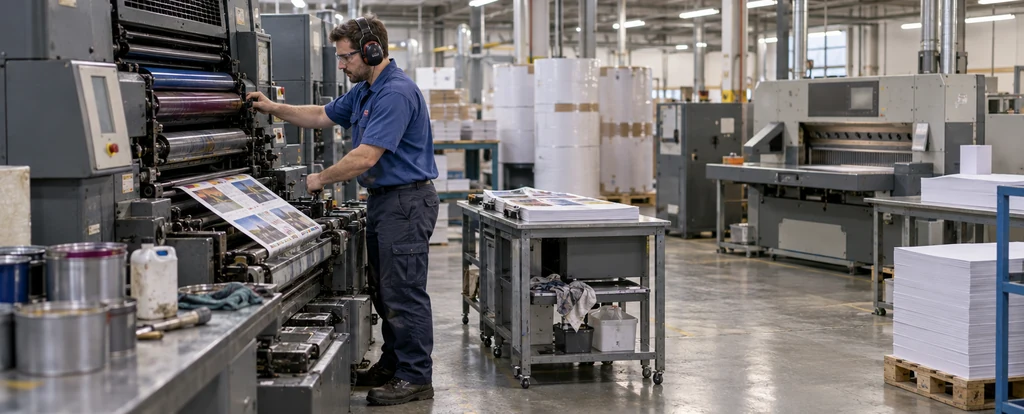
The work happens in commercial print rooms, binderies and packaging plants, where a small crew runs offset or digital presses and the finishing equipment behind them. The printer sets up the job and manages colour while the assistant keeps stock loaded, watches the sheets coming off, and keeps the folders, guillotines and binders fed. Most assistants learn on site, and some take up a printing apprenticeship once they know the equipment well enough to be useful on a press.
How much do printer's assistants earn?
The median full-time salary for a printer's assistant is $65,200 per annum, before tax, up $13,700 since 2018.
Pay usually follows the Graphic Arts award or an enterprise agreement, so the base rate is fairly consistent from one print room to the next. Overtime and afternoon or night loadings are what lift a week's earnings, since production often runs to a freight deadline. If you take up an apprenticeship, your rate moves through the training levels as you complete each stage of the qualification.
What does a printer's assistant do day to day?
The list below is what fills most weeks; the exact mix shifts with seniority and whatever stage the current work is at.
- Loading paper stock, ink and plates into presses and finishing machines
- Watching printed sheets come off the press and pulling aside misaligned or poorly inked copies
- Running guillotines, folders, collators and binding equipment to cut, fold and assemble jobs
- Stacking, wrapping, labelling and palletising finished work for dispatch
- Cleaning rollers and work areas and doing basic maintenance between jobs
What skills do printer's assistants need?
Employers look for plant and equipment operation, hand and power tool work, inventory management, backed by Heidelberg offset press fluency and strong attention to detail.
Specialist skills
- Plant and equipment operation
- Hand and power tool work
- Inventory management
- Cleaning and grounds maintenance
- Process improvement
Software and tools
- Heidelberg offset press
- Polar paper guillotine
- Stahl folding machine
- EFI Fiery
- Adobe Acrobat
General skills
- Attention to detail
- Safety and compliance awareness
Is the job growing?
About 1,600 people work as printer's assistants in Australia, and employment is projected to decline 0.1% over the decade to 2035. That's a real decline, worth weighing carefully before training into the role.
How do you become a printer's assistant?
Here's the path most printer's assistants take, step by step.
- 1Finish school, or leave with a Year 12 certificate
No formal qualification is required to start as a printer's assistant, and most people in the role hold a Year 12 certificate or less. Employers look for reliability, a willingness to learn the machines and the physical capacity to handle paper stock all day.
- 2Apply directly to print rooms, binderies and packaging printers
Entry is almost always on the job, so vacancies sit with the businesses themselves rather than on a central register. Casual and labour hire work is a common way in, and it often turns into a permanent position once you can run a machine safely on your own.
- 3Pick up the licences that help around the plant
A forklift licence is worth having where you move pallets of stock, and employers will put you through site safety induction for the specific machines you operate. There is no licensing requirement to work on a press itself.
- 4Start a Certificate III in Printing apprenticeship
Assistants who show they can set up and mind a press often move into an apprenticeship, which combines paid work with study at TAFE or a private training provider. The qualification is completed at trade level and is what opens up printer roles rather than assistant work.
Ready to apply as a printer's assistant?
Whether you're working toward becoming a printer's assistant or already are one and want a hand with the next step (sharpening your resume for ATS screening, tightening your cover letter, or knowing what you'll actually be asked at interview), here are examples grounded in this specific role, not generic templates.
What jobs can a printer's assistant move to?
Moving into Printer typically comes with the biggest pay rise, worth $8,000 a year more on average.
| Move to | Typical pay change | Overlap | Retraining |
|---|---|---|---|
| Printer Assistants who know the presses can take up a printing apprenticeship, building on the paper, ink and machine handling they already do daily.Known move | +$8,000 | 28% | requalify |
| Photo Lab Technician Photo lab work uses similar print production and machine feeding skills, with study in photographic processing and digital imaging.Known move | +$7,900 | 32% | reskill |
| Print Finisher Print finishing draws on the same paper handling and machine feeding skills, and it is a common route into a trade qualification.Known move | −$2,800 | 28% | requalify |
| Pre-press Operator Pre-press work builds on an assistant's understanding of print jobs, with an apprenticeship covering layout, plate making and file preparation.Known move | −$2,800 | 4% | requalify |
| Screen Printer Screen printing uses the same press setup, ink mixing and substrate handling, and an apprenticeship opens the trade to assistants.Known move | −$5,400 | 26% | requalify |
Moves are chosen from Jobs and Skills Australia's Data on Occupation Mobility, which follows income tax records between 2011-12 and 2020-21, together with entry requirements and skill overlap. A known move is one people were seen making in that data. Pay change compares median full-time pay for the two roles.
Who works as a printer's assistant?
The typical printer's assistant is 43 years old; 60% are men, 66% work full-time, and full-timers average 40 hours a week.
- 43
- Median age
- 40%
- Female share
- 66%
- Full-time
- +0h
- vs all-jobs avg
What's it like being a printer's assistant?
The rhythm follows the press schedule: a run starts, the assistant feeds it, checks it and packs the output, then the next job goes on. Print rooms are noisy, dusty places and the work is physical, with paper stacks to lift and long stretches on your feet. It suits someone who likes machinery, notices when something looks off, and would rather work with their hands than sit at a screen all day.
What people like
- You see the job stack up. A run of brochures, labels or packaging comes off the machine within a shift, so you can see exactly what your work produced before it goes out the door.
- The equipment is learnable by hand. Assistants who pay attention to setup, paper behaviour and colour pick up the presses quickly, and that knowledge is what employers look for when they sponsor an apprenticeship.
- Small crews. A print room often runs with three or four people, so you know everyone you work with and the day moves with the jobs rather than with meetings.
- A trade without a degree. You can start with no qualification and build toward a Certificate III in Printing while you are paid, which keeps the cost of getting qualified low.
What people find hard
- The noise and the paper dust. Press rooms are loud enough that hearing protection is standard, and trimming and folding leave fine dust in the air around the finishing lines.
- Long runs get repetitive. A big job can mean hours of the same loading, checking and stacking before the pile is finished, and the sameness is the hard part rather than the effort.
- Deadlines bunch before dispatch. Freight cut-offs mean the last part of a shift can be spent wrapping, labelling and palletising against a fixed time.
- Shifts can run late. In larger plants the presses run across more than one shift, so afternoon starts and rotating rosters come with the job.
Based on our synthesis of professional-body surveys and public accounts of the role, not first-person verified reviews.
Which industries employ printer's assistants?
Manufacturing employs the largest share of printer's assistants, followed by Information Media and Telecommunications.
Top employing industries
- 1Manufacturing
- 2Information Media and Telecommunications
Ranked by employment share; the source doesn't publish an exact percentage per industry.
| Year 12 or below | 54.2% | |
|---|---|---|
| Certificate III/IV | 19.7% | |
| Bachelor degree | 10.6% | |
| Diploma / Advanced Diploma | 7.3% | |
| Postgraduate | 3% |
Will AI replace printer's assistants?
This is a hands-on job, but much of what surrounds the machine is already automated, and the role's exposure is high. Presses run from stored job setups, guillotines and folders cut and fold through programmed sequences, and inline cameras check sheets on the fly. The physical work of loading stock, clearing jams, jigging stacks and keeping the line fed is harder to automate and is likely to stay with a person for now.
Share of typical working time by exposure level
- Loading paper, ink and platesLifting and positioning stacks of stock, topping up ink and changing plates still needs hands and judgement about how the paper is sitting.30%low
- Cutting, folding and binding finished workGuillotines and folders run stored programs that set the cut and fold sequence, so the assistant mainly loads, jogs and checks the finished stack.25%high
- Counting, wrapping and palletising outputCounters, wrapping machines and palletising robots do most of this work where the volume justifies the equipment, leaving the assistant to check labels and keep the line moving.25%high
- Checking print quality as sheets come offInline cameras and colour measurement catch a lot of faults, but an assistant still pulls sheets and compares them against the proof when something looks wrong.20%moderate
Common questions about becoming a printer's assistant
Straight answers to the questions people ask most.
How much does a printer's assistant earn?
Full-time printer's assistants earn a median of $65,200 per year before tax. Shift loadings and overtime are the main things that move that figure week to week, and pay generally follows the Graphic Arts award or an enterprise agreement rather than individual negotiation.
How do you become a printer's assistant?
Most people start straight from school with no formal qualification, because print rooms train new staff on their own equipment. A Certificate II or III in Printing helps, and a forklift licence is useful where stock has to be moved around the plant. The common route in is a casual or labour hire start that becomes permanent once you can run a machine safely.
Are printer's assistants in demand?
Printer's assistants are currently not in shortage, and employment is projected to decline 0.1% over the decade to 2035 over the decade to 2035. With a workforce this small, most openings come from people leaving the trade rather than from new positions being created. Print rooms still need reliable hands on the machines, so contacting local printers directly is often more productive than waiting for advertised vacancies.
Will AI replace printer's assistants?
Much of the machine work around the job is already automated: presses run from stored job settings, inline cameras scan sheets as they move, and cutters and folders work through programmed sequences. The physical side, loading stock, clearing jams and keeping the machines fed, is the part that stays with a person. Assistants who learn pre-press files and the digital workflow have more options if their print room invests in further automation.
What can a printer's assistant move on to?
The move most assistants aim for is an apprenticeship and then a printer's job, which typically pays $8,000 more and builds directly on the press work they already do. Print finishing is a sideways step that uses the same paper handling and machine feeding, and it is a recognised route into a trade qualification. Pre-press operator is another option for assistants who take an interest in how jobs are prepared before they reach the press.
Is printer's assistant work physically demanding?
Yes, in the way most production work is. Assistants lift and move paper stacks, stand for most of a shift and reload machines through the day, so reasonable fitness matters more than strength. Employers provide lifting aids and trolleys in most plants, but the job is not a desk role.
Related roles
Not sure this is you? Take the career quiz and get a ranked shortlist of roles that fit how you like to work.