Home Manufacturing & Production
Screen Printer
Screen printers push ink through a fine mesh stencil to print onto garments, signage, glass and plastics, which suits short runs and awkward surfaces that other presses handle poorly.
- Median salary*
- $59,800
3.8%vs last year, before tax
- People employed
- 1,100
0.0%vs last year
- Projected growth
- +5.1%
to 2035
- AI exposure*
- Moderate
- automation risk
- Average hours
- 40/wk
matches all-jobs average
- Shortage status
- Not in shortage
national
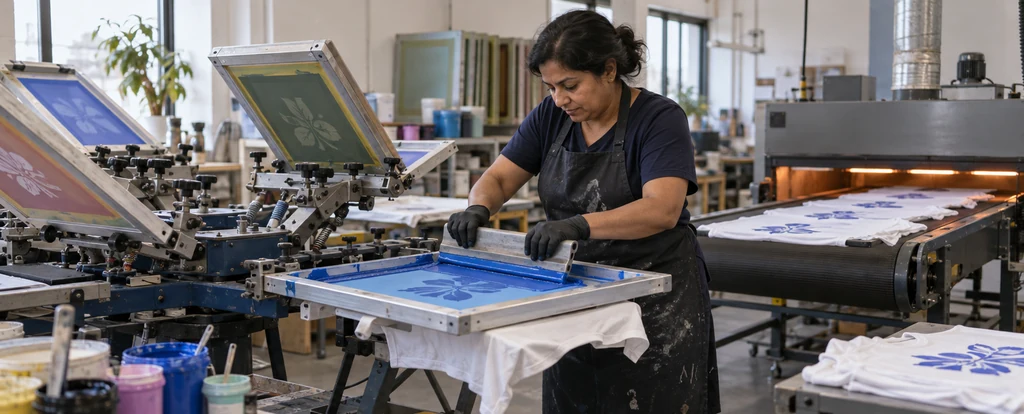
Screen printers work in small custom shops and in manufacturing plants, coating and exposing mesh screens, mixing inks and running manual or automatic carousel presses. What sets the job apart from other printing is the stencil itself: ink is laid down in one thick pass through a mesh screen, so the process handles curved bottles, tote bags and forty-shirt orders that offset or digital presses would cost too much to set up. Most people learn it on the job through an apprenticeship rather than in a classroom.
How much do screen printers earn?
The median full-time salary for a screen printer is $59,800 per annum, before tax, up $12,400 since 2018.
Pay depends most on the award or enterprise agreement covering the workplace and on when you work, since afternoon, night and weekend shifts attract penalty rates that lift the weekly figure. Larger manufacturers and specialist garment printers generally pay above the award, while small custom shops often sit closer to it, and overtime in the busy months adds to take-home pay.
What does a screen printer do day to day?
The list below is what fills most weeks; the exact mix shifts with seniority and whatever stage the current work is at.
- Coating mesh screens with light-sensitive emulsion and exposing artwork to create stencils
- Mixing inks to match colour specifications and Pantone references
- Setting up and registering screens on manual or automatic carousel presses
- Pulling squeegees to transfer ink onto garments, signage and other substrates
- Curing printed items through conveyor dryers and inspecting output for defects
What skills do screen printers need?
Employers look for craft and handmade production, plant and equipment operation, installation and maintenance, backed by Adobe Illustrator fluency and strong attention to detail.
Specialist skills
- Craft and handmade production
- Plant and equipment operation
- Installation and maintenance
- Process improvement
- Operations management
Software and tools
- Adobe Illustrator
- CorelDRAW
- Wasatch SoftRIP
- Exposure unit
- Conveyor dryer
General skills
- Attention to detail
- Time and deadline management
Is the job growing?
About 1,100 people work as screen printers in Australia, and employment is projected to grow 5.1% over the decade to 2035. That's modest growth: demand is steady rather than booming.
How do you become a screen printer?
Here's the path most screen printers take, step by step.
- 1Start with a Certificate III in Printing
The screen printing stream covers mesh preparation, ink mixing, press operation and finishing, and it is offered through TAFE and other registered training providers.
- 2Take it on as an apprenticeship
Most people combine the qualification with paid work under a qualified printer, which is where the practical skills are actually built. The apprenticeship runs over several years and you earn while you train.
- 3Or start as a printer's assistant
Shops hire assistants to load garments, mix ink and clean screens, and that experience shortens the apprenticeship considerably if you decide to formalise it later.
- 4Build colour and press judgement
Matching a reference colour by eye, adjusting squeegee pressure and knowing when ink has thinned too far take time on the job, and they matter more than the certificate once you are running your own jobs.
- 5Settle into a speciality
Printers typically end up in garment printing, industrial and signage work or glass and plastics, because the substrates, inks and equipment differ, and that choice shapes where the work is available.
Ready to apply as a screen printer?
Whether you're working toward becoming a screen printer or already are one and want a hand with the next step (sharpening your resume for ATS screening, tightening your cover letter, or knowing what you'll actually be asked at interview), here are examples grounded in this specific role, not generic templates.
What jobs can a screen printer move to?
Moving into Graphic Designer typically comes with the biggest pay rise, worth $36,400 a year more on average.
| Move to | Typical pay change | Overlap | Retraining |
|---|---|---|---|
| Graphic Designer A screen printer brings print production knowledge to graphic design, but needs substantial design training to create layouts and artwork.Known move | +$36,400 | 4% | reskill |
| Printer A screen printer brings ink, substrate and press setup skills to general printing, with further training covering other press types.Known move | +$13,400 | 78% | reskill |
| Print Finisher A screen printer brings print production and substrate knowledge to finishing, with training in binding, laminating and trimming.Known move | +$2,600 | 78% | reskill |
Moves are chosen from Jobs and Skills Australia's Data on Occupation Mobility, which follows income tax records between 2011-12 and 2020-21, together with entry requirements and skill overlap. A known move is one people were seen making in that data. Pay change compares median full-time pay for the two roles.
Who works as a screen printer?
The typical screen printer is 45 years old; 76% are men, 68% work full-time, and full-timers average 40 hours a week.
- 45
- Median age
- 24%
- Female share
- 68%
- Full-time
- +0h
- vs all-jobs avg
What's it like being a screen printer?
A screen printing day moves between the screen room and the press: coating and exposing in the morning, then setting up and running jobs, with cleaning down at the end. The rhythm is set by job size, because short custom runs mean frequent changeovers while long runs mean standing at the press feeding and checking. It suits people who like working with their hands, notice colour and finish, and are content to solve a setup problem before the printing starts.
What people like
- The print is finished in front of you. Unlike work that disappears into a screen, a run comes off the dryer as a stack of finished garments or signs you can check and hand to the customer.
- The process suits odd jobs. Laying a thick ink film in one pass means curved bottles, tote bags and short runs are all practical, and those are the jobs that would cost too much to set up on another press.
- The craft shows in the setup. Mesh count, ink thickness and squeegee angle all change the result, and experienced printers develop a feel for the combination that machines have not replaced.
- The work crosses industries. One week might be band merchandise, the next industrial labels or printed glass, so the substrate changes and the problem changes with it.
What people find hard
- Inks and screen chemicals need managing. Solvent-based inks, emulsion and reclaiming chemicals mean gloves, ventilation and correct disposal are part of the daily routine rather than an occasional precaution.
- Setup can take longer than the run. A forty-shirt order may need three screens coated, exposed, registered and proofed before the first good print, and the customer is paying for finished shirts rather than preparation.
- Long runs get repetitive. Once a job is registered and running, the work becomes loading, pulling and checking for hours, and a print fault means stopping the whole run.
- Deadlines cluster around events and seasons. Festival merchandise, school orders and Christmas stock land in the same few months, and a late delivery is a missed event rather than an inconvenience.
Based on our synthesis of professional-body surveys and public accounts of the role, not first-person verified reviews.
Which industries employ screen printers?
Manufacturing employs the largest share of screen printers.
Top employing industries
- 1Manufacturing
Ranked by employment share; the source doesn't publish an exact percentage per industry.
| Year 12 or below | 45.6% | |
|---|---|---|
| Certificate III/IV | 29.6% | |
| Bachelor degree | 9.6% | |
| Diploma / Advanced Diploma | 9.4% | |
| Postgraduate | 1.3% |
Will AI replace screen printers?
Screen printing sits in the middle. The digital prep that turns a file into separated screens is largely automated, and computer-to-screen imaging has replaced hand exposure in many shops. The physical side resists that, because registration, squeegee technique and the way ink behaves change with every substrate and are judged by eye and hand.
Share of typical working time by exposure level
- Setting up and running the pressRegistration, squeegee angle and pressure are adjusted by feel, and an automatic carousel still needs someone watching ink build-up and substrate alignment.45%low
- Preparing artwork and colour separationsSoftware splits a design into screens and a RIP arranges the layout, though someone still decides mesh count, ink order and trapping for the job.20%high
- Coating, exposing and reclaiming screensComputer-to-screen units image mesh automatically in larger shops, while coating, drying and reclaiming stay manual and are hard on the hands.20%moderate
- Curing, inspecting and finishingDryer temperature and belt speed are set by the substrate, and spotting a misprint before the run ships is a visual check against the proof.15%low
Common questions about becoming a screen printer
Straight answers to the questions people ask most.
How much do screen printers earn?
Full-time screen printers earn a median of $59,800 per year before tax, which reflects full-time workers rather than casual or part-time rates. Shift loadings, the size of the shop and whether the work is award-based or covered by an enterprise agreement all move that figure.
How do you become a screen printer?
The usual route is a Certificate III in Printing (ICP31220) with a screen printing focus, taken as an apprenticeship so you train under a qualified printer while being paid. Many people start as a printer's assistant loading garments and cleaning screens, which is a practical way in and shortens the apprenticeship later.
Are screen printers in demand?
Screen printers are currently not in shortage, and employment is projected to grow 5.1% over the decade to 2035. With about 1,100 people in the occupation, openings come up as experienced printers leave as well as from new positions, so a shop looking for someone with press experience may still take time to fill the role.
Will AI or automation replace screen printers?
The prep work is the most exposed part: design software and RIP software split artwork into colour separations, and computer-to-screen units image mesh directly in many larger shops. The press itself stays hands on, because registration, squeegee pressure and ink viscosity are judged by eye and adjusted for each substrate.
What can a screen printer move into?
Moving into general printing as a printer uses the same press and ink knowledge and pays $13,400 more, while print finishing is a smaller step at $2,600 more. Graphic design pays $36,400 more but needs substantial design training, since the skill overlap is small. Owning a small custom apparel or signage business is a common progression and often where earnings grow.
Do you need a qualification to work as a screen printer?
Not always. Some shops hire people with no formal training and teach screen preparation and press work on the job, and around 46% of the current workforce finished at Year 12 or below. A Certificate III still helps if you want to move into supervision or set up your own business.
Related roles
Not sure this is you? Take the career quiz and get a ranked shortlist of roles that fit how you like to work.