Home Manufacturing & Production
Print Finisher
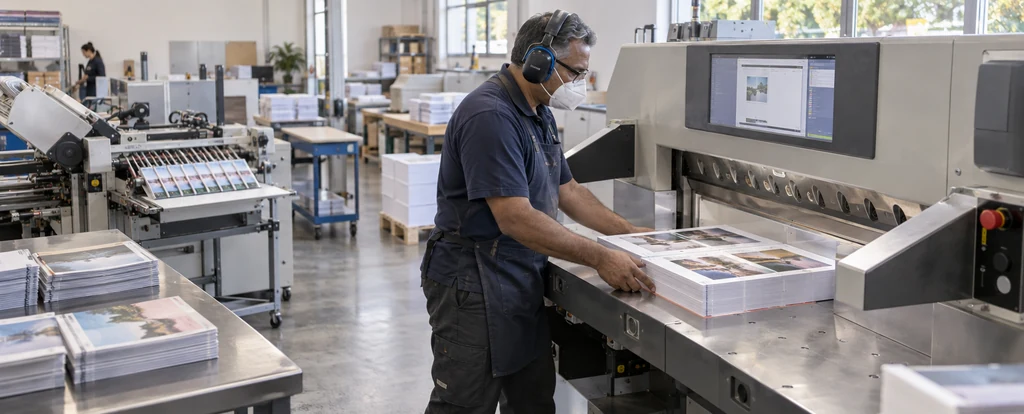
Print finishers complete printed work, cutting, folding, stitching and binding sheets into finished books, brochures and packaging.
- Median salary*
- $62,400
3.5%vs last year, before tax
- People employed
- 1,400
0.0%vs last year
- Projected growth
- +5.1%
to 2035
- AI exposure*
- Moderate
- automation risk
- Average hours
- 39/wk
−1h vs all jobs
- Shortage status
- Not in shortage
national
Print finishers work at the end of the printing process, in commercial print rooms, bindery departments and mail houses. They are the last people to handle a job before it is packed and delivered, so the final check on quality sits with them. The printer produces the sheets; the finisher turns those sheets into something a customer can use.
How much do print finishers earn?
The median full-time salary for a print finisher is $62,400 per annum, before tax, up $13,300 since 2018.
Most print finishers are covered by the Graphic Arts, Printing and Publishing Award, so shift loadings, overtime and weekend work add to the base rate. Larger print and packaging plants tend to pay above the award and offer more overtime, while small binderies often pay closer to it. Pay also follows the machines you can set up, with a perfect binder or a supervisory role worth more than a feeding or packing position.
What does a print finisher do day to day?
The list below is what fills most weeks; the exact mix shifts with seniority and whatever stage the current work is at.
- Setting up and running guillotines to trim stacks of printed sheets to size
- Folding sheets on a folding machine and checking that the folds line up
- Binding books and brochures by stitching, perfect binding or sewing
- Feeding stock, clearing jams and adjusting machines when paper or card misbehaves
- Checking finished jobs against the sample and packing them for delivery
What skills do print finishers need?
Employers look for plant and equipment operation, operations management, craft and handmade production, backed by Guillotine fluency and strong attention to detail.
Specialist skills
- Plant and equipment operation
- Operations management
- Craft and handmade production
- Process improvement
Software and tools
- Guillotine
- Folding machine
- Perfect binder
- Stitching machine
- Print management software (e.g. Heidelberg Prinect)
General skills
- Attention to detail
- Problem solving
- Time and deadline management
Is the job growing?
About 1,400 people work as print finishers in Australia, and employment is projected to grow 5.1% over the decade to 2035. That's modest growth: demand is steady rather than booming.
How do you become a print finisher?
Here's the path most print finishers take, step by step.
- 1Start on the floor as a finishing hand or printer's assistant
This is a trade you can enter without a qualification, feeding machines, stacking and packing, and much of the training happens on the job. It is paid work from day one and gives you a look at the equipment before you commit to an apprenticeship.
- 2Take on a Certificate III in Printing apprenticeship
The certificate includes finishing streams covering cutting, folding and binding, and it usually takes three to four years while you are employed, so you are paid throughout. Around 45% of print finishers hold a certificate III or IV, and most gained it through an Australian Apprenticeship.
- 3Learn the machines one at a time
Most finishers start on the guillotine or a folding machine and move across to stitchers and perfect binders as they gain experience. Being able to set up and troubleshoot a perfect binder without help is what turns a machine operator into someone employers hold onto.
- 4Add the licences and qualifications your employer uses
A forklift licence helps in plants where you move pallets of stock, and familiarity with print management software such as Heidelberg Prinect matters as more jobs are set from digital job specifications. Requirements vary between employers, so ask what the plant runs before paying for training.
Ready to apply as a print finisher?
Whether you're working toward becoming a print finisher or already are one and want a hand with the next step (sharpening your resume for ATS screening, tightening your cover letter, or knowing what you'll actually be asked at interview), here are examples grounded in this specific role, not generic templates.
What jobs can a print finisher move to?
Moving into Graphic Designer typically comes with the biggest pay rise, worth $33,800 a year more on average.
| Move to | Typical pay change | Overlap | Retraining |
|---|---|---|---|
| Graphic Designer Print finishers bring production knowledge to design for print, but design software and portfolio skills require substantial study.Known move | +$33,800 | 8% | reskill |
| Printer Print finishers bring binding and finishing knowledge to press operations, but additional printing training is required.Known move | +$10,800 | 100% | reskill |
| Pre-press Operator Print finishers bring print workflow knowledge to pre-press, but file preparation and software skills require a new qualification. | +$0 | 30% | requalify |
| Screen Printer Print finishers bring trade skills and print production knowledge to screen printing, with training in screen processes.Known move | −$2,600 | 78% | reskill |
Moves are chosen from Jobs and Skills Australia's Data on Occupation Mobility, which follows income tax records between 2011-12 and 2020-21, together with entry requirements and skill overlap. A known move is one people were seen making in that data. Pay change compares median full-time pay for the two roles.
Who works as a print finisher?
The typical print finisher is 51 years old; 71% are men, 75% work full-time, and full-timers average 39 hours a week.
- 51
- Median age
- 29%
- Female share
- 75%
- Full-time
- −1h
- vs all-jobs avg
What's it like being a print finisher?
Print finishing is the last stage of the print process, which shapes the working day: jobs arrive from the press needing to go out, so pressure builds towards the afternoon and around deadlines. The work itself is steady and hands-on, mostly standing at machines with short bursts of problem solving when stock misbehaves. It suits people who like order, tidy results and equipment that responds to a careful setup.
What people like
- You finish something you can hold. A stack of flat sheets becomes a bound book or a boxed brochure by the end of the shift, and the result is easy to check.
- Machines reward a careful setup. A guillotine cuts square and a folder lines up its signatures when the settings are right, so accuracy shows straight away.
- Different jobs through the week. Short digital runs bring new stock, sizes and formats regularly rather than one product for months.
- Practical problem solving. Paper that curls, jams or slips is a puzzle you solve with tension, air and speed rather than a manual.
What people find hard
- Deadlines land at the end. Finishing is the last step, so delays earlier in the process get made up here, often with the delivery van waiting.
- Standing work and heavy stock. Shifts are spent on your feet, and lifting and moving paper stacks is part of the job in most plants.
- Long repetitive runs. A large print run means the same fold or stitch for hours, watching for faults rather than doing anything new.
- Small tolerances. A millimetre out shows on the finished edge of a book, so trimming and folding have to be right every time.
Based on our synthesis of professional-body surveys and public accounts of the role, not first-person verified reviews.
Which industries employ print finishers?
Manufacturing employs the largest share of print finishers, followed by Information Media and Telecommunications.
Top employing industries
- 1Manufacturing
- 2Information Media and Telecommunications
Ranked by employment share; the source doesn't publish an exact percentage per industry.
| Certificate III/IV | 44.7% | |
|---|---|---|
| Year 12 or below | 37.3% | |
| Bachelor degree | 7.1% | |
| Diploma / Advanced Diploma | 6.8% | |
| Postgraduate | 1.1% |
Will AI replace print finishers?
Print finishing sits in the middle: the setup and calculation side of the job is increasingly handled by software, while the machines still need someone to feed them, watch them and fix what goes wrong. Print management systems such as Heidelberg Prinect now push job settings straight to a guillotine or folder, and inline inspection on digital presses catches faults that used to be picked up by eye. What has not changed is the physical handling of stock and the judgement that comes from knowing how a particular paper behaves.
Share of typical working time by exposure level
- Running guillotines, folders and bindersThe machines run once they are set, but they still need watching, adjusting and reloading through a long run.30%moderate
- Feeding stock and clearing jamsLifting paper stacks onto the feed, clearing misfeeds and keeping the run moving is manual work that depends on feel.30%low
- Programming cuts and folds from the job specificationImposition and setup software works out the cut sequence and fold settings, so the operator checks the numbers rather than calculating them.20%high
- Checking and packing finished workInline inspection catches many errors, though the final check against the sample and packing for dispatch still means handling the job.20%moderate
Common questions about becoming a print finisher
Straight answers to the questions people ask most.
How much does a print finisher earn?
Print finishers earn a median of $62,400 per year before tax, or about $1,200 a week for full-time work. Shift loadings, overtime and the machines you can set up move that figure most, and larger plants generally pay above the award.
How do you become a print finisher?
Most people start as a finishing hand or printer's assistant and take on a Certificate III in Printing (ICP31220) apprenticeship within the first year or two. The apprenticeship takes three to four years and covers cutting, folding and binding, and you are paid while you complete it. No prior qualification is needed to start on the floor, so factory or warehouse work can also be a way in.
Are print finishers in demand?
Print finishers are currently not in shortage. Employment is projected to grow 5.1% over the decade to 2035, and with about 1,400 people in the trade, openings tend to be local and specific, so approaching print and packaging plants directly is worth as much as watching advertised roles.
Will AI and automation replace print finishers?
Automation has reached setup and quality checking more than the machines themselves. Print management software now sends cut and fold settings straight to the equipment, and inline inspection on digital presses picks up some faults, but someone still has to load stock, clear jams and judge how a particular paper is running. That leaves fewer calculations in the job and about the same amount of hands-on work.
What can print finishers move into?
Many move into press work: printers earn $10,800 more and bring their finishing knowledge with them, though they need training on press operation. Screen printing is a closer sideways move, at $2,600 less with much of the trade skill carrying over. Moving into pre-press is also possible at about the same pay, but file preparation and software skills usually mean a new qualification.
Do you need a qualification to work as a print finisher?
You can start without one, and plenty of finishers learn the machines on the job first. A Certificate III in Printing with a finishing stream is the qualification employers recognise, and it is usually completed as an apprenticeship while you work. Practical machine time counts for a lot when you apply for the next role.
Related roles
Not sure this is you? Take the career quiz and get a ranked shortlist of roles that fit how you like to work.