Picture Framer
Picture framers cut, join and finish the frames that protect artworks and photographs, and help customers decide how a piece will be presented.
- Median salary*
- $57,200
4.2%vs last year, before tax
- People employed
- 1,600
0.0%vs last year
- Projected growth
- +6.1%
to 2035
- AI exposure*
- Low
- automation risk
- Average hours
- 42/wk
+2h vs all jobs
- Shortage status
- Not in shortage
national
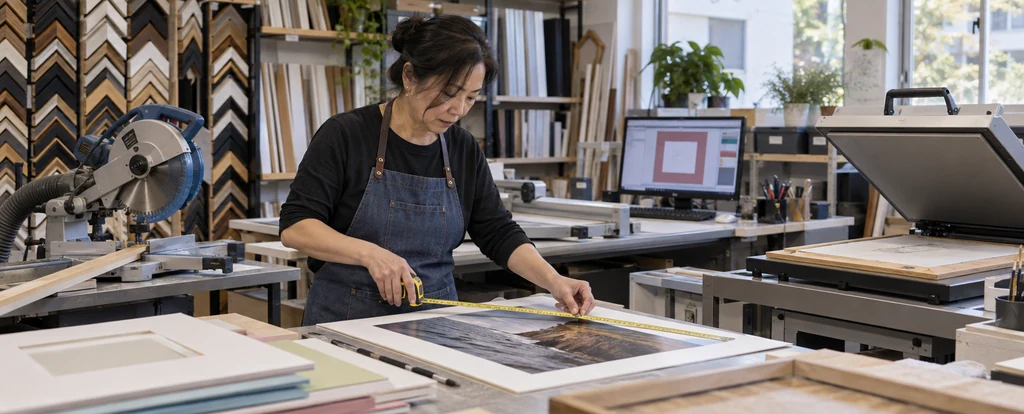
Most picture framers work in small workshops, often attached to a retail shopfront, handling a job from the first measurement to the final fit. The role sits between a craft trade and a retail service, because you cut and assemble the frame yourself and then talk the customer through mouldings, mounts and glass. It is not the same as conservation, which treats the artwork itself and is usually done by specialists in galleries and museums.
How much do picture framers earn?
The median full-time salary for a picture framer is $57,200 per annum, before tax, up $12,000 since 2018.
What a framer earns depends on the business, since small retail studios tend to pay less than workshops supplying galleries, museums or corporate clients. Framers who run their own workshop set their own prices and keep the margin on each job, which is where earnings can grow most. Additional training in conservation framing can support higher rates for gallery and museum work.
What does a picture framer do day to day?
The list below is what fills most weeks; the exact mix shifts with seniority and whatever stage the current work is at.
- Measuring artworks and cutting moulding, mount board and backing to size
- Joining frame corners and assembling the frame
- Cutting glass and fitting it, the mount and the backing into the frame
- Mounting and hinging artworks, photographs and objects
- Advising customers on moulding, mount colour and glass
What skills do picture framers need?
Employers look for craft and handmade production, quoting and estimating, visual design, backed by FrameReady fluency and strong attention to detail.
Specialist skills
- Craft and handmade production
- Quoting and estimating
- Visual design
- Inventory management
Software and tools
- FrameReady
- EstLite
- computerised mat cutter
- mitre saw
- dry mount press
General skills
- Attention to detail
- Customer service
- Written communication
Is the job growing?
About 1,600 people work as picture framers in Australia, and employment is projected to grow 6.1% over the decade to 2035. That's modest growth: demand is steady rather than booming.
How do you become a picture framer?
Here's the path most picture framers take, step by step.
- 1Build hand skills with materials
Art, design and woodwork subjects at school, or a hobby in woodwork, printmaking or photography, develop the measuring and cutting habits framing relies on. Most people still enter through a workshop rather than study.
- 2Find work in a framing workshop
Entry is usually as a framing assistant or apprentice, learning measuring, cutting, joining and mounting on the job while being paid. Retail framing businesses and gallery workshops are the common employers.
- 3Complete a Certificate III in picture framing
This is the trade qualification, covering mount cutting, conservation mounting, glass and frame finishing, and it can be done part time while you work. Some TAFE and private providers offer it, so check what is available in your state.
- 4Add conservation and specialist skills
Short courses in conservation framing and in handling works on paper open up gallery, museum and collector work, where the standards for materials and reversible mounting are stricter.
- 5Learn the business side
Many framers eventually run their own studio, which means quoting jobs accurately, managing stock of moulding, glass and mount board, and keeping relationships with suppliers.
Ready to apply as a picture framer?
Whether you're working toward becoming a picture framer or already are one and want a hand with the next step (sharpening your resume for ATS screening, tightening your cover letter, or knowing what you'll actually be asked at interview), here are examples grounded in this specific role, not generic templates.
What jobs can a picture framer move to?
Moving into Leather Goods Maker typically comes with the biggest pay rise, worth $7,800 a year more on average.
| Move to | Typical pay change | Overlap | Retraining |
|---|---|---|---|
| Leather Goods Maker Picture framers bring accurate cutting, assembly and finishing to leather goods making, with a short course covering leather techniques. | +$7,800 | 52% | short course |
| Engraver Picture framers bring steady hand skills and glass cutting to engraving, with reskilling in metal and stone techniques. | +$7,800 | 33% | reskill |
| Jeweller Picture framers bring fine-detail work and precision tool use to jewellery, but a full apprenticeship is needed to learn metalwork. | +$2,600 | 40% | requalify |
| Tailor Picture framers bring precise cutting, measuring and finishing skills to tailoring, though fabric handling needs a short course. | −$2,600 | 53% | short course |
| Milliner Picture framers bring hand-tool precision and structural assembly to millinery, requiring reskilling in blocking and fabric shaping. | −$2,600 | 53% | reskill |
Moves are chosen from Jobs and Skills Australia's Data on Occupation Mobility, which follows income tax records between 2011-12 and 2020-21, together with entry requirements and skill overlap. A known move is one people were seen making in that data. Pay change compares median full-time pay for the two roles.
Who works as a picture framer?
The typical picture framer is 51 years old; 65% are men, 51% work full-time, and full-timers average 42 hours a week.
- 51
- Median age
- 35%
- Female share
- 51%
- Full-time
- +2h
- vs all-jobs avg
What's it like being a picture framer?
The rhythm of the job comes from the mix of bench work and counter work: a framer moves between the mitre saw and mat cutter and the customer choosing a moulding. Jobs are small and varied, which suits people who like seeing a piece finished and out the door, and who do not mind that each one is priced before it exists. The pace is steady rather than fast, but the tolerance for error is low because moulding and glass are already paid for by the time you cut them.
What people like
- Every job is a different size. A 40 by 50 centimetre print, a stretched canvas and a cricket ball in a display case all need different measurements, mounts and depths, so the bench work rarely becomes identical.
- You finish something physical. A frame is completed in a day or a week rather than over months, and the customer usually sees it at the counter, which is a quick and visible result.
- The design side rewards a good eye. Matching a moulding and mount to a piece changes how it reads, and customers notice when the proportions and colour work.
- Small studios mean broad responsibility. In a two or three person workshop you may quote, order stock, cut, assemble and serve customers in the same week, which keeps the role varied.
What people find hard
- Quoting one-off jobs is guesswork at the edges. You price a job before you have cut anything, so a misjudged measurement or an awkward shape eats the margin on that piece.
- Materials are a big share of the price. Moulding, glass and mount board are a large part of what the customer pays, so supplier price changes squeeze margins quickly.
- The work is physical and the space is dusty. Framers stand for most of the day, lift sheets of glass and board, and work around the noise of mitre saws and the dust that comes with cutting.
- Demand follows discretionary spending. Custom framing is something households postpone when budgets tighten, so a workshop tied to walk-in retail trade is quieter in those periods.
Based on our synthesis of professional-body surveys and public accounts of the role, not first-person verified reviews.
Which industries employ picture framers?
Retail Trade employs the largest share of picture framers, followed by Manufacturing.
Top employing industries
- 1Retail Trade
- 2Manufacturing
- 3Arts and Recreation Services
Ranked by employment share; the source doesn't publish an exact percentage per industry.
| Year 12 or below | 41.3% | |
|---|---|---|
| Bachelor degree | 19.7% | |
| Certificate III/IV | 19.1% | |
| Diploma / Advanced Diploma | 11.8% | |
| Postgraduate | 4.3% |
Will AI replace picture framers?
Picture framing carries low exposure to AI and automation. Computerised mat cutters, quoting software and online frame previews have changed how quickly a job can be planned and priced, but the artwork still has to be measured, hinged and fitted by hand, and much of the day is spent physically handling other people's possessions.
Share of typical working time by exposure level
- Measuring, cutting and joining frame mouldingA computerised cutter handles repeat mat work, while cutting a one-off frame to fit an odd-sized canvas remains a hand job at the mitre saw.30%low
- Cutting mounts and fitting glassGlass and board are cut to the frame in front of you, and a mistake on a piece of non-reflective glass means starting again.25%low
- Mounting and hinging artworks and objectsHinging a watercolour with conservation tape or building a deep mount for a medal still depends on knowing what is safe to do to the object.25%low
- Advising customers on frame design, mounts and glassSoftware and online previews can show a customer how a moulding will look before it is cut, but a framer still reads the artwork and suggests what will suit it.20%moderate
Common questions about becoming a picture framer
Straight answers to the questions people ask most.
How much do picture framers earn?
Picture framers earn $57,200 per annum, before tax. Small studios and retail shopfronts tend to pay less than workshops supplying galleries, museums or corporate clients, and framers who own the business keep the margin on each job instead of a wage. Treat the figure as a guide, since rates are set by the individual business.
How do you become a picture framer?
Most people start by getting a job in a framing workshop as an assistant or apprentice and learn measuring, cutting and mounting on the job. A Certificate III in picture framing is the formal trade qualification and can be completed part time while you work. Conservation framing courses are the usual next step if you want gallery or museum work.
Are picture framers in demand?
Picture framers are currently not in shortage, and employment is projected to grow 6.1% over the decade to 2035. Demand is tied to how much households and businesses spend on framing, which moves with discretionary spending, so work is steadier in workshops with gallery, corporate or interior design clients than in purely retail framing.
Will AI replace picture framers?
Not the hands-on parts of the job, which is why picture framing rates as low exposure to AI. Design software and online tools let a customer preview a frame or generate a quote, and computerised mat cutters speed up the cutting. The measuring, joining, glass cutting and mounting of a real object still happen at the bench, and that is most of the week.
What can picture framers move into?
Running your own workshop is a common progression and is often where earnings grow, because you keep the margin on each job rather than a wage. Leather goods making and engraving use the same precision cutting and finishing, and those framers earn $7,800 more and $7,800 more, though each needs a short course or reskilling. Jewellery is a larger step, since it takes a full apprenticeship to learn metalwork, and jewellers earn $2,600 more.
Is picture framing the same as conservation?
No. A picture framer mounts and presents an artwork, while a conservator treats the object itself by cleaning, repairing and stabilising it. Good framers use conservation-grade materials and reversible mounting so their work does not damage the piece, but treating a damaged work is a separate qualification and usually happens in galleries and museums.
Related roles
Not sure this is you? Take the career quiz and get a ranked shortlist of roles that fit how you like to work.