Milliner
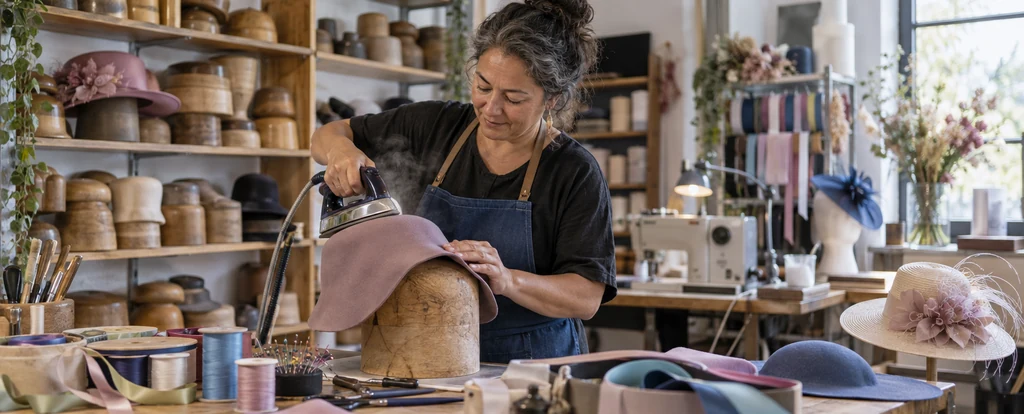
Milliners design and make hats and headwear, often shaping felt or straw over a wooden block by hand.
- Median salary*
- $54,600
4.2%vs last year, before tax
- People employed*
- 450
12.5%vs last year
- Projected growth
- +10%
to 2035
- AI exposure*
- Low
- automation risk
- Average hours*
- 38/wk
−2h vs all jobs
- Shortage status
- Not in shortage
national
Milliners usually work in small studios or from home, making hats to order for weddings, racing, theatre and film as well as for retail stock. The trade sits closer to tailoring than to fashion design: each hat is shaped over a block, hand finished and fitted to one head. Many milliners run their own business, and those employed by labels or costume houses are a minority.
How much do milliners earn?
The median full-time salary for a milliner is $54,600 per annum, before tax, up $11,500 since 2018.
Most milliners are self-employed or work in very small studios, so income depends on the order book rather than an award rate. Retail and bridal work brings steadier money, while bespoke and racing commissions can pay more per piece but arrive in seasonal bursts. Reputation and repeat clients move earnings more than location does, though a studio near a busy racing or theatre scene has more occasions to sell into.
What does a milliner do day to day?
The list below is what fills most weeks; the exact mix shifts with seniority and whatever stage the current work is at.
- Blocking felt or straw over a wooden block, steaming and pinning it into the crown shape a design calls for
- Hand sewing sweatbands, wiring brims and stitching linings so a hat sits comfortably and keeps its shape
- Trimming finished pieces with ribbon, feathers, veiling or flowers to match a client's outfit or a label's range
- Measuring a customer's head and fitting a hat in the studio or at a retail counter, adjusting it on the spot
- Repairing and reshaping worn hats, which brings regular customers back between the seasonal peaks
What skills do milliners need?
Employers look for craft and handmade production, visual design, backed by Sewing machine fluency and strong attention to detail.
Specialist skills
- Craft and handmade production
- Visual design
Software and tools
- Sewing machine
- Hat blocks
- Steam iron
- Adobe Illustrator
- Pins and needles
General skills
- Attention to detail
- Customer service
- Written communication
- Problem solving
- Time and deadline management
Is the job growing?
About 450 people work as milliners in Australia, and employment is projected to grow 10% over the decade to 2035. That's healthy, above-average growth, and the role should stay in solid demand.
How do you become a milliner?
Here's the path most milliners take, step by step.
- 1Learn the craft
A Certificate III in Millinery (MST30316), offered by some TAFE colleges, covers blocking, shaping, trimming and finishing and can be done part time. Check what is running in your state, because courses come and go with demand.
- 2Train in a working studio
Apprenticeships and assistant roles with an established milliner are how many people pick up the speed and hand skills a course cannot teach. Expect to be paid while you learn, and to spend your first months on trimming and finishing rather than design.
- 3Build a portfolio
Hats photograph well, so keep a record of finished pieces and the occasions they were made for. Entering millinery awards and showing at racing carnivals is a common way to be noticed, because the industry is small.
- 4Choose a market
Milliners sell through retail, bridal and racing work, costume houses for theatre and film, or their own label. Each has a different customer and pace, and it is worth trying more than one before settling.
- 5Set up your own studio
Many milliners end up self-employed, which means handling pricing, material sourcing, photography and bookkeeping alongside the making. Business skills start to matter as much as the craft once you are on your own.
Ready to apply as a milliner?
Whether you're working toward becoming a milliner or already are one and want a hand with the next step (sharpening your resume for ATS screening, tightening your cover letter, or knowing what you'll actually be asked at interview), here are examples grounded in this specific role, not generic templates.
What jobs can a milliner move to?
Moving into Textile Designer typically comes with the biggest pay rise, worth $23,400 a year more on average.
| Move to | Typical pay change | Overlap | Retraining |
|---|---|---|---|
| Textile Designer A milliner brings headwear design, colour and material knowledge to textile design, though a design qualification is needed.Known move | +$23,400 | 44% | reskill |
| Clothing Patternmaker A milliner brings hat blocking, pattern and hand-finishing skills to clothing patternmaking, though formal patternmaking study is needed. | +$10,400 | 30% | reskill |
| Costume Maker A milliner brings hand sewing, shaping and decorative finishing to costume making, with a short course to adapt. | +$10,400 | 53% | short course |
| Fashion Designer A milliner brings garment and headwear construction plus design sense to fashion design, with further formal study required.Known move | +$4,900 | 21% | reskill |
Moves are chosen from Jobs and Skills Australia's Data on Occupation Mobility, which follows income tax records between 2011-12 and 2020-21, together with entry requirements and skill overlap. A known move is one people were seen making in that data. Pay change compares median full-time pay for the two roles.
Who works as a milliner?
The typical milliner is 46 years old; 88% are women, 45% work full-time, and full-timers average 38 hours a week.
- 46
- Median age
- 88%
- Female share
- 45%
- Full-time
- −2h
- vs all-jobs avg
What's it like being a milliner?
Millinery is a small, hands-on trade with a seasonal rhythm. Spring racing, weddings and summer drive the busy months and the weeks after are quieter, so the work suits someone who can plan around that. It rewards patience and precision more than speed, and it tends to hold the people who like working with their hands and seeing a finished piece worn.
What people like
- You make the whole piece. Blocking, sewing, trimming and fitting all sit with you, so a hat is recognisably yours from the crown to the last stitch.
- The work gets worn. A finished hat goes to a wedding, a race day or a stage, and clients often send back photographs of the occasion.
- Room for your own style. Bespoke clients come for a particular look, so there is space to develop a signature in shape and trim that retail work does not allow.
- Skills that keep improving. Blocking and shaping take years to get right, and the technique carries over to costume and textile work if you branch out later.
What people find hard
- The calendar drives everything. Spring racing, weddings and summer fill the order book, and the quieter months that follow need planning for.
- Most milliners work alone. Running a studio means quoting, ordering materials, photographing work and keeping accounts on top of the making.
- Repetitive handwork. Hours of pinning, steaming, wiring and stitching take a toll on hands, wrists and shoulders, especially through a busy season.
- Deadlines around events. A hat is needed for a date that cannot move, and a late change of outfit or trim leaves very little room to rework it.
Based on our synthesis of professional-body surveys and public accounts of the role, not first-person verified reviews.
Which industries employ milliners?
Clothing, footwear and personal accessory retailing employs the largest share of milliners, followed by Clothing and footwear manufacturing.
Top employing industries
- 1Clothing, footwear and personal accessory retailing
- 2Clothing and footwear manufacturing
- 3Creative and performing arts
- 4Personal and other services
Ranked by employment share; the source doesn't publish an exact percentage per industry.
| Certificate III/IV | 34% | |
|---|---|---|
| Diploma / Advanced Diploma | 26% | |
| Bachelor degree | 20% | |
| Year 12 or below | 20% |
Will AI replace milliners?
Millinery is one of the least exposed trades to AI, because the product is a shaped, hand-finished object made to fit one person. Design software can speed up sketches, colourways and lookbooks, and AI tools have changed how milliners market themselves, but nothing available blocks felt, wires a brim or measures a head.
Share of typical working time by exposure level
- Blocking and shaping hatsSteaming and pinning felt or straw over a wooden block to form a crown is judged by hand, and the block, the moisture and the pressure cannot be automated.35%low
- Hand finishing and trimmingSewing sweatbands, wiring brims and attaching veiling or feathers is slow handwork, and customers pay for a finish they can see and feel.30%low
- Fitting, consultations and repairsMeasuring a customer's head, adjusting a hat to a wedding outfit and reshaping a damaged brim are in-person services built on trust and handling.20%low
- Sketching designs and selecting materialsIllustration software and AI image tools can produce concept sketches and colour variations quickly, but choosing a felt or sinamay that will hold a shape is a maker's judgement.15%moderate
Common questions about becoming a milliner
Straight answers to the questions people ask most.
How much does a milliner earn?
$54,600 per year before tax is the median for full-time milliners. Because many milliners are self-employed or work part time, take-home income depends on how much bespoke and retail work you keep coming through the year.
How do you become a milliner?
Training usually starts with a Certificate III in Millinery (MST30316), which some TAFE colleges offer, or an apprenticeship with an established milliner. From there you build a portfolio of finished hats and a client base, since no licence or registration is needed to sell your work. Most custom comes through word of mouth and repeat customers.
Are milliners in demand?
Milliners are currently not in shortage, and employment is projected to grow 10% over the decade to 2035. Work is concentrated in small studios, retail millinery and costume houses, so openings come up through those rather than large employers. A strong portfolio and a niche, such as bridal or racing, makes it easier to find them.
Will AI replace milliners?
Very unlikely. Sketching and AI image tools can speed up concepts, colourways and marketing, but blocking felt, wiring a brim, hand sewing and measuring a head are physical work done by hand. The exposed part of the job is the design drafting and promotion, not the making.
What is the difference between a milliner and a fashion designer?
A milliner specialises in headwear, while a fashion designer works across full garments. Milliners shape hats over blocks and finish them by hand, which is closer to tailoring and costume work than to garment design. Some people move between the two, but each has its own training.
Where do milliners move on to?
Costume making is a common next step, since hand sewing and shaping carry over and a short course covers the rest, and textile design uses the same colour and material knowledge but pays $23,400 more and needs a design qualification. Many milliners stay in the trade and build their own label or studio, which is often where earnings grow.
Related roles
Not sure this is you? Take the career quiz and get a ranked shortlist of roles that fit how you like to work.