Textile Designer
Textile designers create the patterns, prints, weaves and knits that end up on clothing, furnishings and other fabrics.
- Median salary*
- $78,000
3.6%vs last year, before tax
- People employed*
- 1,600
0.0%vs last year
- Projected growth
- +20.9%
to 2035
- AI exposure*
- Moderate
- automation risk
- Average hours*
- 39/wk
−1h vs all jobs
- Shortage status
- Not in shortage
national
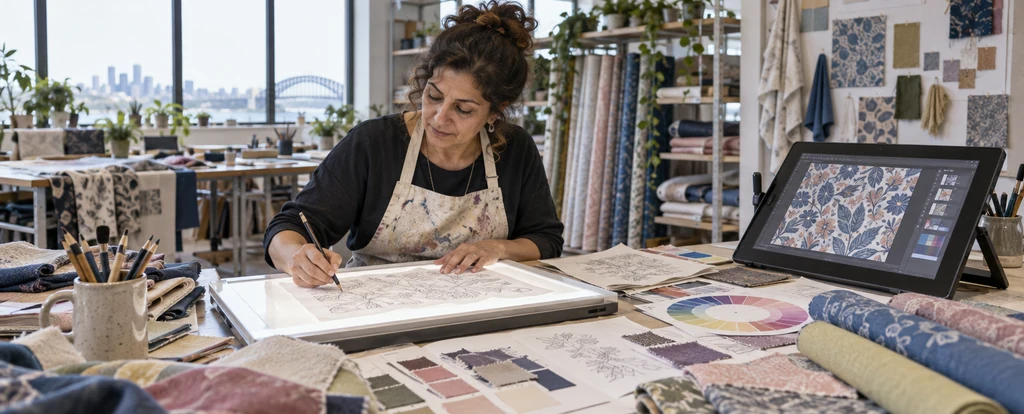
The work happens in studios attached to textile mills, fashion labels, homewares brands and design consultancies. A textile designer has to know how a design will behave once it is printed, woven or knitted, which is what separates the role from graphic design. About 1,600 people work in the role, so it is a small field where most designers work in small teams rather than large departments.
How much do textile designers earn?
The median full-time salary for a textile designer is $78,000 per annum, before tax, up $16,600 since 2018.
Pay in textile design depends more on who employs you than on the job title. Salaried studio roles at a mill or a larger brand sit under an award or enterprise agreement and come with steady hours, while freelance designers are usually paid per design, per collection or on a royalty arrangement, so annual earnings depend on how much work they win. Licensing, where one print is sold to several manufacturers, changes the picture again.
What does a textile designer do day to day?
The list below is what fills most weeks; the exact mix shifts with seniority and whatever stage the current work is at.
- Researching colour, texture and pattern trends for an upcoming season
- Drawing motifs by hand and building them into digital repeat files
- Developing colourways and checking them against fabric and ink samples
- Testing designs on strike-offs and adjusting them for production
- Preparing technical specifications, artwork files and colour standards for manufacturers
What skills do textile designers need?
Employers look for visual design, creative software production, craft and handmade production, backed by Adobe Illustrator fluency and strong attention to detail.
Specialist skills
- Visual design
- Creative software production
- Craft and handmade production
- Project management
Software and tools
- Adobe Illustrator
- Adobe Photoshop
- NedGraphics
- Procreate
- CLO 3D
General skills
- Attention to detail
- Written communication
- Client relationships and advisory
Is the job growing?
About 1,600 people work as textile designers in Australia, and employment is projected to grow 20.9% over the decade to 2035. That's very strong growth. Few roles in Australia are expanding this fast, and it points to solid demand for years to come.
How do you become a textile designer?
Here's the path most textile designers take, step by step.
- 1Build a folio before you apply
Design courses and junior studio roles both turn on a portfolio, so keep a sketchbook of prints, drawings and fabric experiments and photograph the samples you make.
- 2Study textile design, fashion or a related field
A bachelor degree takes about three years and is the most common route: 52% of textile designers hold a Bachelor degree. TAFE diplomas in textile design or applied fashion are a shorter option and can lead into assistant work.
- 3Learn the production software and the mill end of the job
NedGraphics, Adobe Illustrator and Photoshop are standard in studios, and CLO 3D is increasingly used to show how a print sits on a garment. Understanding how screen printing, digital printing and weaving change a design is what makes a file manufacturable.
- 4Start as a design assistant or studio junior
These roles usually involve colouring repeats, preparing artwork files and archiving prints, and they teach the production knowledge that studios expect before you design a collection of your own.
Ready to apply as a textile designer?
Whether you're working toward becoming a textile designer or already are one and want a hand with the next step (sharpening your resume for ATS screening, tightening your cover letter, or knowing what you'll actually be asked at interview), here are examples grounded in this specific role, not generic templates.
What jobs can a textile designer move to?
Moving into Marketing Manager typically comes with the biggest pay rise, worth $61,200 a year more on average.
| Move to | Typical pay change | Overlap | Retraining |
|---|---|---|---|
| Marketing Manager A textile designer brings product and trend knowledge to marketing management, with retraining to learn campaign strategy and budget oversight.Known move | +$61,200 | 14% | reskill |
| Graphic Designer A textile designer brings pattern, colour and composition skills to graphic design, with retraining to adapt to digital tools and layout.Known move | +$18,200 | 44% | reskill |
| Interior Designer A textile designer brings colour, texture and material knowledge to interior design, with a short course to learn spatial planning and building codes.Known move | +$10,000 | 55% | short course |
| Retail Buyer A textile designer brings fabric and trend expertise to retail buying, with retraining to master range planning and supplier negotiation.Known move | +$1,800 | 3% | reskill |
| Milliner A textile designer brings fabric manipulation and construction skills to millinery, with retraining to specialise in hat blocking and trimming.Known move | −$23,400 | 44% | reskill |
Moves are chosen from Jobs and Skills Australia's Data on Occupation Mobility, which follows income tax records between 2011-12 and 2020-21, together with entry requirements and skill overlap. A known move is one people were seen making in that data. Pay change compares median full-time pay for the two roles.
Who works as a textile designer?
The typical textile designer is 38 years old; 78% are women, 68% work full-time, and full-timers average 39 hours a week.
- 38
- Median age
- 78%
- Female share
- 68%
- Full-time
- −1h
- vs all-jobs avg
What's it like being a textile designer?
The job runs on the fashion and homewares calendar, so studio life swings between intense concept periods and the slower work of pushing a design through sampling and production. Teams are usually small, which means one person often handles the drawing, the repeat file and the conversation with the mill. It suits people who enjoy both the craft and the production puzzle.
What people like
- Seeing a print on a finished product. After colour matching, sampling and production, the first time a design appears on a garment or a cushion is when the whole process pays off.
- Days that move between hand and screen. Drawing, painting and print experiments sit alongside repeat files in Illustrator or NedGraphics, so the work rarely stays at a desk for long.
- Working with the people who make the cloth. Talking through fabric weight, dye behaviour and screens with printers and mill staff teaches you more about design than any brief does.
- A small field where a style gets known. With few designers in the country, a distinctive look can become familiar to buyers and brands reasonably quickly.
What people find hard
- Designing a season ahead. A collection is finished close to a year before shoppers see it, so the colours you commit to have to hold up against a trend that may have moved on.
- The repeat file takes longer than the idea. Making a motif tile seamlessly and hold its colour across a print run can take far longer than the drawing that started it.
- Buyers can drop a design. A print can be cut, recoloured or handed to another supplier after sampling, and that decision usually sits outside the designer's control.
- Few employers to move between. The field is tiny, so openings come up with the mills, labels and consultancies that happen to be hiring, which can mean relocating for the right role.
Based on our synthesis of professional-body surveys and public accounts of the role, not first-person verified reviews.
Which industries employ textile designers?
Textile product manufacturing employs the largest share of textile designers, followed by Clothing and footwear manufacturing.
Top employing industries
- 1Textile product manufacturing
- 2Clothing and footwear manufacturing
- 3Furniture and homewares retailing
- 4Design services
- 5Wholesale trade
Ranked by employment share; the source doesn't publish an exact percentage per industry.
| Bachelor degree | 52% | |
|---|---|---|
| Postgraduate | 26% | |
| Diploma / Advanced Diploma | 13% | |
| Other | 9% |
Will AI replace textile designers?
Textile design sits in the middle: AI tools now generate motifs and colour variations quickly and are genuinely useful in early concept work, but the parts of the job that reach the mill still sit with the designer. Pattern software such as NedGraphics and 3D tools such as CLO 3D speed up repeat building and garment visualisation, and both still need someone to set colour standards and check proof prints.
Share of typical working time by exposure level
- Building production-ready repeats and colourwaysA file has to tile exactly and hold its colour under production inks and dyes, which is settled against proof prints rather than on screen.30%low
- Drawing and recolouring motifsImage generators produce motifs and endless colour variations from a prompt, which has cut the time spent on first drafts.25%high
- Sampling, proofing and client sign-offReading a strike-off, explaining why a dye shifted and agreeing changes with a buyer are conversations rather than file work.25%low
- Trend and concept researchAI tools can pull together runway and colour forecast images in minutes, which speeds up the mood board but leaves the choice of direction to the designer.20%moderate
Moves least exposed to AI
These career moves from textile designer work are rated low for AI exposure:
- Milliner
Solid skill overlap (44%), reskill to get there, and a low automation-risk profile.
Common questions about becoming a textile designer
Straight answers to the questions people ask most.
How much do textile designers earn?
$78,000 per annum, before tax is the median for full-time textile designers. Studio salaries are the steadiest, while freelance and licensing work can pay more or less depending on how much work you win.
How do you become a textile designer?
Most people start with a design degree or a TAFE diploma in textile design or applied fashion, then build a folio of prints and fabric samples. Assistant and studio junior roles are the usual first job, and they teach the production side that courses cover only briefly.
Are textile designers in demand?
Textile designers are currently not in shortage, and employment is projected to grow 20.9% over the decade to 2035. The occupation is small, so the number of new roles in any year depends on a handful of mills, labels and consultancies hiring.
Will AI replace textile designers?
Not on its own. AI image tools are quick at generating motifs and colour variations, which has changed early concept work, but production repeats, colour standards and client sign-off still depend on a designer's eye and the mill's feedback.
What can textile designers move into?
Interior design is a common move, since colour, texture and material knowledge carries over with a short course, and interior designers typically earn $10,000 more. Graphic design draws on the same pattern and composition skills, and some designers move into millinery or set up their own studio or label, which is often where earnings grow.
Related roles
Not sure this is you? Take the career quiz and get a ranked shortlist of roles that fit how you like to work.