Home Manufacturing & Production
Shoemaker
Shoemakers make and repair footwear by hand and machine, keeping custom fitting, resoling and small-batch leather production going in local workshops.
- Median salary*
- $59,800
4.2%vs last year, before tax
- People employed
- 720
2.9%vs last year
- Projected growth
- +6%
to 2035
- AI exposure*
- Moderate
- automation risk
- Average hours
- 42/wk
+2h vs all jobs
- Shortage status
- Not in shortage
national
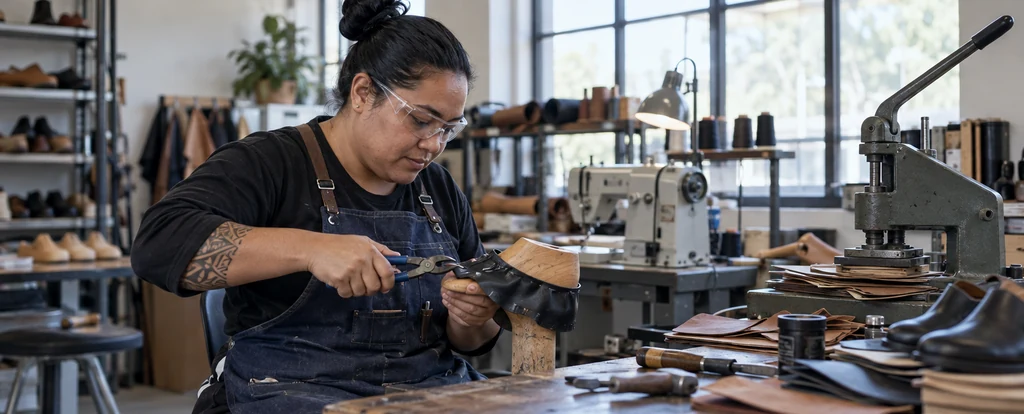
Shoemakers cut, stitch and finish footwear, either to a customer's measurements or as part of a small production run, and much of the trade is repair and resoling rather than new pairs. Most work alone or in workshops of two or three people, and about 720 people work as shoemakers across Australia. The role sits close to a leather goods maker, who applies similar cutting and stitching skills to bags and belts rather than fitted footwear.
How much do shoemakers earn?
The median full-time salary for a shoemaker is $59,800 per annum, before tax, up $12,600 since 2018.
What a shoemaker takes home depends more on the setting than on the craft: employees in manufacturing, retail or a repair business work under the relevant award or enterprise agreement, while those running their own workshop set their prices and carry the cost of leather, soles and machinery. Bespoke and orthopaedic fitting is quoted per pair, and repair work is priced job by job, so income follows the mix of the two you take on.
What does a shoemaker do day to day?
The list below is what fills most weeks; the exact mix shifts with seniority and whatever stage the current work is at.
- Measuring customers' feet and recording last and fit details
- Cutting leather uppers and soles with knives, dies and clicker presses
- Stitching uppers and attaching them to soles and heels
- Shaping, burnishing and finishing footwear by hand
- Repairing, resoling and altering worn footwear, which makes up much of the work in a repair counter
What skills do shoemakers need?
Employers look for craft and handmade production, hand and power tool work, fabrication and finishing, backed by Industrial sewing machine fluency and strong attention to detail.
Specialist skills
- Craft and handmade production
- Hand and power tool work
- Fabrication and finishing
- Quoting and estimating
- Inventory management
Software and tools
- Industrial sewing machine
- Clicker press
- Lasting pliers
- Shoemaster
- Rhino 3D
General skills
- Attention to detail
- Customer service
Is the job growing?
About 720 people work as shoemakers in Australia, and employment is projected to grow 6% over the decade to 2035. That's modest growth: demand is steady rather than booming.
How do you become a shoemaker?
Here's the path most shoemakers take, step by step.
- 1Start in a workshop
Many shoemakers come in as a repair hand or workshop assistant and pick up leather selection, cutting and machine stitching on the job. That route is paid, and it is often how people find out whether the standing and repetition suit them.
- 2Do a Certificate III in footwear
The formal qualification covers pattern cutting, lasting, heel and sole attachment and finishing. Only a small number of TAFE campuses teach it, and in some states it is delivered as an apprenticeship or traineeship, so check with your state training authority for a provider near you.
- 3Choose your mix of repair, bespoke and production
Repair and alteration is the most common way to earn a living from the trade, while bespoke and orthopaedic fitting is a smaller, more specialised market. Manufacturing runs are short in Australia, so many shoemakers combine repair with custom orders.
- 4Set up the business side
Working for yourself means an ABN, public liability insurance and the machinery to handle resoling and heel repairs, because customers expect those done in-house. Quoting a repair and sourcing leather and soles at a workable price matter as much as the craft.
Ready to apply as a shoemaker?
Whether you're working toward becoming a shoemaker or already are one and want a hand with the next step (sharpening your resume for ATS screening, tightening your cover letter, or knowing what you'll actually be asked at interview), here are examples grounded in this specific role, not generic templates.
What jobs can a shoemaker move to?
Moving into Upholsterer typically comes with the biggest pay rise, worth $19,600 a year more on average.
| Move to | Typical pay change | Overlap | Retraining |
|---|---|---|---|
| Upholsterer Shoemakers bring hand sewing, cutting and finishing skills to upholstery work, though furniture framing and padding require formal retraining. | +$19,600 | 100% | reskill |
| Orthotic and Prosthetic Technician Shoemakers bring custom fitting and leatherworking skills to making orthoses, with short training in clinical materials and methods. | +$13,000 | 50% | short course |
| Leather Goods Maker Shoemakers bring leather cutting, stitching and finishing skills to making bags, belts and small leather goods. | +$5,200 | 70% | minimal |
| Canvas Goods Maker Shoemakers bring pattern cutting and heavy stitching skills to canvas goods, with retraining in industrial fabrics and hardware. | +$2,600 | 52% | reskill |
Moves are chosen from Jobs and Skills Australia's Data on Occupation Mobility, which follows income tax records between 2011-12 and 2020-21, together with entry requirements and skill overlap. A known move is one people were seen making in that data. Pay change compares median full-time pay for the two roles.
Who works as a shoemaker?
The typical shoemaker is 51 years old; 85% are men, 67% work full-time, and full-timers average 42 hours a week.
- 51
- Median age
- 15%
- Female share
- 67%
- Full-time
- +2h
- vs all-jobs avg
What's it like being a shoemaker?
Shoemaking is bench work in a small workshop, with the rhythm set by the pairs in front of you rather than by a production line. Much of the trade is repair and fitting, so you deal with customers and their worn footwear as often as you build something new, and the work rewards patience and a good eye for leather. It suits people who like working alone or in a very small team, with a finished object at the end of it.
What people like
- You finish something you can hold. A shoe leaves the bench as a whole object you shaped, and a clean resole or a well-fitted pair is obvious to the customer the moment they walk in it.
- The work rewards precision. Small differences in last shape, stitching tension and edge finishing decide whether footwear fits and lasts, so the job keeps your attention in a way looser work does not.
- The variety of repair and custom work. One day is a heel replacement on a worn work boot, the next is building up a last for a customer whose feet do not match any standard size.
- Independence. Self-employed shoemakers set their own hours and take the work they want, which matters when the alternative is a production line.
What people find hard
- Standing and repetition. Cutting, hammering and lasting are done standing at a bench, and the same wrist and hand movements repeat through the day.
- Leather shows every mistake. A misplaced knife cut or an over-sanded edge can spoil a hide, and there is no way to patch it invisibly.
- Not every shoe can be saved. Repair jobs often arrive worn past a clean fix, and the customer is usually attached to the pair and hoping for better news.
- Output is slow. Hand construction limits how many pairs or repairs you get through in a day, which caps what a one-person workshop can earn.
Based on our synthesis of professional-body surveys and public accounts of the role, not first-person verified reviews.
Which industries employ shoemakers?
Other Services employs the largest share of shoemakers, followed by Manufacturing.
Top employing industries
- 1Other Services
- 2Manufacturing
- 3Retail Trade
Ranked by employment share; the source doesn't publish an exact percentage per industry.
| Year 12 or below | 50.5% | |
|---|---|---|
| Certificate III/IV | 26.8% | |
| Bachelor degree | 6.4% | |
| Diploma / Advanced Diploma | 6.3% | |
| Postgraduate | 2.5% |
Will AI replace shoemakers?
Shoemaking is moderately exposed to AI and automation. Machine cutting, digitised patterns and 3D foot scanning are already standard in larger workshops, but lasting, finishing and hand repair still depend on feel, eye and the fit of an individual pair. The small batches and one-off repairs that make up most Australian shoemaking keep the trade away from full automation.
Share of typical working time by exposure level
- Stitching and lastingIndustrial sewing machines set consistent seams, but pulling the upper over the last and attaching the heel and sole is still guided by hand.30%moderate
- Cutting uppers and solesClicker presses and computer-controlled cutting tables lay out and cut leather faster and with less waste than by hand, though hides vary and someone still decides where each piece comes from.25%high
- Repair, resoling and edge finishingDeciding how much of a worn sole can be saved and finishing an edge to match the rest of the shoe depends on the condition of that individual pair.25%low
- Measuring and fitting customersFoot scanners and 3D last software capture measurements and generate a last shape, but judging how a shoe will wear and where it needs easing is still done on the foot.20%moderate
Moves least exposed to AI
These career moves from shoemaker work are rated low for AI exposure:
- Leather Goods Maker
High skill overlap (70%), little retraining to get there, and a low automation-risk profile.
- Upholsterer
High skill overlap (100%), reskill to get there, and a low automation-risk profile.
Common questions about becoming a shoemaker
Straight answers to the questions people ask most.
How much do shoemakers earn?
Shoemakers earn $59,800 per year before tax on a full-time median, and what you actually take home depends on whether you are paid a wage or run your own workshop. Employees are covered by the award or enterprise agreement for their setting, while self-employed shoemakers set their own prices and carry material and overhead costs.
How do you become a shoemaker?
Most shoemakers start in a workshop, learning cutting and machine stitching on the job, and add a Certificate III in footwear if a TAFE near them offers it. It is a small trade with few formal apprenticeship places, so approaching repair shops and bespoke makers directly is often the practical way in.
Are shoemakers in demand?
Shoemakers are currently not in shortage, and employment is projected to grow 6% over the decade to 2035. The occupation is small, so openings in any given year come largely from replacing people who leave the trade, and repair work tends to arrive more consistently than bespoke orders.
Will AI replace shoemakers?
AI and automation reach the measuring, cutting and design side of shoemaking more than the bench work. Foot scanning and CAD lasts can shape a last and lay out a pattern, and automated cutters handle leather efficiently, but lasting a shoe over a last, judging fit and repairing a worn pair are still done by hand and eye.
What else can a shoemaker do?
Leather goods making applies the same cutting, stitching and finishing to bags and belts, and pays $5,200 more. Orthotic and prosthetic technician work uses custom fitting in a clinical setting and pays $13,000 more, while canvas goods making trades leather for heavy industrial fabrics. Many shoemakers instead stay and build their own repair or bespoke business, which is often where earnings grow.
Do shoemakers work full time?
Most do, with average full-time hours of 42 a week and 67% of shoemakers working full time. Repair shops keep regular trading hours, while self-employed makers often fit bench time around the customers who walk in.
Related roles
- Leather Goods Maker
- Upholsterer
- Canvas Goods Maker
- Orthotic and Prosthetic Technician
- Leather Goods Maker
- Canvas Goods Maker
Not sure this is you? Take the career quiz and get a ranked shortlist of roles that fit how you like to work.