Surveyor
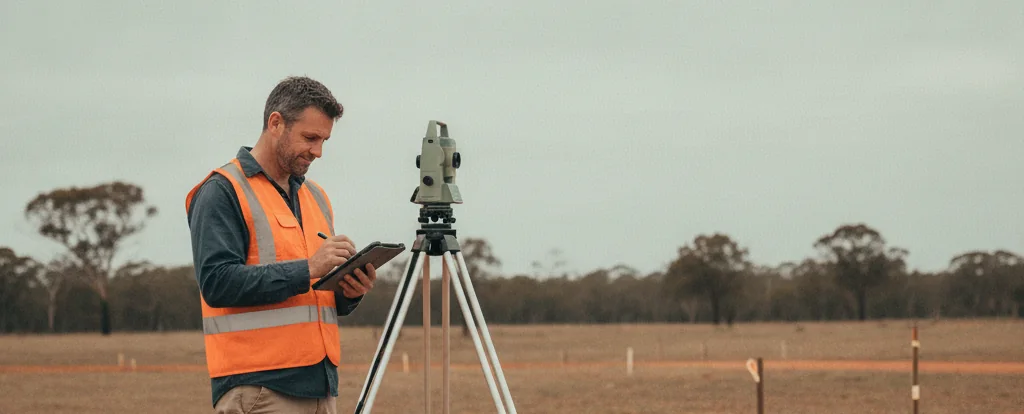
Surveyors measure land and structures accurately enough to settle where a boundary sits, how much earth a site needs moved and whether a building went up where the plans said it would.
- Median salary
- $119,600
4.3%vs last year, before tax
- People employed
- 9,700
2.1%vs last year
- Projected growth
- +18.6%
to 2035
- AI exposure*
- Low
- automation risk
- Average hours
- 48/wk
+8h vs all jobs
- Shortage status
- In shortage
national
Surveyors split their week between fieldwork on construction sites, subdivisions, mine sites and infrastructure corridors, and desk time turning those measurements into plans that stand as legal and engineering records. The job is often confused with civil engineering or drafting, but a surveyor produces the accurate spatial data those professions build on rather than designing the structure itself. Signing off a boundary or subdivision plan requires registration as a land surveyor with the relevant state or territory board, and what that involves differs between jurisdictions.
How much do surveyors earn?
The median full-time salary for a surveyor is $119,600 per annum, before tax, up $25,200 since 2018.
Pay in surveying moves more with where you work than with how long you have been in the job. Mine sites, remote infrastructure projects and resources work pay above local government and small suburban consultancies, largely through site allowances and rosters, and registering as a land surveyor is what opens cadastral and boundary work. Average full-time hours are long, so a weekly figure often reflects more than a standard week.
What does a surveyor do day to day?
The list below is what fills most weeks; the exact mix shifts with seniority and whatever stage the current work is at.
- Setting out pegs and survey marks so builders know exactly where to excavate or pour
- Running total stations, GNSS receivers and laser scanners across paddocks, road reserves and building sites
- Searching old plans and title records to work out where a boundary was originally placed
- Processing raw field data into cadastral plans, contour models and as-built drawings
- Checking a finished structure against the approved plans and reporting the discrepancies to the engineer or council
What skills do surveyors need?
Employers look for surveying and geospatial work, field inspection and testing, cAD and technical drawing, backed by theodolite fluency and strong attention to detail.
Specialist skills
- Surveying and geospatial work
- Field inspection and testing
- CAD and technical drawing
- Project engineering and delivery
- Regulatory compliance
Software and tools
- theodolite
- GPS/GNSS receiver
- laser scanner
- AutoCAD
- survey management software
General skills
- Attention to detail
- Problem solving
- Written communication
Is the job growing?
About 9,700 people work as surveyors in Australia, and employment is projected to grow 18.6% over the decade to 2035. That's healthy, above-average growth, and the role should stay in solid demand.
How do you become a surveyor?
Here's the path most surveyors take, step by step.
- 1Take an accredited surveying degree
A four-year Bachelor of Surveying is the direct route, and the degree needs professional accreditation for it to count towards registration. A related degree in geospatial science or engineering can be topped up with a graduate diploma in surveying.
- 2Or begin on the tools with a diploma
A Certificate IV or diploma in surveying and spatial information services gets you into paid work as a survey assistant or technician, which is a realistic way to try the job before committing to degree study. Most boards still require degree-level study before you can register as a land surveyor.
- 3Build supervised field experience
Boards set a minimum period of supervised practice under a registered surveyor, usually around two years, and it has to include boundary work. Assistant work while you study builds familiarity with the instruments and plans, but the supervised period is counted against your qualification.
- 4Register with your state or territory board
Registration is handled by state and territory surveyors boards rather than a single national body, and each sets its own assessment and practical requirements. Once registered, you are generally recognised in other states and in New Zealand under reciprocal arrangements.
- 5Specialise or keep your registration current
Mine surveying requires additional registration in the mining states, and continuing professional development keeps a registration active. Membership of a professional body such as the Geospatial Council of Australia is one way to access that training and the industry contacts that come with it.
Ready to apply as a surveyor?
Whether you're working toward becoming a surveyor or already are one and want a hand with the next step (sharpening your resume for ATS screening, tightening your cover letter, or knowing what you'll actually be asked at interview), here are examples grounded in this specific role, not generic templates.
What jobs can a surveyor move to?
Moving into Mining Engineer typically comes with the biggest pay rise, worth $63,300 a year more on average.
| Move to | Typical pay change | Overlap | Retraining |
|---|---|---|---|
| Mining Engineer Surveyors' mine site and spatial measurement experience suits mining engineering, though a mining engineering degree is required.Known move | +$63,300 | 33% | requalify |
| Mine Surveyor Surveyors can specialise in mine surveying, applying spatial measurement underground, with further training and mining registration required. | +$5,200 | 41% | reskill |
| Building Inspector Surveyors' measurement and construction knowledge suit building inspection, though a building surveying qualification is needed.Known move | −$1,000 | 33% | reskill |
| Quantity Surveyor A surveyor's site measurement and construction knowledge transfer to cost estimating, but quantity surveying requires a construction management qualification.Known move | −$4,300 | 16% | requalify |
| Civil Engineer Surveyors bring site measurement and geospatial skills to civil design, but a civil engineering degree is required.Known move | −$4,300 | 36% | requalify |
Moves are chosen from Jobs and Skills Australia's Data on Occupation Mobility, which follows income tax records between 2011-12 and 2020-21, together with entry requirements and skill overlap. A known move is one people were seen making in that data. Pay change compares median full-time pay for the two roles.
Who works as a surveyor?
The typical surveyor is 39 years old; 95% are men, 86% work full-time, and full-timers average 48 hours a week.
- 39
- Median age
- 5%
- Female share
- 86%
- Full-time
- +8h
- vs all-jobs avg
What's it like being a surveyor?
Surveying is project work with two distinct halves: days on site measuring, then desk time turning those measurements into plans and reports. The field side is outdoor and physical, with early starts, travel to remote sites and long weeks when a project is running. It suits someone who likes precision and the independence of being the person on site whose numbers everyone else builds from.
What people like
- You watch the project take shape. Marks you set in a bare paddock become the lines a subdivision, road or pipeline is built along, and you are often back on site to check the finished result.
- Field and office in the same week. The job alternates between instrument work outdoors and analysis at a desk, so few days look the same as the one before.
- Every site is its own problem. Boundaries conflict, old plans are missing or a benchmark has been moved, and working out what actually happened on the ground is a large part of the job.
- Your measurements carry weight. A builder, engineer or council acts on the numbers you produce, so the decisions that follow depend on getting the level or the boundary right.
What people find hard
- Weather and long days on site. Fieldwork runs through heat, dust, rain and mud, and early starts to beat traffic and temperature are normal rather than occasional.
- Time away from home. Fly-in, fly-out and remote project rosters mean blocks of days or weeks living away from home, which is hard on families and on anyone with commitments at home.
- The legal weight of a boundary. When neighbours dispute a fence line or a developer challenges a plan, the surveyor is the one who has to defend the measurement, sometimes years after the fact.
- Surveying sits late in the schedule. Other trades often see the survey as a box to tick, so site access can be delayed until everything else is ready and your window to measure gets compressed.
Based on our synthesis of professional-body surveys and public accounts of the role, not first-person verified reviews.
Which industries employ surveyors?
Professional, Scientific and Technical Services employs the largest share of surveyors, followed by Construction.
Top employing industries
- 1Professional, Scientific and Technical Services
- 2Construction
- 3Mining
Ranked by employment share; the source doesn't publish an exact percentage per industry.
| Bachelor degree | 46.2% | |
|---|---|---|
| Diploma / Advanced Diploma | 25.2% | |
| Year 12 or below | 11.7% | |
| Certificate III/IV | 7.6% | |
| Postgraduate | 6.9% |
Will AI replace surveyors?
Surveying has low exposure to automation overall, because the work depends on physically measuring ground and on a registered person certifying the result. GNSS, robotic total stations, laser scanning and drone photogrammetry have changed how quickly data is collected and drafted, but they have not changed who decides where a boundary sits or who signs the plan.
Share of typical working time by exposure level
- Measuring and setting out on siteEstablishing control, pegging a boundary or checking a level still needs an instrument on the ground and someone who can judge what the site is doing.40%low
- Boundary research and cadastral plansSoftware speeds up title searches, plan drafting and comparison with earlier surveys, but a registered surveyor still works out where the boundary was originally placed.20%moderate
- Turning field data into drawingsPoint clouds, GNSS files and drone imagery are increasingly registered and drafted automatically, so the surveyor checks the output rather than building it by hand.20%high
- Dealing with clients and signing offExplaining a discrepancy to a builder or council, and certifying the final plan, is registered professional work that automation does not carry.20%low
Common questions about becoming a surveyor
Straight answers to the questions people ask most.
How much do surveyors earn?
The median full-time surveyor earns $119,600 per year before tax, which puts the role above many construction and engineering support jobs. Pay climbs with registration as a land surveyor and with mining, resources and remote site work, where allowances and rosters add to the base.
How do you become a surveyor in Australia?
You need an accredited surveying degree, or a related degree plus a graduate diploma in surveying, followed by supervised field practice and registration with your state or territory surveyors board. The diploma route through a Certificate IV or diploma in surveying and spatial information services is a common way in for people who start as survey assistants, but registration as a land surveyor still requires degree-level study.
Are surveyors in demand?
Surveyors are currently in shortage nationally, and employment is projected to grow 18.6% over the decade to 2035. Most of the work sits in construction, mining and the surveying consultancies that serve them, so a qualification that lets you move between those sectors keeps your options open.
Will AI replace surveyors?
Surveying has low exposure to AI overall, because the core of the job is physically measuring ground that software cannot see. GNSS, robotic total stations and laser scanning have automated much of the data collection and drafting, but a registered surveyor still researches the boundary and certifies the result.
What can a surveyor move into?
Mine surveying applies the same measurement work underground and pays $5,200 more, though the mining states require additional registration. Mining engineering pays $63,300 more, but it needs an engineering degree, so it suits someone willing to requalify. Many registered surveyors eventually open their own practice or become a director of a surveying firm, and that is often where earnings grow.
What hours do surveyors work?
Full-time surveyors average 48 hours a week, which is well above a standard office week. Site work often starts before sunrise, and remote or mining rosters mean blocks of consecutive days away from home.
Related roles
Not sure this is you? Take the career quiz and get a ranked shortlist of roles that fit how you like to work.