Switchboard Operator
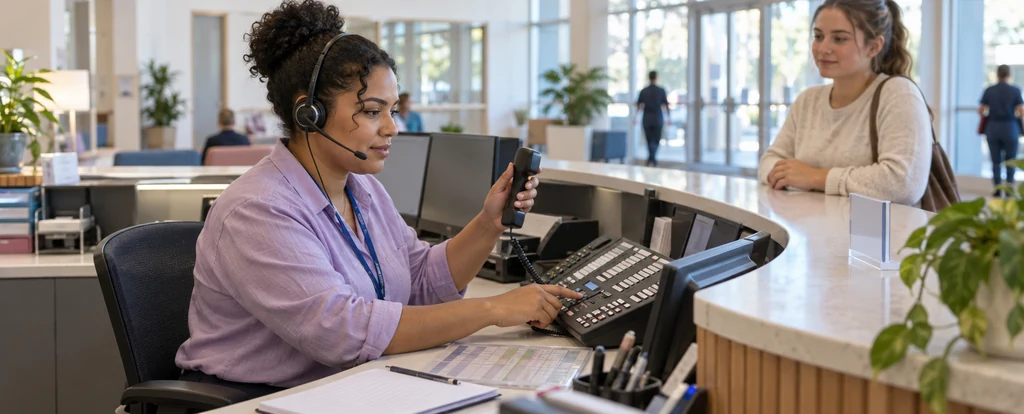
Switchboard operators answer an organisation's main phone line and connect each caller to the right person, extension or department.
- Median salary*
- $49,300
4.4%vs last year, before tax
- People employed
- 2,600
0.0%vs last year
- Projected growth
- +1.6%
to 2035
- AI exposure*
- High
- automation risk
- Average hours
- 40/wk
matches all-jobs average
- Shortage status*
- Not in shortage
national
Switchboard operators work at a console in hospitals, government offices, universities and large retail or utility sites, where calls arrive on one main number and need to reach the right place quickly. In a smaller workplace the switchboard is often a desk near the front door, so the same person greets visitors and answers questions about opening hours or who to contact. It looks similar to reception, but a receptionist handles whoever walks in as well as the phone, while a switchboard operator's day is built around call flow and volume.
How much do switchboard operators earn?
The median full-time salary for a switchboard operator is $49,300 per annum, before tax, up $10,500 since 2018.
Most switchboard operators are covered by an award or an enterprise agreement, so the rate depends on the employer as much as the job title. Shift work makes a real difference, because hospitals and emergency lines pay loadings for evenings, weekends and public holidays. Part-time and casual arrangements are common, which changes both the weekly figure and the leave you build up.
What does a switchboard operator do day to day?
The list below is what fills most weeks; the exact mix shifts with seniority and whatever stage the current work is at.
- Answering incoming calls and routing them to the correct extension, department or staff member
- Working a PBX console or VoIP platform to hold, transfer and park several calls at once
- Taking messages and passing them on promptly when a caller needs an answer the same day
- Keeping the staff directory and extension list current, since a wrong transfer sends callers back to the queue
- Welcoming visitors, logging their arrival and letting the person they have come to see know they are there
What skills do switchboard operators need?
Employers look for , backed by PBX telephone systems fluency and strong written communication.
Specialist skills
Software and tools
- PBX telephone systems
- VoIP platforms
- call management software
- visitor management systems
General skills
- Written communication
- Customer service
- Attention to detail
- Problem solving
- Time and deadline management
Is the job growing?
About 2,600 people work as switchboard operators in Australia, and employment is projected to grow 1.6% over the decade to 2035. That's modest growth: demand is steady rather than booming.
How do you become a switchboard operator?
Here's the path most switchboard operators take, step by step.
- 1Build customer service experience
Retail, hospitality, reception or call centre work gives you the phone manner and the habit of staying calm with frustrated callers that employers look for. Many people enter switchboard work from exactly these roles.
- 2Finish Year 12 or a Certificate III in Business
There is no mandated qualification for the job, but a Certificate III or IV in Business or Business Administration is a common way to show office skills such as records, correspondence and scheduling alongside phone work.
- 3Learn the switchboard system on the job
Training happens in the workplace, because each site runs its own PBX console, VoIP platform or call management software. Expect a handover period shadowing an experienced operator before you work the board alone.
- 4Pick up the extras that site needs
A hospital switchboard often asks for first aid or emergency procedure training, while larger sites may want familiarity with visitor management systems. Short courses in office administration help if you plan to move into broader admin work later.
Ready to apply as a switchboard operator?
Whether you're working toward becoming a switchboard operator or already are one and want a hand with the next step (sharpening your resume for ATS screening, tightening your cover letter, or knowing what you'll actually be asked at interview), here are examples grounded in this specific role, not generic templates.
What jobs can a switchboard operator move to?
Moving into Personal Assistant typically comes with the biggest pay rise, worth $46,000 a year more on average.
| Move to | Typical pay change | Overlap | Retraining |
|---|---|---|---|
| Personal Assistant Switchboard operators bring phone manner and scheduling support, which transfer to personal assistant work with more executive support experience. | +$46,000 | 83% | minimal |
| Call Centre Operator Switchboard operators already manage high call volumes and routing, so the move to call centre operator uses the same phone and customer service skills.Known move | +$15,700 | 83% | minimal |
| Receptionist Front desk and call handling overlap closely, so switchboard operators can move into reception with their customer service and organisational skills.Known move | +$14,600 | 71% | minimal |
| Administration Officer Switchboard operators know the organisation's people and processes, and a short course supports the move into broader administration work.Known move | +$8,900 | 56% | short course |
| Customer Service Officer Switchboard operators' call handling and problem routing transfer directly to customer service officer roles. | +$5,300 | 83% | minimal |
Moves are chosen from Jobs and Skills Australia's Data on Occupation Mobility, which follows income tax records between 2011-12 and 2020-21, together with entry requirements and skill overlap. A known move is one people were seen making in that data. Pay change compares median full-time pay for the two roles.
Who works as a switchboard operator?
The typical switchboard operator is 49 years old; 68% are women, 84% work full-time, and full-timers average 40 hours a week.
- 49
- Median age
- 68%
- Female share
- 84%
- Full-time
- +0h
- vs all-jobs avg
What's it like being a switchboard operator?
The rhythm of the job follows the phone: quiet early, then heavy through the morning and around lunch, with another push at the end of the day. Hospital and emergency switchboards run around the clock, so those operators work rotating shifts and handle calls where the caller is frightened or in a hurry. It suits people who like clear rules, quick resolution and finishing each call before the next one arrives.
What people like
- You learn how the whole place works. Routing calls means knowing who handles what, which departments sit where and who to call when something goes wrong outside normal hours. That knowledge makes you useful well beyond the phone.
- The work ends when your shift does. Calls are handled one at a time and nothing follows you home, which appeals to people who want a clear line between work and the rest of the day.
- Small moments of real help. A lost visitor, a worried relative or a caller who cannot find the right number is often genuinely relieved by a fast, accurate transfer.
- A steady, predictable routine. The scripts, directories and procedures are set, so the job rewards reliability and attention to detail rather than improvisation.
What people find hard
- Peak times come in waves. Mornings and the lunch hour can mean back-to-back calls with several lines holding, and the console does not slow down because you are busy.
- Long stretches at a desk with a headset. You stay in one place for most of the shift, and headsets, screens and repeated phone work can be tiring over a full day.
- You take the frustration first. Callers who are annoyed about something else often vent at the first voice they reach, even though the operator has no part in the problem.
- The role is narrow. There is limited scope to grow the job itself, so progression usually means moving sideways into administration, reception or customer service rather than up.
Based on our synthesis of professional-body surveys and public accounts of the role, not first-person verified reviews.
Which industries employ switchboard operators?
Health Care and Social Assistance employs the largest share of switchboard operators, followed by Public Administration and Safety.
Top employing industries
- 1Health Care and Social Assistance
- 2Public Administration and Safety
- 3Retail Trade
Ranked by employment share; the source doesn't publish an exact percentage per industry.
| Year 12 or below | 54.8% | |
|---|---|---|
| Certificate III/IV | 15% | |
| Diploma / Advanced Diploma | 10.9% | |
| Bachelor degree | 10.3% | |
| Postgraduate | 3.1% |
Will AI replace switchboard operators?
This is a highly exposed job, because the core task of sending a caller to the right extension is exactly what automated attendants and voice assistants do well. Most large sites now run an interactive voice menu before a person answers, so operators handle the calls that fall through or need a human. What keeps part of the role standing is the unpredictable work: distressed or urgent callers, visitors at the desk and judgement about who to interrupt.
Share of typical working time by exposure level
- Routing incoming calls to extensions and departmentsAuto-attendants and voice menus already direct callers by department or name, which removes much of the everyday lookup-and-transfer work.35%high
- Handling distressed, urgent or after-hours callsA caller reporting an emergency or ringing a hospital at 2am needs a person who can judge urgency and reach the right staff member fast.25%low
- Keeping the staff directory and extension lists currentDirectory entries increasingly sync from the phone system or staff records, so manual updates shrink to checking exceptions rather than typing every change.20%high
- Greeting visitors and logging their arrivalSelf-service sign-in kiosks handle routine arrivals, but someone still has to check identity, issue passes and alert the person being visited.20%moderate
Common questions about becoming a switchboard operator
Straight answers to the questions people ask most.
How much do switchboard operators earn?
Switchboard operators earn a median of $49,300 per year before tax. That figure is a guide, because award coverage, shift loadings, weekend work and whether the role is full time all move the number. Hospital and government switchboards tend to pay more than a single-desk operation in a small business.
How do you become a switchboard operator?
Most people come in through customer service work, then learn the site's own console on the job. A Certificate III in Business (BSB30120) or Business Administration helps if you want to stand out, and hospital switchboards may also ask for first aid or emergency procedure training. No licence or registration is required.
Are switchboard operators in demand?
Switchboard operators are currently not in shortage, and employment is projected to grow 1.6% over the decade to 2035 over the decade to 2035. Because the occupation is small, most openings come from operators leaving and being replaced rather than from new positions being created. Openings cluster in health care, public administration and large retail sites.
Will AI replace switchboard operators?
Much of the routine routing is already automated, through interactive voice menus, auto-attendants and voice assistants that send callers to a department without a person. That side of the work is highly exposed, and a good part of a typical shift now involves the calls that get past the menu. Handling distressed callers, after-hours emergencies and visitors at the desk is much harder to automate.
What can a switchboard operator move into?
Call centre operator is a close fit, since both roles manage call volume and routing, and it typically pays $15,700 more. Administration officer is another common move, supported by a short course in office administration and the knowledge of the organisation's processes you build on the board. Receptionist work also overlaps closely and pays $14,600 more.
Do you need a qualification to work a switchboard?
No, there is no required qualification for the role, and just over half of the people doing it finished Year 12 or below. Employers look for a clear speaking voice, accuracy under pressure and comfort with phone systems, and they train you on their own console once you start.
Related roles
- Administration Officer
- Call Centre Operator
- Receptionist
- Customer Service Officer
- Personal Assistant
- Call Centre Operator
Not sure this is you? Take the career quiz and get a ranked shortlist of roles that fit how you like to work.