Hard skills and soft skills
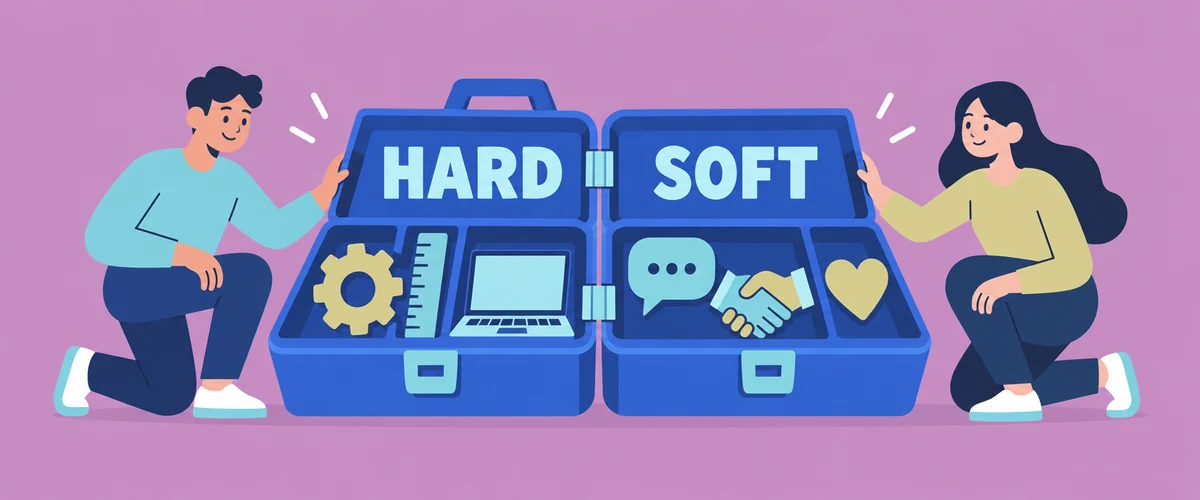
Hard skills are the technical abilities a particular job calls for, such as preparing a pay run, framing a wall or writing code. You usually learn them through study, training or the job itself, and they can be tested or shown directly. Soft skills describe how you go about your work: how you communicate, work with other people, organise yourself and respond when something doesn't go to plan. Many of them carry across from one job to the next.
Almost every job needs both. The practical difference for someone applying for work is in how each kind gets proven. A hard skill can often be named in a few words and checked. A soft skill is easy to claim and only becomes believable when you describe what you did. Below are examples of both across several jobs, what employers tend to look for at each stage of hiring, and wording you can adapt for your own resume, cover letter or interview answers.
Hard skills and soft skills in the same job
The table shows how the two kinds of skill sit side by side in six quite different occupations. The hard skills are specific to each job, while the soft skills could appear in many of them. What changes is the situation the soft skill is used in.
| Job | Hard skills | Soft skills |
|---|---|---|
| Payroll officer | Processing pay runs in Xero or MYOB, applying award rates, reconciling super payments | Explaining a pay error to an upset employee, keeping payroll information confidential |
| Chef | Knife skills, menu costing, food safety practices | Staying organised during a busy service, giving clear instructions to kitchen staff |
| Carpenter | Reading plans, framing, safe use of power tools | Coordinating with other trades on site, turning up when the job needs you |
| Early childhood educator | Planning and documenting learning using the Early Years Learning Framework, child safety practices | Building trust with families, staying patient with children who are unsettled |
| Customer service officer | Using a CRM system, following complaint and refund procedures | Listening to what the customer actually needs, calming a heated conversation |
| Software engineer | Programming languages, version control with Git, cloud platforms | Explaining technical trade-offs to non-technical colleagues, giving and taking code review feedback |
Each occupation page on careertips lists the specialist skills, software and tools, and general skills for that job, which is a quick way to see the same split for your own work.
Where the line between them blurs
The two categories are a useful shorthand, but plenty of skills sit somewhere in between. Writing is a soft skill for most jobs and a core technical skill for a technical writer or a grant writer. Basic digital skills, like working confidently with email, shared documents and online systems, are expected in most workplaces, while specific software is a hard skill.
You'll also see different names for the same idea. Australian government frameworks tend to avoid the word "soft". The Core Skills for Work Developmental Framework, a national framework used in education and employment services, describes "non-technical" skills that work alongside technical or discipline-specific skills. Its skill areas include communicating for work, connecting and working with others, planning and organising, making decisions, identifying and solving problems, and working in a digital world. Job ads and position descriptions may call the same things "employability skills", "capabilities" or "personal attributes".
If a job ad uses one of these terms, it helps to use the ad's wording when you describe your skills, so the reader can see how you match what they asked for.
Which matters more to employers
It depends on the job, and on how far you are through the hiring process. Research by Jobs and Skills Australia gives some sense of the pattern. In a 2022 module of its Recruitment Experiences and Outlook Survey, 499 employers who had recently recruited were asked what they looked for in applicants.
At the application stage, around half said they looked for relevant experience and skills, 28% looked for the right qualifications or licences, and 17% for good communication and interpersonal skills. At interview, the focus moved towards how someone would work in the team. Approach or attitude to work was the most commonly mentioned quality (49%), followed by cultural fit (43%), with skills, knowledge or experience mentioned by 33%. Employers could give more than one answer, and the pattern varied: construction employers, for example, still placed skills and experience first at interview.
A reasonable reading is that hard skills and relevant experience often decide whether you get an interview, and soft skills weigh more heavily once you're in the room. It isn't a strict division, and in regulated work the formal requirements come first. A licence, registration or ticket the job legally requires can't be made up for with strong soft skills.
For people starting out, the balance can tilt further. In a separate 2024 survey module, employers who had hired a young applicant (aged 15 to 24) were asked why that person got the job, and 60% said the applicant had the right attitude. Relevant experience (19%) and good communication skills (18%) came next. If you don't yet have many hard skills to list, the way you show your attitude and reliability can carry a lot of your application.
How to describe hard skills
Hard skills are easiest to believe when they're specific. Name the software, the method, the standard or the licence, and add the scale or level if it gives the reader a better picture. Here are some general descriptions alongside wording that tells an employer more.
If you're still learning a hard skill, say so plainly, for example "Currently completing a Certificate III in Individual Support (CHC33021)". The article on skills for your resume covers how many skills to list and where the section should sit.
How to describe hard skills
- "Good with computers" could become "Advanced Excel, including pivot tables, lookups and building monthly reports".
- "Payroll experience" could become "Processed fortnightly pay runs for 60 employees in Xero, across two modern awards".
- "Construction experience" could become "Framing and fit-out on residential builds, current White Card".
- "Coding" could become "Python and SQL for data cleaning and reporting, with version control in Git".
How to describe soft skills
Words like "team player", "hard worker" and "great communicator" appear on so many applications that they tell a reader very little on their own. A soft skill becomes convincing when you describe what you did, where you did it and, if possible, what happened as a result. The wording below is a starting point to adapt, and the details should come from your own experience.
In a resume, a line like this usually sits under the job where it happened, which lets the skills section stay short. In a cover letter, you have room for one or two fuller examples connected to what the job ad asks for.
How to describe soft skills
- "Team player" could become "Covered shifts and swapped roles on short notice during a staff shortage so the store could stay open on its usual hours".
- "Adaptable" could become "Learned a new booking system in the first week after the practice changed providers, then showed two colleagues how to use it".
- "Reliable" could become "Held a weekend casual role for three years while studying, with the store manager as a referee".
- "Good with customers" could become "Handled phone complaints about delayed orders, with most resolved on the first call".
- "Leadership" could become "Trained four new casual staff on opening and closing procedures".
Talking about both in an interview
Interview questions often test a hard skill and a soft skill at once, even when they only ask about one. A question about a difficult payroll error, for instance, is partly about your technical knowledge and partly about how you explained the problem and kept people informed while you fixed it.
When you prepare, it can help to pick a few situations from your work, study or volunteering that show a technical skill being used with other people involved. Explain what the task was, what you did and how it turned out. The same examples can then answer questions about teamwork, pressure or problem solving without sounding rehearsed. The guides on how to prepare for an interview and on answering tell me about yourself go into more detail on building those answers.
If you're not sure which hard skills your field expects, look up your occupation on careertips and compare its specialist skills and tools with what you already have. A gap in hard skills can often be closed with a short course or on-the-job training.
Article sources
- Department of Employment and Workplace Relations, core skills work developmental framework
- Department of Employment and Workplace Relations, key features core skills work developmental framework
- Department of Employment and Workplace Relations, pdf
- Jobs and Skills Australia, how employers recruit
- Jobs and Skills Australia, how employers recruit report.docx
- Jobs and Skills Australia, employers experiences of young job applicants
- Jobs and Skills Australia, australian skills classification
- Jobs and Skills Australia, national skills taxonomy
Related articles
Communication skills at work
Communication skills are the abilities you use to understand what other people need at work and to get your own information across to them.
Problem solving skills
Problem solving skills are what let you notice that something at work isn't going to plan, work out why, choose a fix and check that it worked.
Time management at work
Time management at work comes down to a few decisions you make again and again: what gets your attention first, how you protect time for work that needs concentration, and how you adjust when the day doesn't go to plan.