Automotive Dismantler
Automotive dismantlers strip end-of-life and written-off vehicles so that usable parts can be resold and the rest recycled.
- Median salary*
- $65,000
4.2%vs last year, before tax
- People employed*
- 3,800
0.0%vs last year
- Projected growth*
- −2%
to 2035
- AI exposure*
- Low
- automation risk
- Average hours*
- 38/wk
−2h vs all jobs
- Shortage status*
- Not in shortage
national
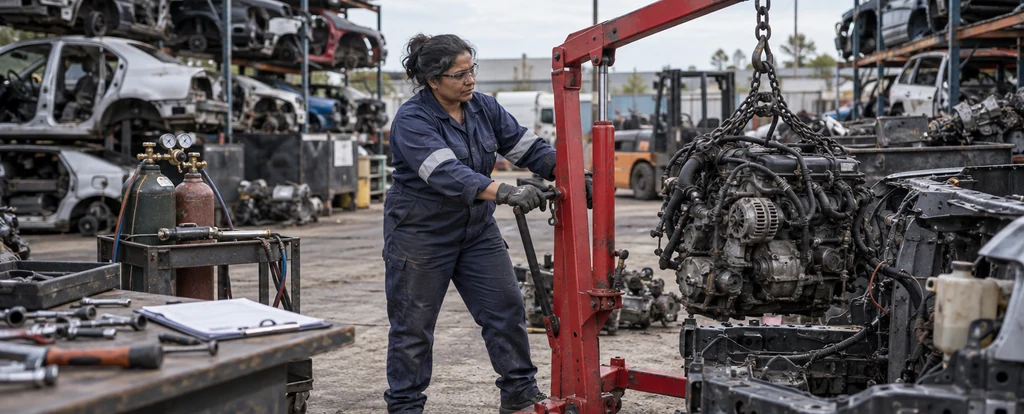
Automotive dismantlers work in wrecking yards and auto recycling businesses, where written-off and end-of-life vehicles are broken down for parts rather than repaired. It sits close to motor mechanic work but shares little of it: nothing gets fixed here, so the job is assessing what is worth salvaging, removing it cleanly and cataloguing it for resale. Many dismantlers also handle the selling side, listing parts online or over the counter for repairers and enthusiasts.
How much do automotive dismantlers earn?
The median full-time salary for an automotive dismantler is $65,000 per annum, before tax, up $13,700 since 2018.
Pay usually follows the award or the yard's enterprise agreement, so a large auto recycler and a small suburban wrecking yard can pay quite different rates for the same work. Yards with a retail parts counter sometimes add a bonus or commission on sales, and overtime is common when stock builds up. Hold a forklift licence or a high risk work licence for plant and you move into a higher classification.
What does an automotive dismantler do day to day?
The list below is what fills most weeks; the exact mix shifts with seniority and whatever stage the current work is at.
- Assessing incoming wrecks and deciding which parts are worth pulling
- Draining fuel, oil, coolant and air conditioning gas and storing them for recycling
- Removing engines, transmissions, panels and wiring with hand tools, a hoist and an oxy-acetylene torch
- Testing and cataloguing components, then listing them for resale in a parts database
- Keeping the yard safe and orderly, which includes stacking shells with a forklift and separating waste streams
What skills do automotive dismantlers need?
Employers look for hand and power tool work, worksite safety management, plant and equipment operation, backed by Hollander Powerlink fluency and strong attention to detail.
Specialist skills
- Hand and power tool work
- Worksite safety management
- Plant and equipment operation
- Inventory management
- Cleaning and grounds maintenance
Software and tools
- Hollander Powerlink
- Forklift
- Engine hoist
- Oxy-acetylene torch
- Diagnostic scan tool
General skills
- Attention to detail
- Problem solving
Is the job growing?
About 3,800 people work as automotive dismantlers in Australia, and employment is projected to decline 2% over the decade to 2035. That's a real decline, worth weighing carefully before training into the role.
How do you become an automotive dismantler?
Here's the path most automotive dismantlers take, step by step.
- 1Start as a yard hand
Most dismantlers begin with a labouring job in a wrecking yard or auto recycler, sorting parts, cleaning up and helping on the tools. It is paid work and no qualification is needed to get in the door.
- 2Get your forklift licence
Moving shells, pallets and stacked parts is daily work, so a forklift licence is what most yards ask for. It is a short course through a registered training organisation and can be done before or alongside the job.
- 3Learn the parts and the software
Yards run inventory systems such as Hollander Powerlink, and knowing how to identify a part, grade its condition and list it is what turns a yard hand into someone the business relies on.
- 4Add a qualification
A traineeship or a Certificate II or III in an automotive field, usually through TAFE, builds the mechanical background for engine and drivetrain work, and you can study while employed.
- 5Specialise or move sideways
From there you can move into parts interpreting or start a motor mechanic apprenticeship if you would rather repair than dismantle, and your stripping experience counts in your favour.
Ready to apply as an automotive dismantler?
Whether you're working toward becoming an automotive dismantler or already are one and want a hand with the next step (sharpening your resume for ATS screening, tightening your cover letter, or knowing what you'll actually be asked at interview), here are examples grounded in this specific role, not generic templates.
What jobs can an automotive dismantler move to?
Moving into Panel Beater typically comes with the biggest pay rise, worth $31,100 a year more on average.
| Move to | Typical pay change | Overlap | Retraining |
|---|---|---|---|
| Panel Beater Automotive dismantlers remove damaged panels and body parts, building familiarity with vehicle structures; panel beating requires a separate apprenticeship. | +$31,100 | 42% | requalify |
| Motor Mechanic Automotive dismantlers remove and inspect engines, drivetrains and suspension, so mechanical knowledge carries into motor mechanic work; an apprenticeship is required. | +$19,300 | 46% | requalify |
| Parts Interpreter Automotive dismantlers identify and catalogue reusable vehicle parts, which transfers to parts interpreting; additional study covers cataloguing and sales. | +$3,400 | 20% | reskill |
| Exhaust Fitter Automotive dismantlers remove exhaust systems and understand their fitment, which transfers to exhaust fitting; additional study covers installation and compliance. | +$2,600 | 33% | reskill |
| Small Engine Mechanic Automotive dismantlers strip engines and small components, giving familiarity with mechanical assemblies; an apprenticeship is needed to repair small engines independently. | +$0 | 50% | requalify |
Moves are chosen from Jobs and Skills Australia's Data on Occupation Mobility, which follows income tax records between 2011-12 and 2020-21, together with entry requirements and skill overlap. A known move is one people were seen making in that data. Pay change compares median full-time pay for the two roles.
Who works as an automotive dismantler?
The typical automotive dismantler is 41 years old; 95% are men, 82% work full-time, and full-timers average 38 hours a week.
- 41
- Median age
- 5%
- Female share
- 82%
- Full-time
- −2h
- vs all-jobs avg
What's it like being an automotive dismantler?
Days in a yard follow what comes off the truck: a run of similar sedans means repetitive stripping, while a late-model write-off means careful work on parts worth real money. The rhythm is set by the forklift and the sorting area, so a lot of the job is keeping stock moving without cutting corners on fluids, lifting or safety. It suits people who enjoy taking things apart and are comfortable being dirty, outdoors and on their feet.
What people like
- Nothing to fix, just to strip. There is no customer comeback if a repair fails, so the job is getting a part out cleanly and describing its condition honestly.
- Parts go back on the road. Reusing an engine, door or tail light saves a repairer the cost of a new one and keeps a usable component out of the crusher.
- No two wrecks are the same. A day can move from a modern SUV full of sensors and plastic clips to an older ute that comes apart with a spanner.
- Hands-on, outdoor work. You spend the day on your feet with tools in a yard or open shed, and the results are visible by knock-off time.
What people find hard
- Weather and the yard. Most work happens outdoors or in an open shed, so summer heat, winter rain and mud are simply part of the job.
- Heavy and dirty work. Fluids, grease, rusted bolts and sharp edges are constant, and some engine and drivetrain parts need a hoist or two people to move.
- Damaged vehicles bring hazards. Undeployed airbags, leaking fuel tanks, damaged batteries and twisted frames make some cars dangerous to strip, and the handling rules around them are strict.
- Repetition when stock is uniform. A batch of the same model means the same sequence of parts over and over, and slow-selling stock still has to be pulled, catalogued and stored.
Based on our synthesis of professional-body surveys and public accounts of the role, not first-person verified reviews.
Which industries employ automotive dismantlers?
Motor Vehicle and Motor Vehicle Parts Wholesaling employs the largest share of automotive dismantlers, followed by Waste Collection, Treatment and Disposal Services.
Top employing industries
- 1Motor Vehicle and Motor Vehicle Parts Wholesaling
- 2Waste Collection, Treatment and Disposal Services
- 3Motor Vehicle Repair and Maintenance
- 4Motor Vehicle Retailing
Ranked by employment share; the source doesn't publish an exact percentage per industry.
| Certificate III/IV | 34% | |
|---|---|---|
| Diploma / Advanced Diploma | 26% | |
| Bachelor degree | 20% | |
| Year 12 or below | 20% |
Will AI replace automotive dismantlers?
Automotive dismantling is a low-exposure job because the work is physical and unpredictable: every wreck is different, and the fluids, damaged panels and seized bolts that make a car hard to strip are exactly what a machine struggles with. Parts cataloguing software already handles pricing, stock levels and listings, which changes the office side of the job more than the yard side. Cutting, lifting and identifying parts still come down to someone with tools and a forklift.
Share of typical working time by exposure level
- Pulling engines, panels and componentsEngines, transmissions and body panels come out with spanners, a hoist, a rattle gun or an oxy-acetylene torch, and damaged vehicles rarely come apart the way a manual suggests.30%low
- Draining and recovering fluidsFuel, oil, coolant and air conditioning gas are drained by hand into marked containers, and the rules about what happens to them are strict.25%low
- Cataloguing, listing and selling partsInventory software handles pricing, stock levels and online listings, which trims the paperwork, but grading condition and photographing each part is still done by hand.25%moderate
- Identifying and assessing parts off the wreckParts look-up and photo tools speed up identification, but someone still has to inspect the vehicle to see whether a part is intact and worth the labour of removal.20%moderate
Common questions about becoming an automotive dismantler
Straight answers to the questions people ask most.
How much do automotive dismantlers earn?
Automotive dismantlers earn a median of $65,000 per year before tax. That figure is a national guide, because what a particular yard pays depends on its award or enterprise agreement, the size of the operation and whether you hold a forklift or plant licence.
How do you become an automotive dismantler?
Most people start as a yard hand and learn on the job, since reliability and comfort with tools matter more at the start than formal study. A traineeship or a Certificate II or III in an automotive field helps if you want to work on engines and drivetrains rather than sorting and labouring.
Are automotive dismantlers in demand?
Automotive dismantlers are currently not in shortage, and about 3,800 people work in the role across Australia. Employment is projected to decline 2% over the decade to 2035, so how many jobs come up depends on turnover in existing yards as much as on new positions. Experience with vehicles, tools or a forklift licence is what makes an application stand out.
Will AI take over automotive dismantling?
Not in the near term. This is a low-exposure job because the physical work, from draining fluids to cutting out engines, is hard to automate on scrapped vehicles that arrive in any condition. Parts cataloguing, pricing and online listings are increasingly software-driven, which changes the office side of the business more than the yard, and someone still has to inspect a part and decide whether it is worth the time to remove.
What licences or qualifications does the job need?
A forklift licence is the one most yards ask for, because moving shells and stacked parts is daily work. If the yard runs an excavator, front-end loader or overhead crane, you will need the relevant high risk work licence, and recovering air conditioning gas is a licensed activity that usually comes with its own short course.
What can automotive dismantling lead to?
Dismantlers often move into parts interpreting or parts warehousing, where knowing vehicle components and catalogue systems carries over, for around $3,400 more a year. A move into motor mechanic work means an apprenticeship, but the experience stripping engines and drivetrains helps, and it is worth about $19,300 more. Some people eventually run or buy a yard or a parts business of their own, which is often where earnings grow.
Related roles
Not sure this is you? Take the career quiz and get a ranked shortlist of roles that fit how you like to work.