Vehicle Body Builder
Vehicle body builders fabricate and fit the bodies of buses, trucks, trailers and specialty vehicles, working from a bare chassis to a finished shell.
- Median salary*
- $75,400
3.9%vs last year, before tax
- People employed
- 3,900
0.0%vs last year
- Projected growth
- +2.5%
to 2035
- AI exposure*
- Low
- automation risk
- Average hours
- 42/wk
+2h vs all jobs
- Shortage status
- In shortage
national
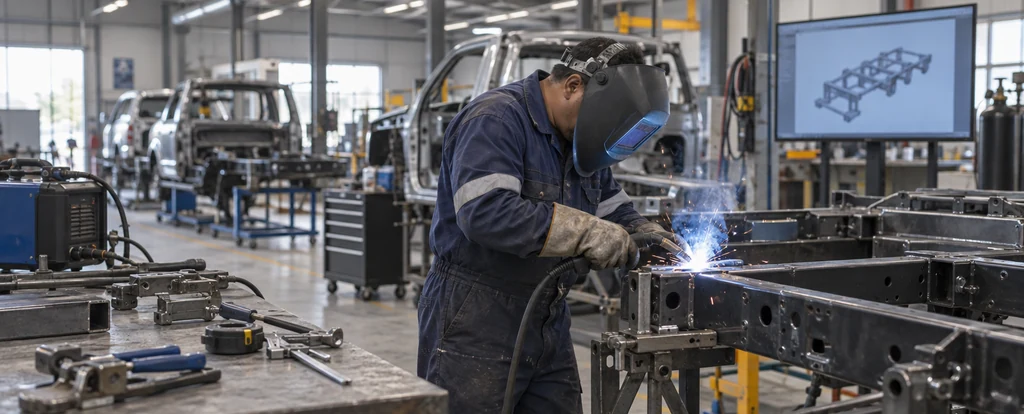
Most of the work happens in manufacturing workshops and body-building plants, where a small team builds each vehicle to a customer's order rather than repairing collision damage the way a panel beater does. Employers include bus and truck body manufacturers, trailer builders, and firms that fit out ambulances, fire appliances and refrigerated transport. The trade sits between metal fabrication and automotive work, which is why welders and fabricators often move across into it.
How much do vehicle body builders earn?
The median full-time salary for a vehicle body builder is $75,400 per annum, before tax, up $15,600 since 2018.
Pay depends heavily on the sector, because bus and truck body manufacturers, trailer builders and specialist vehicle firms each work under different awards and enterprise agreements. Overtime matters too, since production deadlines push many tradespeople past a standard week, and a qualified body builder with experience on buses or emergency vehicles usually earns more than someone on general trailer work. Whether the workshop is unionised and how long you have held your trade qualification both show up in the final figure.
What does a vehicle body builder do day to day?
The list below is what fills most weeks; the exact mix shifts with seniority and whatever stage the current work is at.
- Reading plans and specifications to work out panel sizes, frame positions and fixing points
- Cutting, shaping and forming sheet metal and structural sections with hand tools, power tools and plasma cutters
- Welding and riveting frames, panels and chassis sections into place
- Fitting windows, doors, access panels and interior fixtures
- Checking alignment and tolerances, then adjusting panels so doors and hatches close cleanly
What skills do vehicle body builders need?
Employers look for fabrication and finishing, reading plans and specifications, hand and power tool work, backed by AutoCAD fluency and strong attention to detail.
Specialist skills
- Fabrication and finishing
- Reading plans and specifications
- Hand and power tool work
- Installation and maintenance
- Worksite safety management
- Craft and handmade production
Software and tools
- AutoCAD
- SolidWorks
- MIG welder
- TIG welder
- Plasma cutter
General skills
- Attention to detail
- Problem solving
Is the job growing?
About 3,900 people work as vehicle body builders in Australia, and employment is projected to grow 2.5% over the decade to 2035. That's modest growth: demand is steady rather than booming.
How do you become a vehicle body builder?
Here's the path most vehicle body builders take, step by step.
- 1Choose maths and design or metalwork subjects at school
There is no formal prerequisite, but the trade leans on measurement, spatial reasoning and basic technical drawing, so these subjects make the first year of training easier.
- 2Start an apprenticeship in automotive manufacturing or engineering fabrication
The standard entry is a Certificate III apprenticeship, usually in automotive manufacturing technical operations or engineering fabrication, which combines paid workshop time with TAFE study over about three to four years.
- 3Finish the trade qualification
A completed Certificate III is what employers mean when they advertise for a qualified body builder, and it lets you weld and assemble structural sections unsupervised.
- 4Build experience on specific vehicle types
Workshops specialise, so experience with bus shells, tankers, refrigerated units or emergency vehicles is what opens the door to better-paying employers.
- 5Add drafting or supervisory skills if you want to move up
Short courses in CAD or leadership lead into leading hand, estimating and production planning roles, which take you off the tools some or all of the time.
Ready to apply as a vehicle body builder?
Whether you're working toward becoming a vehicle body builder or already are one and want a hand with the next step (sharpening your resume for ATS screening, tightening your cover letter, or knowing what you'll actually be asked at interview), here are examples grounded in this specific role, not generic templates.
What jobs can a vehicle body builder move to?
Moving into Panel Beater typically comes with the biggest pay rise, worth $20,700 a year more on average.
| Move to | Typical pay change | Overlap | Retraining |
|---|---|---|---|
| Panel Beater Panel beating draws on the same automotive body construction and repair skills, though a separate apprenticeship is needed for the trade.Known move | +$20,700 | 74% | reskill |
| Metal Fabricator Vehicle body builders bring cutting, welding and chassis assembly skills that transfer directly to metal fabrication work.Known move | +$12,400 | 61% | requalify |
| Welder Vehicle body builders already weld frames and panels, so welding work builds on familiar skills through further trade training.Known move | +$12,400 | 61% | requalify |
| Motor Mechanic Vehicle body builders understand vehicle structures and assembly, and can take up a motor mechanic apprenticeship to work on engines.Known move | +$8,900 | 58% | requalify |
Moves are chosen from Jobs and Skills Australia's Data on Occupation Mobility, which follows income tax records between 2011-12 and 2020-21, together with entry requirements and skill overlap. A known move is one people were seen making in that data. Pay change compares median full-time pay for the two roles.
Who works as a vehicle body builder?
The typical vehicle body builder is 42 years old; 97% are men, 89% work full-time, and full-timers average 42 hours a week.
- 42
- Median age
- 3%
- Female share
- 89%
- Full-time
- +2h
- vs all-jobs avg
What's it like being a vehicle body builder?
The work runs on production schedules, and a single bus or truck body is built over weeks, so most days are spent in the same workshop on the same vehicle, moving between cutting, welding, fitting and finishing. It suits people who like watching a build come together and who are comfortable standing, lifting and working around noise, heat and welding fumes. The pace is steady rather than frantic, but the tolerances are tight and a body that does not line up has to be corrected.
What people like
- You can see what you made. A finished bus or trailer leaves the workshop carrying your welds, panels and door fittings, which is a different feeling from work where the output is paperwork.
- Every build is a bit different. Vehicles are made to a customer's order, so layouts, access points, linings and interior fittings change from one job to the next.
- Skills that travel. Welding, cutting and fitting are wanted in metal fabrication, welding and rail work, so you are not tied to one employer or one workshop.
- Small teams and clear instructions. Body-building workshops are usually small enough that you know who is doing what, and the day's tasks are set out on the build sheet.
What people find hard
- Workshop conditions. Noise, welding fumes, summer heat and long stretches on your feet are part of most days, even in plants with good ventilation and extraction.
- Repetition on a production run. When a run of identical trailers or bus shells is going through, you can repeat the same welding and fitting sequence for weeks.
- Tolerances and rework. A panel that will not sit flat or a door that catches has to be fixed, which stretches a job that was already under a deadline.
- Physical demands. Lifting panels, holding them in position and working overhead take a toll, so the job suits people who are physically comfortable with that.
Based on our synthesis of professional-body surveys and public accounts of the role, not first-person verified reviews.
Which industries employ vehicle body builders?
Manufacturing employs the largest share of vehicle body builders, followed by Other Services.
Top employing industries
- 1Manufacturing
- 2Other Services
- 3Transport, Postal and Warehousing
Ranked by employment share; the source doesn't publish an exact percentage per industry.
| Certificate III/IV | 49.5% | |
|---|---|---|
| Year 12 or below | 39.3% | |
| Diploma / Advanced Diploma | 4% | |
| Bachelor degree | 2.4% | |
| Postgraduate | 0.7% |
Will AI replace vehicle body builders?
Automation reaches vehicle body building at the edges rather than the centre of the job. Larger plants use computer-controlled cutting tables, press brakes and some robotic welding, and CAD makes drawing changes quicker, but each body is assembled, fitted and finished by hand around a specific chassis. That keeps overall exposure low.
Share of typical working time by exposure level
- Cutting and forming panels and structural sectionsPlasma tables and press brakes are computer controlled in bigger plants, but working out how a panel meets the chassis and correcting it happens on the workshop floor.35%low
- Welding and assembling framesRobotic welding suits long runs of identical parts, while a body built to a customer's order is tacked and welded in position by hand.30%low
- Fitting windows, doors and interior componentsGetting a door to seal against a curved frame and hang correctly is done by eye, with shims and adjustment, on each individual vehicle.20%low
- Reading drawings and setting out dimensionsCAD drawings and digital build sheets cut down on manual measurement, though the setout is still checked against the actual chassis before assembly.15%moderate
Common questions about becoming a vehicle body builder
Straight answers to the questions people ask most.
How much does a vehicle body builder earn?
Vehicle body builders earn a median of $75,400 per annum, before tax. The sector you work in, whether your employer pays under an enterprise agreement and how much overtime is available all move that figure up or down.
How do you become a vehicle body builder?
The usual route is a Certificate III apprenticeship in automotive manufacturing or engineering fabrication, which mixes paid workshop work with TAFE study over about three to four years. Employers generally want the completed trade qualification before they will hire you as a qualified body builder.
Are vehicle body builders in demand?
Vehicle body builders are currently in shortage nationally, and employment is projected to grow 2.5% over the decade to 2035 over the decade to 2035. Manufacturers building buses, trucks and trailers need trade-qualified people, so a finished apprenticeship leaves you in a reasonable position when you start looking.
Will AI or automation replace vehicle body builders?
Exposure is low. Computer-controlled cutting and press brakes, plus some robotic welding on repetitive runs, handle parts of the job in larger plants, but a vehicle built to a customer's order is assembled, fitted and finished by hand around a specific chassis.
What can a vehicle body builder move into?
Metal fabrication and welding are the closest moves, since both draw on the same cutting, forming and joining skills, and a metal fabricator earns $12,400 more while a welder earns $12,400 more. Panel beating pays $20,700 more and builds on the same automotive body knowledge, though it needs a separate apprenticeship, and motor mechanics earn $8,900 more with further trade training.
Do you need a licence to work as a vehicle body builder?
There is no single national licence for the trade, but employers expect a Certificate III qualification, normally gained through an apprenticeship. Depending on the workshop, you may also need a high risk work licence, for example a forklift licence for moving components or a rigging licence for lifting frames.
Related roles
Not sure this is you? Take the career quiz and get a ranked shortlist of roles that fit how you like to work.