Backhoe Operator
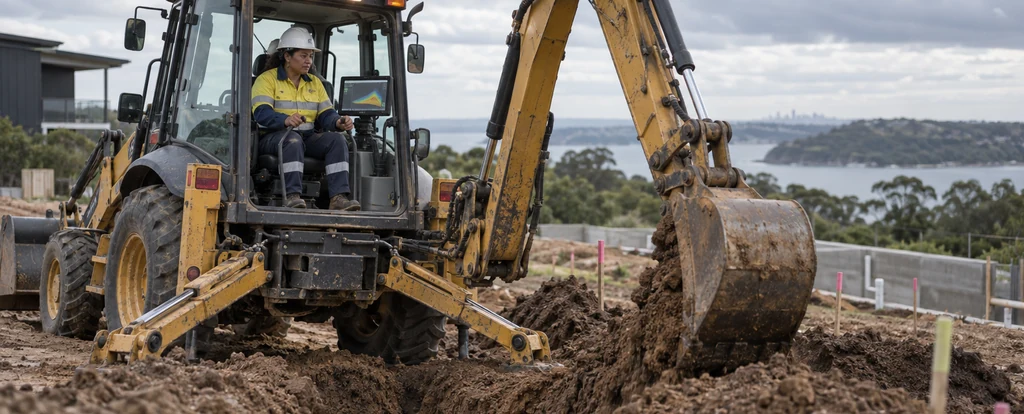
Backhoe operators run a tractor-mounted machine with a rear digging arm and a front loader bucket, digging trenches, footings and service lines for building, roads and utilities.
- Median salary*
- $98,800
4.1%vs last year, before tax
- People employed
- 430
7.5%vs last year
- Projected growth
- +4.3%
to 2035
- AI exposure*
- Low
- automation risk
- Average hours
- 43/wk
+3h vs all jobs
- Shortage status
- In shortage
national
They work on civil, building, utility and rural sites, controlling a machine that is smaller and more mobile than an excavator. That mobility means the same operator often digs the trench, loads the spoil and backfills it before moving on, though on large jobs they may spend a whole shift on one task. Most hold a Certificate III in civil construction plant operations and a competency assessment for the machine class.
How much do backhoe operators earn?
The median full-time salary for a backhoe operator is $98,800 per annum, before tax, up $20,700 since 2018.
Pay depends on the agreement or award covering the site and the type of work, with large civil projects on enterprise agreements paying more than small residential jobs. Overtime and shift loadings are common in the industry and can add a lot to a base rate, particularly on infrastructure work. Operators who can run several machine classes tend to sit at the higher end.
What does a backhoe operator do day to day?
The list below is what fills most weeks; the exact mix shifts with seniority and whatever stage the current work is at.
- Digging trenches, footings and service lines with the rear arm
- Reading site plans and working to survey marks and set levels
- Positioning and stabilising the machine on uneven or sloping ground
- Loading spoil and materials into trucks with the front bucket
- Backfilling, levelling and compacting trenches once pipes or cables are laid
What skills do backhoe operators need?
Employers look for plant and equipment operation, worksite safety management, reading plans and specifications, backed by JCB 3CX backhoe loader fluency and strong attention to detail.
Specialist skills
- Plant and equipment operation
- Worksite safety management
- Reading plans and specifications
- Installation and maintenance
- Operations management
Software and tools
- JCB 3CX backhoe loader
- Caterpillar 428 backhoe loader
- Trimble Earthworks machine control
- Leica iCON excavator system
- Topcon 3D machine control
General skills
- Attention to detail
- Problem solving
Is the job growing?
About 430 people work as backhoe operators in Australia, and employment is projected to grow 4.3% over the decade to 2035. That's modest growth: demand is steady rather than booming.
How do you become a backhoe operator?
Here's the path most backhoe operators take, step by step.
- 1Get a White Card
The general construction induction card is required before you can set foot on a construction site in any state, and most employers ask for it before they consider machine work.
- 2Complete a Certificate III in civil construction plant operations
This is the qualification most employers expect. It usually takes around 12 to 24 months and is often done as a traineeship or apprenticeship with an employer, covering plan reading, levelling, safe digging near services and machine operation.
- 3Do a competency assessment on the backhoe loader
A registered training organisation assesses you on the machine and issues a statement of attainment. Some states also issue a certificate of competency for earthmoving plant, so check the requirement where you work.
- 4Build machine hours on real sites
Employers want demonstrated hours, so many operators start as a labourer or offsider on a civil crew and take machine time when it comes up, or enter through a traineeship that guarantees it.
- 5Add other machine classes
Competencies on an excavator, loader, roller or grader widen the work you can take on and make you more useful to a contractor across a project.
Ready to apply as a backhoe operator?
Whether you're working toward becoming a backhoe operator or already are one and want a hand with the next step (sharpening your resume for ATS screening, tightening your cover letter, or knowing what you'll actually be asked at interview), here are examples grounded in this specific role, not generic templates.
What jobs can a backhoe operator move to?
Moving into Crusher Operator typically comes with the biggest pay rise, worth $20,800 a year more on average.
| Move to | Typical pay change | Overlap | Retraining |
|---|---|---|---|
| Crusher Operator Heavy plant and site safety experience suits crusher operation, with a short course for crushing and screening equipment. | +$20,800 | 78% | short course |
| Bulldozer Operator Earthmoving and grading experience supports bulldozer operation, with minimal retraining for the larger machine and blade work. | +$7,800 | 78% | minimal |
| Earthmoving Plant Operator Trenching and loading skills carry into broader earthmoving plant operation, with a short course for additional machinery.Known move | +$4,200 | 58% | short course |
| Grader Operator Levelling and site preparation skills transfer to grader operation, with minimal retraining for fine grading controls. | +$2,600 | 61% | minimal |
| Excavator Operator Digging and trenching experience translates to excavator operation, needing a short course for the different machine controls.Known move | +$0 | 48% | short course |
Moves are chosen from Jobs and Skills Australia's Data on Occupation Mobility, which follows income tax records between 2011-12 and 2020-21, together with entry requirements and skill overlap. A known move is one people were seen making in that data. Pay change compares median full-time pay for the two roles.
Who works as a backhoe operator?
The typical backhoe operator is 56 years old; 99% are men, 84% work full-time, and full-timers average 43 hours a week.
- 56
- Median age
- 1%
- Female share
- 84%
- Full-time
- +3h
- vs all-jobs avg
What's it like being a backhoe operator?
The day has a steady rhythm: set up, dig to the marks, load out the spoil, backfill, move on. Much of it is spent alone in the cab, with pauses while services are located or another trade finishes, and that mix of independence and waiting suits people who are patient and precise. Weather and ground conditions shape the day as much as the plans do, and infrastructure work can mean staying away from home during the week.
What people like
- Running your own machine. For most of the shift you are responsible for the machine and the ground in front of you, with no one supervising each bucket.
- Skill that shows in the work. A backhoe arm is precise once you know it, and the difference between a rough trench and a clean one comes down to hours on the machine.
- Visible progress. A trench dug, loaded and backfilled to level is finished work you can see before you park the machine for the day.
- The machine does the heavy lifting. Compared with labouring, the work is mostly controlling the machine rather than swinging a shovel, though you still get out to grease, check and shovel around services.
What people find hard
- Waiting on other trades. You often cannot start until services are located, or backfill until the pipe layer has finished, so part of the day is spent sitting in the cab.
- Weather and ground conditions. Wet clay, rock and heavy rain change the plan quickly, and some sites shut down because the machine will bog or tear up the surface.
- Repetition. Trench, load, backfill, repeat covers a lot of the work, and long pipe runs can be monotonous.
- Time away from home. Infrastructure and regional projects often mean staying near the site during the week rather than going home each night.
Based on our synthesis of professional-body surveys and public accounts of the role, not first-person verified reviews.
Which industries employ backhoe operators?
Construction employs the largest share of backhoe operators, followed by Public Administration and Safety.
Top employing industries
- 1Construction
- 2Public Administration and Safety
- 3Electricity, Gas, Water and Waste Services
Ranked by employment share; the source doesn't publish an exact percentage per industry.
| Year 12 or below | 63.5% | |
|---|---|---|
| Certificate III/IV | 30.4% | |
| Diploma / Advanced Diploma | 0.7% | |
| Postgraduate | 0% | |
| Bachelor degree | 0% |
Will AI replace backhoe operators?
Backhoe operation is rated low for AI and automation exposure because the machine works in ground that changes metre by metre. Machine control screens and autograde features now take over some of the levelling and depth work, but someone still has to position the machine, judge what is under the bucket and dig around services. The machine is already the automation in this job, and what it cannot do is decide how to approach a particular trench.
Share of typical working time by exposure level
- Digging and trenching with the rear armGround conditions, buried services and the shape of the trench change every job, so the operator reads the cut and adjusts as they go.35%low
- Loading trucks and moving spoil with the front bucketLoading out a truck in a tight site involves judging clearance, weight and where the driver is, which is done from the seat.25%low
- Working to levels and marks using machine control3D machine control shows grade and depth on a screen and can hold a level automatically, which removes some checking but still needs an operator to set up and interpret.20%moderate
- Pre-start checks, servicing and job recordsDaily pre-start inspections, hour meter logs and service schedules are increasingly captured in fleet apps that flag faults and book maintenance for the operator.20%high
Common questions about becoming a backhoe operator
Straight answers to the questions people ask most.
How much do backhoe operators earn in Australia?
Full-time backhoe operators earn a median of $98,800 per year before tax. Pay moves with the site: enterprise agreements on large civil projects and penalty rates for overtime and shifts push earnings up, while small residential and rural jobs tend to sit lower.
How do you become a backhoe operator?
Start with a White Card, then a Certificate III in civil construction plant operations (RII30826), which most employers expect and many operators complete as a traineeship. You also need a competency assessment on the backhoe loader itself, and many people get their first machine hours as a labourer on a civil crew.
Are backhoe operators in demand in Australia?
Backhoe operators are currently in shortage nationally, and employment is projected to grow 4.3% over the decade to 2035 over the decade to 2035. Work follows the local construction and infrastructure pipeline, so check which major projects are running in the area where you want to work.
Will AI replace backhoe operators?
Not in the near term. Machine control and 3D guidance already handle grade and depth on many sites and cut down on rework, but positioning the machine, reading the ground and deciding how to dig around live services stay with the operator.
Where can a backhoe operator move next?
Moves into other plant are common, and most need only a short course. Bulldozer operation builds on the same earthmoving and grading skills and pays $7,800 more, while crusher operation pays $20,800 more for operators willing to learn crushing and screening equipment. Some operators buy their own machine and contract it out, which is often where earnings grow.
Do you need a licence to operate a backhoe?
You need a general construction induction card, known as a White Card, to work on a construction site anywhere in Australia, and most employers also expect a Certificate III in civil construction plant operations. The rules for the machine itself vary by state, with some issuing a certificate of competency for earthmoving plant and others relying on a competency assessment, so check what applies where you work.
Specialisation of
Related roles
- Earthmoving Plant Operator
- Excavator Operator
- Bulldozer Operator
- Grader Operator
- Crusher Operator
- Earthmoving Plant Operator
Not sure this is you? Take the career quiz and get a ranked shortlist of roles that fit how you like to work.