Civil Engineering Technician
Civil engineering technicians turn an engineer's design into the drawings, quantities and site documentation that road, drainage and water projects are built from.
- Median salary*
- $91,000
3.6%vs last year, before tax
- People employed
- 3,500
0.0%vs last year
- Projected growth
- +11.3%
to 2035
- AI exposure*
- Moderate
- automation risk
- Average hours
- 43/wk
+3h vs all jobs
- Shortage status
- In shortage
national
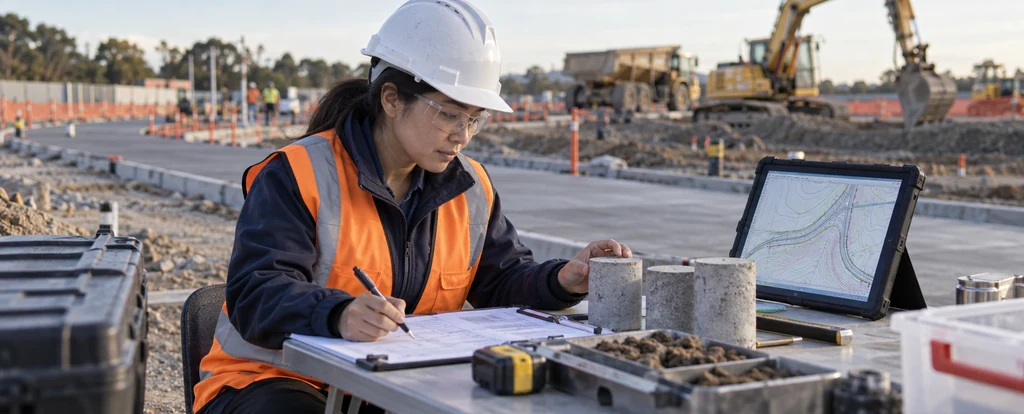
They work for consulting firms, contractors and local or state government, splitting the week between an office desk and project sites. The role sits between the civil drafter, who mainly produces drawings, and the civil engineer, who designs and signs off, because a technician handles the drafting as well as the measuring, testing and checking that keeps a design buildable. Entry is mixed, with diploma, certificate IV and degree holders all working in the job, and some starting on site and studying part time.
How much do civil engineering technicians earn?
The median full-time salary for a civil engineering technician is $91,000 per annum, before tax, up $19,400 since 2018.
Where you work shapes the figure more than the title does. Technicians employed by local or state government are usually paid under an enterprise agreement with set increments, while consulting and construction firms set pay individually and often add site allowances or paid overtime on top. Experience counts quickly here: once you can run a drawing set or a testing program with little supervision, your rate rises.
What does a civil engineering technician do day to day?
The list below is what fills most weeks; the exact mix shifts with seniority and whatever stage the current work is at.
- Preparing detailed civil drawings and models in CAD software such as Civil 3D and 12d Model
- Working out material quantities and costs for roads, drainage and water works
- Inspecting construction sites and checking work against the design and specifications
- Testing soil, concrete and aggregate samples and recording the results
- Liaising with engineers, contractors and councils when a design has to change
What skills do civil engineering technicians need?
Employers look for reading plans and specifications, cAD and technical drawing, engineering design and analysis, backed by AutoCAD fluency and strong attention to detail.
Specialist skills
- Reading plans and specifications
- CAD and technical drawing
- Engineering design and analysis
- Field inspection and testing
- Laboratory analysis
- Worksite safety management
Software and tools
- AutoCAD
- Civil 3D
- 12d Model
- MicroStation
- Microsoft Excel
General skills
- Attention to detail
- Written communication
Is the job growing?
About 3,500 people work as civil engineering technicians in Australia, and employment is projected to grow 11.3% over the decade to 2035. That's healthy, above-average growth, and the role should stay in solid demand.
How do you become a civil engineering technician?
Here's the path most civil engineering technicians take, step by step.
- 1Finish Year 12 with a maths subject
Most entrants come through a vocational qualification rather than direct from school, but maths and a science subject make the diploma far easier and are what registered training organisations look for.
- 2Complete a Diploma of Civil Construction Design or a certificate IV in civil engineering
This is the standard entry qualification and takes roughly one to two years, full time or part time. It covers drafting, materials testing, estimating and construction methods, and many students work in a related job while they study.
- 3Get a White Card and build CAD skills
A White Card is required before you can set foot on a construction site, which most technician roles involve. Employers expect working knowledge of Civil 3D, 12d Model or MicroStation, and you can pick these up in the diploma or in short courses.
- 4Start as a junior technician or drafting assistant
Early roles are paid and supervised, and they are where you learn how a drawing set is assembled, how testing records are kept and how a project actually runs.
- 5Study further if you want to move up
A degree in civil engineering opens the path to civil engineer, and further study in engineering technology or management opens the others. None of it is required to work as a technician.
Ready to apply as a civil engineering technician?
Whether you're working toward becoming a civil engineering technician or already are one and want a hand with the next step (sharpening your resume for ATS screening, tightening your cover letter, or knowing what you'll actually be asked at interview), here are examples grounded in this specific role, not generic templates.
What jobs can a civil engineering technician move to?
Moving into Construction Manager typically comes with the biggest pay rise, worth $104,100 a year more on average.
| Move to | Typical pay change | Overlap | Retraining |
|---|---|---|---|
| Construction Manager Site documentation and project coordination skills carry into construction management, though further study in management is needed.Known move | +$104,100 | 13% | reskill |
| Civil Engineer Civil engineering technicians bring practical drafting and site documentation experience, but need a degree to work as a civil engineer.Known move | +$24,300 | 29% | requalify |
| Engineering Technologist Technicians bring hands-on knowledge of civil design and construction, but need further study to become engineering technologists.Known move | +$15,600 | 44% | requalify |
| Mechanical Engineering Technician Civil drafting and technical documentation skills transfer to mechanical engineering technician work, with retraining in mechanical systems.Known move | +$2,600 | 37% | reskill |
Moves are chosen from Jobs and Skills Australia's Data on Occupation Mobility, which follows income tax records between 2011-12 and 2020-21, together with entry requirements and skill overlap. A known move is one people were seen making in that data. Pay change compares median full-time pay for the two roles.
Who works as a civil engineering technician?
The typical civil engineering technician is 39 years old; 86% are men, 87% work full-time, and full-timers average 43 hours a week.
- 39
- Median age
- 14%
- Female share
- 87%
- Full-time
- +3h
- vs all-jobs avg
What's it like being a civil engineering technician?
The job has a rhythm of its own: quiet stretches at a desk producing drawings and quantities, broken by bursts of activity when a design changes, a tender is due or a problem turns up on site. Technicians tend to enjoy it if they like precision and do not mind being the person who catches an error before it gets built. The trade-off is that the final say stays with the engineer, so you influence the work through accuracy and clear documentation rather than by making the call yourself.
What people like
- You see the work get built. Drawings for a drainage upgrade or a bridge approach turn into something you can drive past, which is a different feeling from work that never leaves a screen.
- Desk and site in the same week. Most weeks mix drafting and documentation with time on site, checking that a pour or an excavation matches what was designed.
- The standards are clear. Specifications, testing standards and tolerances tell you what a good result looks like, so the work has a definite right answer more often than not.
- The skills travel. CAD, estimating and materials testing work the same way whether the project is a subdivision, a treatment plant or a rail upgrade, which makes it easy to change employers or move interstate.
What people find hard
- Late design changes mean redrawing. A change to levels, alignment or services late in the process can mean reworking a whole drawing set and the quantities that go with it, often to a tight deadline.
- Site work in whatever weather. Inspection and testing happen outdoors in heat, rain, dust or mud, and you may spend hours on a site with no amenities nearby.
- Responsibility without the final say. You are expected to pick up errors and flag problems, but the engineer signs off, so you sometimes have to argue your case rather than settle it.
- The paperwork accumulates. As-built records, revision registers and test results all have to be kept current, and staying on top of the documentation is a steady background task.
Based on our synthesis of professional-body surveys and public accounts of the role, not first-person verified reviews.
Which industries employ civil engineering technicians?
Professional, Scientific and Technical Services employs the largest share of civil engineering technicians, followed by Public Administration and Safety.
Top employing industries
- 1Professional, Scientific and Technical Services
- 2Public Administration and Safety
- 3Construction
Ranked by employment share; the source doesn't publish an exact percentage per industry.
| Certificate III/IV | 28.3% | |
|---|---|---|
| Year 12 or below | 23.1% | |
| Diploma / Advanced Diploma | 21.3% | |
| Bachelor degree | 16.1% | |
| Postgraduate | 6% |
Will AI replace civil engineering technicians?
AI and automation reach this job moderately, landing mostly on the drafting and estimating tools rather than the site work. Automated take-offs, parametric design and clash detection in Civil 3D and 12d Model cut the time spent producing standard drawings and quantities, but someone still has to set up the model, decide what it should show and confirm it matches conditions on the ground. Testing and inspection remain physical tasks done in the field.
Share of typical working time by exposure level
- Producing civil drawings and models in CADThe software generates much of the geometry from design parameters, so the work shifts towards setting up the model, checking the output and detailing what the tools leave out.40%high
- Inspecting sites and testing soil, concrete and aggregateA compaction test or a concrete slump test is hands-on field work, and judging whether a pour can proceed stays with the technician standing on site.25%low
- Measuring quantities and estimating costsTake-off tools pull quantities straight from the model, but the technician still decides what is measured, how it is priced and whether the result makes sense.20%moderate
- Keeping drawings, revisions and as-built records currentDocument control software tracks versions automatically, though someone has to confirm that a site change has actually been captured in the record.15%moderate
Moves least exposed to AI
These career moves from civil engineering technician work are rated low for AI exposure:
- Civil Engineer
Some skill overlap (29%), requalify to get there, and a low automation-risk profile.
Common questions about becoming a civil engineering technician
Straight answers to the questions people ask most.
How much do civil engineering technicians earn?
Full-time civil engineering technicians earn $91,000 per year before tax. That is a median, so half earn more and half less, and it moves with the employer: government roles follow enterprise agreement increments, while consulting and contracting firms set rates individually and often pay site allowances on top.
How do you become a civil engineering technician?
The usual route is a diploma or certificate IV in civil construction design or civil engineering, which takes about one to two years and can be done part time while you work. Employers look for CAD skills, most often Civil 3D or 12d Model, and a White Card if the role involves site visits. A degree is not required, though some technicians go on to study for one.
Are civil engineering technicians in demand?
Civil engineering technicians are currently in shortage nationally, and employment is projected to grow 11.3% over the decade to 2035. The work follows public and private infrastructure spending, so openings tend to cluster where road, rail, water and subdivision projects are under way.
Will AI replace civil engineering technicians?
AI reaches the drafting and estimating side of this job more than the site side. Parametric design and automated take-offs in Civil 3D and 12d Model speed up routine drawing production and quantity measurement, which changes how the work is done more than whether it is needed. Inspection and materials testing stay physical and hands on.
What can a civil engineering technician move into?
Retraining as a civil engineer is a common goal and needs a degree, and civil engineers earn $24,300 more. Engineering technologist work takes further study but builds directly on the same design and documentation skills, and pays $15,600 more. Some technicians also move into construction management, which trades design work for site and contract management.
What is the difference between a civil engineering technician and a civil drafter?
A civil drafter produces the drawings, while a civil engineering technician does that as well as estimating quantities, testing materials and checking site work against the design. Many technicians start as drafters and take a short course to widen the role.
Related roles
- Civil Engineer
- Engineering Technologist
- Construction Manager
- Mechanical Engineering Technician
- Civil Drafter
- Civil Construction Labourer
Not sure this is you? Take the career quiz and get a ranked shortlist of roles that fit how you like to work.