Civil Drafter
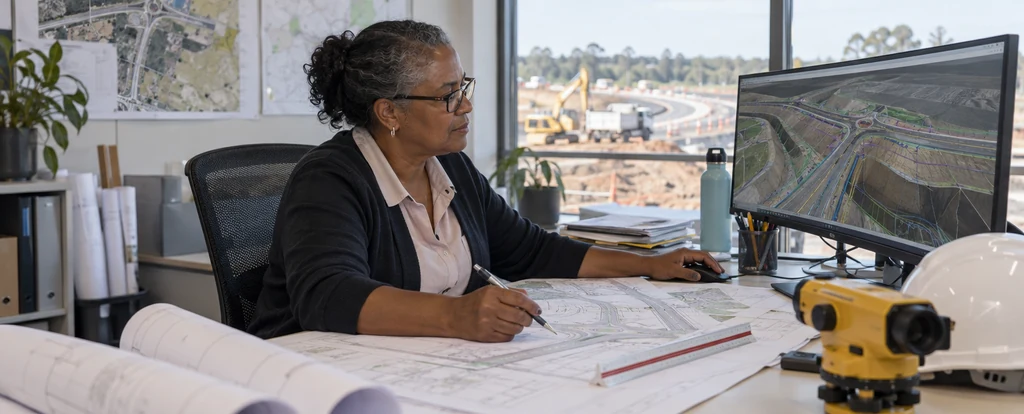
Civil drafters turn engineers' designs for roads, drainage and structures into the detailed drawings and 3D models that guide construction on site.
- Median salary*
- $88,400
4.5%vs last year, before tax
- People employed
- 6,800
1.5%vs last year
- Projected growth
- +11.3%
to 2035
- AI exposure*
- Moderate
- automation risk
- Average hours
- 41/wk
+1h vs all jobs
- Shortage status
- In shortage
national
Civil drafters work under engineers, producing the drawings, plans and models used for infrastructure such as roads, subdivisions, drainage and bridges. They convert survey data, design calculations and sketches into accurate CAD documentation, then revise it as the design changes and construction proceeds. Most are employed by engineering consultancies, construction contractors or government infrastructure teams, and the role sits between the engineer who sets the design intent and the crews who build it.
How much do civil drafters earn?
The median full-time salary for a civil drafter is $88,400 per annum, before tax, up $18,700 since 2018.
What you earn depends on where you work and how much responsibility you carry. Large engineering consultancies and government infrastructure teams generally pay more than small drafting practices, and a drafter who leads documentation on a project or supervises others moves above the middle of the range. Hours are usually standard full-time, so extra earnings tend to come from a higher classification rather than overtime.
What does a civil drafter do day to day?
The list below is what fills most weeks; the exact mix shifts with seniority and whatever stage the current work is at.
- Producing detailed drawings of roads, drainage, earthworks and structures in AutoCAD or Civil 3D
- Building and updating 3D models of site layouts so engineers can check levels, grades and services
- Interpreting survey data, engineer mark-ups and specifications, and querying anything that doesn't add up
- Revising drawings as designs change, including recording as-built conditions after site inspections
- Checking drawing sets against project standards and coordinating them with structural, hydraulic and electrical documentation before issue
What skills do civil drafters need?
Employers look for cAD and technical drawing, engineering design and analysis, reading plans and specifications, backed by AutoCAD fluency and strong attention to detail.
Specialist skills
- CAD and technical drawing
- Engineering design and analysis
- Reading plans and specifications
- Project management
Software and tools
- AutoCAD
- Autodesk Civil 3D
- Revit
- 12d Model
- MicroStation
General skills
- Attention to detail
- Problem solving
- Written communication
Is the job growing?
About 6,800 people work as civil drafters in Australia, and employment is projected to grow 11.3% over the decade to 2035. That's healthy, above-average growth, and the role should stay in solid demand.
How do you become a civil drafter?
Here's the path most civil drafters take, step by step.
- 1Finish Year 12 with a maths subject
Most entrants complete Year 12 with maths, which is the usual prerequisite for the TAFE pathway and helps with the geometry and survey calculations the work involves.
- 2Complete a diploma in civil construction design or engineering technical practice
This takes about 18 months to two years and covers CAD, 3D modelling and documentation standards, and it is the qualification most people in the role hold.
- 3Build software fluency in your first drafting job
Employers expect familiarity with AutoCAD, Civil 3D or 12d Model, and entry-level roles under a senior drafter are where most people learn to produce a full drawing set to a project's standards. Software changes regularly, so training continues throughout a career.
- 4Consider a degree if you want design responsibility
A bachelor degree in civil engineering opens the path to engineering roles and registration, and some drafters study part time while working. Without it, documentation and technician roles are where the responsibility usually stops.
Ready to apply as a civil drafter?
Whether you're working toward becoming a civil drafter or already are one and want a hand with the next step (sharpening your resume for ATS screening, tightening your cover letter, or knowing what you'll actually be asked at interview), here are examples grounded in this specific role, not generic templates.
What jobs can a civil drafter move to?
Moving into Civil Engineer typically comes with the biggest pay rise, worth $26,900 a year more on average.
| Move to | Typical pay change | Overlap | Retraining |
|---|---|---|---|
| Civil Engineer Civil drafters move into engineering roles by building on their drawing and design knowledge, though the step requires completing an engineering degree.Known move | +$26,900 | 40% | requalify |
| Structural Engineer Drafters who work on structures can move into structural engineering by adding a degree to their documentation and modelling experience.Known move | +$26,900 | 52% | requalify |
| Civil Engineering Technician Civil drafters step into technician work that applies the same documentation and modelling skills, needing only a short course in technical practice.Known move | +$2,600 | 46% | short course |
| Mechanical Drafter Drafters move across to mechanical drafting with little retraining, as drawing standards, modelling software and detailing practice carry directly across.Known move | −$5,200 | 67% | minimal |
| Architectural Drafter Architectural drafting draws on the same documentation skills, with a short course covering building design codes and practices.Known move | −$7,800 | 45% | short course |
Moves are chosen from Jobs and Skills Australia's Data on Occupation Mobility, which follows income tax records between 2011-12 and 2020-21, together with entry requirements and skill overlap. A known move is one people were seen making in that data. Pay change compares median full-time pay for the two roles.
Who works as a civil drafter?
The typical civil drafter is 40 years old; 82% are men, 86% work full-time, and full-timers average 41 hours a week.
- 40
- Median age
- 18%
- Female share
- 86%
- Full-time
- +1h
- vs all-jobs avg
What's it like being a civil drafter?
The work follows project deadlines rather than a daily routine, so a week might be heavy modelling one day and a rush of drawing revisions the next when a design changes. Drafters spend most of their time at a screen, working from engineer mark-ups and coordinating with the people producing the structural, hydraulic and electrical drawings. It suits someone who likes precision and gets satisfaction from a clean, accurate set of drawings, and who doesn't mind that their name rarely appears on the finished project.
What people like
- You can see the result on the ground. Drawings you produce become a road, a subdivision or a drainage system, and a site visit makes that connection concrete.
- Problems with checkable answers. A drawing either matches the survey data and the design or it doesn't, which suits people who like work they can verify and finish.
- Software skills that travel. Civil 3D, 12d Model and AutoCAD skills are wanted across consultancies, contractors and government agencies, so changing employer is rarely starting over.
- Steadier hours than site roles. Most drafting is office based with standard full-time hours, though a project issue date can mean extra time at the screen.
What people find hard
- Revision rounds can feel endless. A design change late in a project can send a whole set of drawings back through checking, and the same sheets get redrawn several times.
- Pressure clusters before an issue. Documentation goes out to a program, so the work concentrates in the days before a drawing release and stacks up when several projects land at once.
- You work to someone else's design. Engineers set the intent and drafters document it, so there is limited room to make your own design calls without moving into an engineering role.
- Screen-bound and sedentary. Long stretches at a desk are the norm, and for many drafters site visits are occasional rather than routine.
Based on our synthesis of professional-body surveys and public accounts of the role, not first-person verified reviews.
Which industries employ civil drafters?
Professional, Scientific and Technical Services employs the largest share of civil drafters, followed by Construction.
Top employing industries
- 1Professional, Scientific and Technical Services
- 2Construction
- 3Public Administration and Safety
Ranked by employment share; the source doesn't publish an exact percentage per industry.
| Diploma / Advanced Diploma | 41.6% | |
|---|---|---|
| Bachelor degree | 21.1% | |
| Year 12 or below | 14.3% | |
| Certificate III/IV | 13.7% | |
| Postgraduate | 5.7% |
Will AI replace civil drafters?
Civil drafting sits in the middle: software now generates standard road cross sections, pipe layouts and sheet annotations, so much of the routine production is faster than it was. The parts that still rest on the drafter are reading what an engineer intends, sorting out a clash between services and knowing which drawings matter most. The role is shifting toward modelling and coordination work rather than disappearing.
Share of typical working time by exposure level
- Producing detail drawings from engineer mark-upsTemplates and automated sections handle much of the repetitive sheet work, but someone still sets the drawing up and resolves what the template cannot.30%high
- Building and updating 3D modelsCivil 3D and 12d Model generate surfaces and earthwork volumes automatically, though a drafter decides which survey data to use and checks the model against the design.30%moderate
- Checking drawings and coordinating with other disciplinesClash detection flags conflicts between services, but working out which one should move and agreeing it with the structural or hydraulic team is a conversation between people.25%low
- Site visits and as-built measurementMeasuring what was actually built and photographing it is physical work that no software does, although the measurements then feed straight back into the model.15%low
Moves least exposed to AI
These career moves from civil drafter work are rated low for AI exposure:
- Civil Engineer
Solid skill overlap (40%), requalify to get there, and a low automation-risk profile.
Common questions about becoming a civil drafter
Straight answers to the questions people ask most.
How much does a civil drafter earn?
$88,400 per annum before tax is the median for full-time civil drafters. What you are offered depends on whether you work for a consultancy, a contractor or a government agency, and on how much of a project's documentation you take responsibility for.
How do you become a civil drafter?
The usual route is a diploma in civil construction design or engineering technical practice, followed by junior drafting work where you learn Civil 3D, 12d Model or similar software on real projects. Year 12 maths helps, and some people come across from a trade or technician background and pick up drafting on the job.
Do you need a degree to be a civil drafter?
No. Drafting is one of the engineering roles you can enter with a TAFE diploma, and employers hire on drawing and modelling ability rather than a degree. A degree is only needed if you want to move into engineering work itself.
Are civil drafters in demand?
Civil drafters are currently in shortage nationally, and employment is projected to grow 11.3% over the decade to 2035. Infrastructure and land development spending drives most of that work, so consultancies and contractors are the employers to watch when you are looking.
Will AI replace civil drafters?
Automation already handles more of the routine production, and drafting software can generate standard sections, annotate sheets and flag clashes between services, which is why the role carries moderate exposure. What it handles less well is interpreting an engineer's intent, resolving a design conflict on site or judging what matters in a set of drawings, so the work is shifting toward modelling and coordination rather than disappearing.
What can a civil drafter move into?
A move into civil engineering technician work applies the same documentation and modelling skills after a short course in technical practice, and typically pays $2,600 more. Stepping up to a civil engineer role builds on the same drawing and modelling experience but requires completing an engineering degree, which the pay gap of $26,900 more reflects. A move to structural engineering also draws on documentation and modelling work, and again needs a degree.
Specialisation of
Related roles
- Civil Engineer
- Structural Engineer
- Civil Engineering Technician
- Mechanical Drafter
- Architectural Drafter
- Architectural Drafter
Not sure this is you? Take the career quiz and get a ranked shortlist of roles that fit how you like to work.