Mechanical Drafter
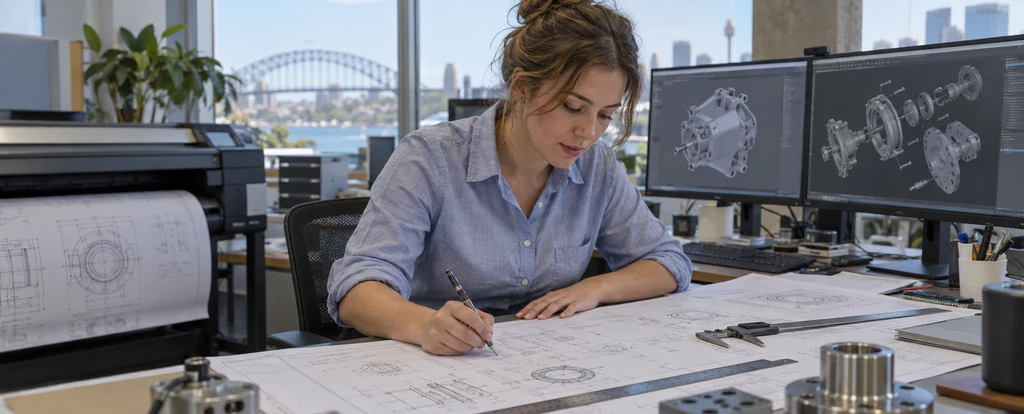
Mechanical drafters turn engineers' ideas into the detailed drawings and 3D models that manufacturers use to build, install and maintain equipment.
- Median salary*
- $83,200
4.3%vs last year, before tax
- People employed
- 3,000
0.0%vs last year
- Projected growth
- +12.6%
to 2035
- AI exposure*
- Moderate
- automation risk
- Average hours
- 42/wk
+2h vs all jobs
- Shortage status
- In shortage
national
Mechanical drafters work in engineering consultancies, manufacturing plants and construction firms, producing the drawings and models that sit between a design concept and a finished part. They are often confused with mechanical engineers, though a drafter's focus is documenting and detailing a design accurately rather than calculating and owning it. Most of the day is spent at a computer, checking dimensions and tolerances and reissuing drawings as a design changes.
How much do mechanical drafters earn?
The median full-time salary for a mechanical drafter is $83,200 per annum, before tax, up $17,500 since 2018.
Rates move with the sector, since drafters in mining, heavy manufacturing and utilities are often covered by enterprise agreements that pay above the middle of the market, while small consultancies and local fabrication shops pay less. Experience and software skill matter too, because a drafter who can manage a project's whole drawing set and check other people's work is worth more than one producing routine detail drawings. Location has some effect, mainly through which industries are hiring nearby.
What does a mechanical drafter do day to day?
The list below is what fills most weeks; the exact mix shifts with seniority and whatever stage the current work is at.
- Preparing 2D drawings and 3D models of mechanical components and assemblies
- Interpreting engineering sketches, specifications and standards so the finished drawing can be manufactured
- Reworking designs after feedback from engineers, machinists and fabricators
- Checking dimensions, tolerances and materials against project requirements
- Updating drawing registers and issuing controlled revisions to the project team
What skills do mechanical drafters need?
Employers look for cAD and technical drawing, engineering design and analysis, reading plans and specifications, backed by AutoCAD fluency and strong attention to detail.
Specialist skills
- CAD and technical drawing
- Engineering design and analysis
- Reading plans and specifications
- Project engineering and delivery
Software and tools
- AutoCAD
- SolidWorks
- Autodesk Inventor
- Creo
General skills
- Attention to detail
- Problem solving
- Written communication
Is the job growing?
About 3,000 people work as mechanical drafters in Australia, and employment is projected to grow 12.6% over the decade to 2035. That's healthy, above-average growth, and the role should stay in solid demand.
How do you become a mechanical drafter?
Here's the path most mechanical drafters take, step by step.
- 1Finish Year 12 with maths and a technical subject
Maths, physics or design and technology give you the base for reading engineering drawings and working with tolerances. Most drafting courses ask for Year 12 or equivalent, and providers often accept mature-age applicants without it.
- 2Study a Certificate IV in Engineering Drafting or a Diploma of Engineering (Technical)
These are the standard qualifications for the job, offered at TAFE and some private providers, and take roughly one to two years. Coursework covers CAD software, drafting standards, materials and tolerances, and usually includes a project or placement you can show an employer.
- 3Build a portfolio and learn the main software
Employers hiring drafters ask to see drawings you have produced, so keep the models and drawing sets from your course. AutoCAD is the baseline, while SolidWorks, Inventor and Creo appear often in manufacturing, and a short course in one of them is worth doing if your qualification did not cover it.
- 4Apply for drafting roles in manufacturing, consultancies or construction
Titles vary, and junior drafter, design drafter, CAD technician and technical officer all describe similar work. Traineeships and cadetships combine paid work with study and are a common way in, particularly with larger manufacturers.
- 5Specialise in a sector or discipline
Drafters tend to settle into an area such as mining equipment, heating and ventilation, pressure vessels or building services, because the standards and terminology differ. That depth is what makes you useful to an employer, and it also opens the move into engineering or across to another drafting discipline.
Ready to apply as a mechanical drafter?
Whether you're working toward becoming a mechanical drafter or already are one and want a hand with the next step (sharpening your resume for ATS screening, tightening your cover letter, or knowing what you'll actually be asked at interview), here are examples grounded in this specific role, not generic templates.
What jobs can a mechanical drafter move to?
Moving into Mechanical Engineer typically comes with the biggest pay rise, worth $52,700 a year more on average.
| Move to | Typical pay change | Overlap | Retraining |
|---|---|---|---|
| Mechanical Engineer Mechanical drafters bring detailed component modelling and drawing skills, and can move into engineering design with a mechanical engineering degree.Known move | +$52,700 | 63% | requalify |
| Civil Drafter Drafting skills and CAD knowledge carry across to civil infrastructure drawings, needing only familiarisation with civil standards.Known move | +$5,200 | 67% | minimal |
| Electrical Drafter Mechanical drafters can apply their CAD and technical drawing skills to electrical layouts with minimal retraining.Known move | +$5,200 | 67% | minimal |
| Architectural Drafter Technical drawing and modelling experience transfers to building documentation, with a short course covering architectural standards.Known move | −$2,600 | 45% | short course |
| Industrial Designer Product-focused drafters can move into industrial design by requalifying, using their modelling skills in concept and product development.Known move | −$6,200 | 19% | requalify |
Moves are chosen from Jobs and Skills Australia's Data on Occupation Mobility, which follows income tax records between 2011-12 and 2020-21, together with entry requirements and skill overlap. A known move is one people were seen making in that data. Pay change compares median full-time pay for the two roles.
Who works as a mechanical drafter?
The typical mechanical drafter is 43 years old; 91% are men, 88% work full-time, and full-timers average 42 hours a week.
- 43
- Median age
- 9%
- Female share
- 88%
- Full-time
- +2h
- vs all-jobs avg
What's it like being a mechanical drafter?
The work follows project schedules, so a drafting week swings between quiet stretches of modelling and sudden pressure when a design changes late. Much of the day is spent at a screen, interrupted by engineers and fabricators who need a dimension confirmed or a revision issued. It suits someone who likes precision, takes satisfaction from a clean set of drawings, and is content to work through detail without much of the spotlight.
What people like
- Drawings that work on the shop floor. A drafter often hears back that a part fitted first time because the drawing was clear. That feedback is direct in a way that office work rarely is.
- Variety across components and industries. One month might be a pump housing, the next a conveyor frame or a piece of process equipment. Each job brings its own tolerances, materials and manufacturing constraints.
- Skills that travel. CAD and drawing standards are broadly similar across employers, which makes it easier to change industries or move between cities than in many trades.
- Focused, self-directed work. Once a drafter understands the brief, much of the job is uninterrupted modelling and checking. People who like getting into detail tend to enjoy that part most.
What people find hard
- Late design changes. When an engineer revises a concept after the drawings are issued, the drafter redoes the model, the dimensions and the documentation, sometimes against a deadline they did not set.
- Long hours at a screen. Full-time drafters average around 42 hours a week, and most of that is spent at a computer. The physical variety of site or workshop work is not part of the job.
- Caught between engineers and production. Drafters field questions from both sides, and when a drawing is queried on the factory floor, they are the ones explaining or correcting it.
- Crunch points before tenders and builds. Documentation tends to be due just before everyone else needs it, so drafters often absorb the pressure at the front end of a project.
Based on our synthesis of professional-body surveys and public accounts of the role, not first-person verified reviews.
Which industries employ mechanical drafters?
Professional, Scientific and Technical Services employs the largest share of mechanical drafters, followed by Manufacturing.
Top employing industries
- 1Professional, Scientific and Technical Services
- 2Manufacturing
- 3Construction
Ranked by employment share; the source doesn't publish an exact percentage per industry.
| Diploma / Advanced Diploma | 35.5% | |
|---|---|---|
| Certificate III/IV | 25.1% | |
| Bachelor degree | 18.9% | |
| Year 12 or below | 10.9% | |
| Postgraduate | 5.7% |
Will AI replace mechanical drafters?
Mechanical drafting sits in the middle. Software already handles parts of the routine work, such as generating standard views, dimensions and drawing templates from a 3D model, and that capability keeps improving. What holds the job up is the manufacturing judgement behind a drawing, knowing what a machinist can hold, which tolerance actually matters and how a change to one part affects everything around it, which is why drafters who work closely with engineers and fabricators stay in demand.
Share of typical working time by exposure level
- Drawing components and assemblies in CADAutoCAD, SolidWorks and Inventor can now produce standard views and drawing sheets straight from a model, and template libraries remove much of the repetitive line work.35%high
- Checking dimensions, tolerances and materialsSoftware can flag a dimension that clashes with another, but deciding whether a tolerance is achievable on the machines that will make the part still takes a drafter's judgement.25%moderate
- Working through design changes with engineers and fabricatorsReading a shop-floor query about a hole that will not line up, then negotiating a fix with the engineer, depends on understanding the whole job rather than the file.20%low
- Managing drawing registers and issuing revisionsDocument control systems automate version tracking and distribution, though someone still has to decide which revision is approved and who needs to see it.20%moderate
Common questions about becoming a mechanical drafter
Straight answers to the questions people ask most.
How much do mechanical drafters earn?
Mechanical drafters earn a median of $83,200 per year before tax, based on full-time workers. What moves that figure most is the sector you work in and the level of drawing you take responsibility for, since enterprise agreements in mining and heavy industry pay more than small consultancies.
How do you become a mechanical drafter?
The usual route is a Certificate IV in Engineering Drafting (MEM40422) or a Diploma of Engineering (Technical) through TAFE or a private provider, sometimes as a paid trainee while you study. Employers want to see drawings you have produced and familiarity with AutoCAD at minimum, so treat your course models as portfolio pieces. A bachelor's degree is not required for drafting work, though some drafters arrive through an engineering degree.
Are mechanical drafters in demand?
About 3,000 people work as mechanical drafters in Australia, and they are currently in shortage nationally, with employment projected to grow 12.6% over the decade to 2035. Because the occupation is small, openings come up mainly as people retire or move into engineering roles, so your CAD experience and willingness to work where the projects are will matter more than volume of vacancies.
Will AI replace mechanical drafters?
Parts of the job are already changing, since CAD and modelling software can generate standard views, dimensions and drawing templates from a 3D model, which takes over routine drafting work. What holds up is manufacturing judgement: knowing what a machinist can actually hold, which tolerance matters for function, and how a change to one part ripples through an assembly. Drafters who understand production and work closely with engineers and fabricators are the ones these tools support rather than replace.
What can mechanical drafters move into?
The clearest step is into mechanical engineering, where pay is $52,700 more and the move needs a mechanical engineering degree, because the work shifts from documenting a design to calculating and owning it. A sideways move into civil or electrical design documentation takes little retraining, since the CAD skills and drawing standards carry across, and the main adjustment is learning a different set of codes and terminology. People move in both directions as projects and sectors change, so the skills built here are portable into and out of this occupation.
Do mechanical drafters need a degree?
No, and most of the current workforce does not hold one. A Certificate IV or diploma in engineering drafting is the standard entry qualification, and employers judge applicants largely on the drawings they can produce. A degree becomes relevant only if you later want to move into engineering or design management.
Specialisation of
Related roles
- Mechanical Engineer
- Civil Drafter
- Electrical Drafter
- Architectural Drafter
- Industrial Designer
- Civil Drafter
Not sure this is you? Take the career quiz and get a ranked shortlist of roles that fit how you like to work.