Commercial Diver
Commercial divers carry out construction, inspection and repair work underwater, keeping ports, pipelines and offshore structures in service.
- Median salary*
- $114,400
4.3%vs last year, before tax
- People employed
- 910
1.1%vs last year
- Projected growth
- +13.9%
to 2035
- AI exposure*
- Low
- automation risk
- Average hours
- 48/wk
+8h vs all jobs
- Shortage status
- Not in shortage
national
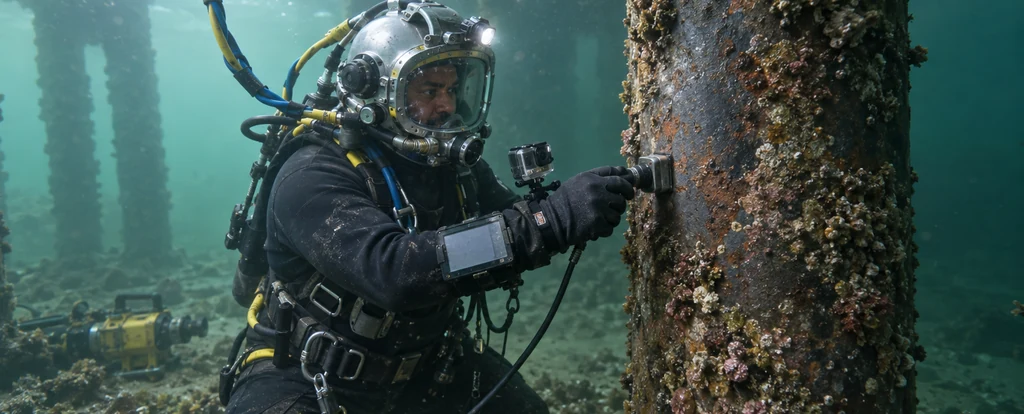
Commercial divers work below the surface on wharves, pipelines, bridges, dams and offshore platforms, using scuba or surface-supplied breathing apparatus and the same tools a construction site uses above water. Most work in small teams of two or three divers with a supervisor and a tender on the surface, following a decompression schedule on the way up. It is a licensed trade rather than a recreational activity, and most of the week is inspection and maintenance work rather than salvage.
How much do commercial divers earn?
The median full-time salary for a commercial diver is $114,400 per annum, before tax, up $24,100 since 2018.
Pay is set largely by the project and the depth of the work. Offshore oil and gas, saturation diving and defence contracts pay more than inshore construction and maintenance, and enterprise agreements or project rates often add allowances for travel and remote rosters. Certification matters too, so divers who add deeper-diving qualifications, underwater welding or non-destructive testing tend to earn more.
What does a commercial diver do day to day?
The list below is what fills most weeks; the exact mix shifts with seniority and whatever stage the current work is at.
- Inspecting wharf piles, pipelines and offshore structures for corrosion, cracks and scour, often filming the survey for an engineer on shore
- Welding and cutting steel underwater, either in a flooded habitat or with a wet welding technique approved for the job
- Operating hydraulic tools such as impact wrenches, grinders and dredges to prepare a surface or clear a blocked intake
- Installing and maintaining mooring systems, intake screens and pipeline sections
- Working as part of a dive team, tending a partner's umbilical and following the decompression schedule on the way up
What skills do commercial divers need?
Employers look for hand and power tool work, installation and maintenance, worksite safety management, backed by Dive computers fluency and strong physical stamina and dexterity.
Specialist skills
- Hand and power tool work
- Installation and maintenance
- Worksite safety management
- Plant and equipment operation
Software and tools
- Dive computers
- Underwater welding equipment
- Hydraulic tools
- Ultrasonic testing equipment
- Dive planning software
General skills
- Physical stamina and dexterity
- Problem solving
- Attention to detail
Is the job growing?
About 910 people work as commercial divers in Australia, and employment is projected to grow 13.9% over the decade to 2035. That's healthy, above-average growth, and the role should stay in solid demand.
How do you become a commercial diver?
Here's the path most commercial divers take, step by step.
- 1Get a commercial dive medical
Before any course, you need a medical assessment to the standard for commercial diving, because hearing, lung function and heart health all affect how you cope with pressure at depth. The certificate is renewed regularly, so it stays part of the job rather than a one-off check.
- 2Complete an ADAS-accredited commercial diving course
The entry qualification is a commercial diving course through a registered training organisation, commonly a Certificate III in Commercial Diving, covering surface-supplied breathing apparatus, dive physics and physiology, underwater tools and emergency procedures. It runs for several months full time and includes a set number of logged dives.
- 3Start inshore and build logged dives
Most people begin on construction and maintenance work in ports, rivers and dams, or as a tender supporting a more experienced diver. Employers look at your logbook and the tasks you have actually done underwater when moving you onto bigger projects.
- 4Add the licences and qualifications the work needs
A White Card for construction sites, first aid, a coxswain or boat handling certificate and high risk work licences for rigging or crane operations all widen the jobs you can take. Underwater welding and non-destructive testing qualifications are the ones that lead to higher-level work.
- 5Progress to deeper and offshore certification
Deeper diving, saturation work and offshore projects generally require further commercial diving certification plus offshore survival training and a current medical. That combination is what opens oil and gas, defence and major infrastructure contracts.
Ready to apply as a commercial diver?
Whether you're working toward becoming a commercial diver or already are one and want a hand with the next step (sharpening your resume for ATS screening, tightening your cover letter, or knowing what you'll actually be asked at interview), here are examples grounded in this specific role, not generic templates.
What jobs can a commercial diver move to?
None of the roles commercial divers typically move into pay more than the role itself. Dive Instructor is the closest match. If a bigger salary is the goal, moving up into a senior or principal position within the role is usually the faster route than moving sideways.
| Move to | Typical pay change | Overlap | Retraining |
|---|---|---|---|
| Dive Instructor Commercial divers bring underwater work experience and equipment familiarity, but need instructor certification to teach recreational diving.Known move | −$54,600 | 17% | reskill |
Moves are chosen from Jobs and Skills Australia's Data on Occupation Mobility, which follows income tax records between 2011-12 and 2020-21, together with entry requirements and skill overlap. A known move is one people were seen making in that data. Pay change compares median full-time pay for the two roles.
Who works as a commercial diver?
The typical commercial diver is 35 years old; 93% are men, 74% work full-time, and full-timers average 48 hours a week.
- 35
- Median age
- 7%
- Female share
- 74%
- Full-time
- +8h
- vs all-jobs avg
What's it like being a commercial diver?
The work runs on a project rhythm: a dive window, a set of tasks, a decompression stop and a debrief, repeated until the job is finished. It suits people who are comfortable in the water, methodical about procedure and physically capable, because the margin for error is small and the rest of the team depends on you following the plan. The trade-offs are the rosters, the heavy gear and the fact that most divers eventually move into surface roles.
What people like
- Every project is a different site. One month it is a wharf pile in a working port, the next it is a pipeline intake or a bridge pier, so the problems you are solving change with the job.
- Small teams that depend on each other. Divers work in twos and threes with a supervisor watching the umbilical from the surface, so you know the people you are in the water with.
- Skills that carry across industries. Welding, rigging, non-destructive testing and boat handling all transfer to above-water work, which matters because a diving career does not last forever.
- Working in a place few people see. Ports, dams and offshore structures look nothing like this from underneath, and the clarity of the water or the marine life on a job is part of the appeal.
What people find hard
- Rosters that keep you away from home. Offshore and remote projects run on swings away from home, and the travel to and from site eats into the time off at the other end.
- Long days in heavy gear. A working day includes suiting up, equipment checks and decompression as well as time in the water, and a hot suit or a dry suit in cold water is tiring in a way that is hard to prepare for.
- Weather sets the schedule. Swell, tide and visibility decide whether a dive goes ahead, so plans change at short notice and a job can wait days for a workable window.
- Medical clearance is renewed, not earned once. Hearing, lung and joint problems can end a diving career earlier than expected, which is why the qualifications and site skills you build alongside the diving matter.
Based on our synthesis of professional-body surveys and public accounts of the role, not first-person verified reviews.
Which industries employ commercial divers?
Agriculture, Forestry and Fishing employs the largest share of commercial divers, followed by Transport, Postal and Warehousing.
Top employing industries
- 1Agriculture, Forestry and Fishing
- 2Transport, Postal and Warehousing
- 3Public Administration and Safety
Ranked by employment share; the source doesn't publish an exact percentage per industry.
| Certificate III/IV | 33% | |
|---|---|---|
| Year 12 or below | 25.7% | |
| Diploma / Advanced Diploma | 13.9% | |
| Bachelor degree | 11.2% | |
| Postgraduate | 2.8% |
Will AI replace commercial divers?
Commercial diving has low exposure to AI and automation. Remotely operated vehicles, sonar imaging and dive planning software have changed how surveys and schedules are handled, but the repairs and installations themselves still happen in the water. The certification and medical requirements do not change either, so the entry path looks much as it did a decade ago.
Share of typical working time by exposure level
- Rigging, tool work and installationBolting a mooring system or clearing an intake screen with hydraulic tools is physical work at depth, guided by a supervisor on the surface rather than a machine.40%low
- Underwater welding and cuttingWelding a wharf pile in a flooded habitat or wet welding in poor visibility depends on the diver's hands, torch angle and the conditions on the day.25%low
- Underwater inspection and surveyROVs and sonar imaging cover some pipeline and hull surveys, but a diver still goes in where access is tight or a defect needs to be seen and felt up close.20%moderate
- Dive planning, logging and reportingPlanning software and digital logbooks speed up the paperwork, though the decompression schedule and the record of what was found still rest on the supervisor and the diver.15%moderate
Common questions about becoming a commercial diver
Straight answers to the questions people ask most.
How much do commercial divers earn?
Commercial divers earn $114,400 per annum, before tax, as a median for full-time work. That figure is a guide, and the range around it is wide because offshore, saturation and defence work pays more than inshore construction and maintenance, and higher certification lifts rates further.
How do you become a commercial diver?
You pass a commercial dive medical, complete an ADAS-accredited diving course such as a Certificate III in Commercial Diving, then build logged dives on inshore projects before moving offshore. Employers want the certification, a current medical and a record of the tasks you have done underwater.
Are commercial divers in demand?
Commercial divers are currently not in shortage, and employment is projected to grow 13.9% over the decade to 2035. The occupation is small, so hiring follows port, infrastructure and offshore maintenance projects rather than steady turnover, and up-to-date certification and a current medical are what get you onto a crew list.
Will AI or automation replace commercial divers?
Remotely operated vehicles and sonar imaging have taken over some routine inspection work that divers once did by hand, and dive planning software now handles much of the scheduling and logging. The physical work that remains, welding, rigging, cutting and repairing structures in poor visibility, still needs someone in the water.
What other jobs can a commercial diver move into?
Deckhands and dive instructors both move into commercial diving, and the step is worth $25,000 more and $54,600 less respectively, because both arrive with water skills and need only the commercial certification. Experienced divers also set up on their own as contractors tendering for port and maintenance work, and that is often where earnings grow.
What are the hours like?
Commercial diving is full-time work for 74% of the people in the role and averages around 48 hours a week. Offshore rosters mean weeks away followed by a break at home, while inshore projects are closer to standard days with early starts, and both are shaped by tides, weather and the dive window.
Related roles
- Dive Instructor
- Deckhand
- Dive Instructor
- Defence Force Member
- Railway Track Worker
- Telecommunications Cable Jointer
Not sure this is you? Take the career quiz and get a ranked shortlist of roles that fit how you like to work.