Railway Track Worker
Railway track workers build and maintain the rails, sleepers and ballast that trains run on.
- Median salary*
- $70,700
3.7%vs last year, before tax
- People employed
- 5,600
0.0%vs last year
- Projected growth
- +1.2%
to 2035
- AI exposure*
- Low
- automation risk
- Average hours
- 48/wk
+8h vs all jobs
- Shortage status
- In shortage
national
The work happens on the permanent way itself, in rail corridors and sidings, and often at night or on weekends inside a track possession, when trains are shut down and the track is handed over for maintenance. Track workers are employed mainly by rail infrastructure contractors, freight and passenger operators, and the mining railways, and many jobs involve travel to sections of line far from the depot. This is hands-on outdoor work rather than signalling or driving trains, though the two sides of the job depend on each other.
How much do railway track workers earn?
The median full-time salary for a railway track worker is $70,700 per annum, before tax, up $14,600 since 2018.
Pay is usually set by an enterprise agreement with a rail operator or contractor, so shift loadings, night and weekend penalties and public holiday rates make up a large share of what people take home. Away-from-home allowances, travel time and remote project work add to earnings on major construction and maintenance jobs, and the mining railways tend to pay above the state networks. Moving into track machine operation or gaining higher track competencies is the main way to step up within the trade.
What does a railway track worker do day to day?
The list below is what fills most weeks; the exact mix shifts with seniority and whatever stage the current work is at.
- Walking sections of track to check rails, sleepers, fastenings and ballast for cracks, wear and movement
- Replacing worn rails, sleepers and turnout components with rail saws, impact wrenches and clip applicators
- Operating tamping, lifting and ballast regulating machines to restore track level and alignment
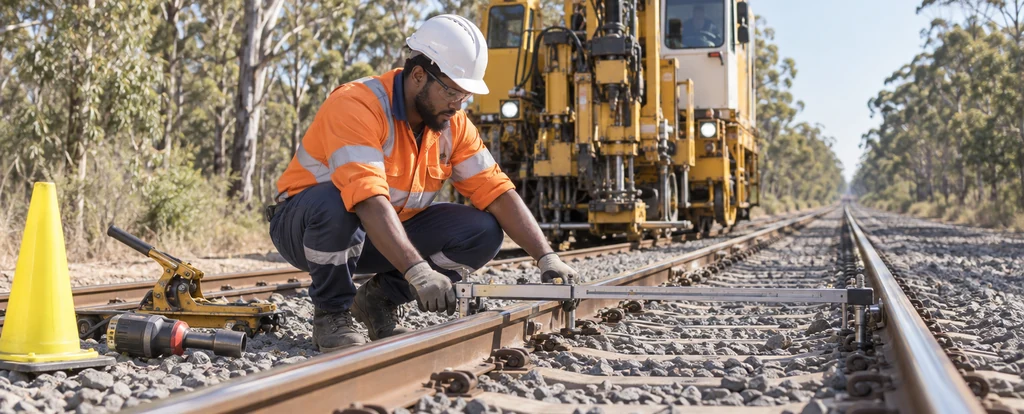
- Measuring track gauge, cross level and alignment with measuring tools and recording trolleys, then correcting what is out of tolerance
- Setting up safeworking protection, lookouts and possession boundaries before work starts so crews and trains stay separated
What skills do railway track workers need?
Employers look for installation and maintenance, worksite safety management, hand and power tool work, backed by Track geometry recording trolleys fluency and strong safety and compliance awareness.
Specialist skills
- Installation and maintenance
- Worksite safety management
- Hand and power tool work
- Plant and equipment operation
Software and tools
- Track geometry recording trolleys
- Ballast tamping machines
- Rail cutters and impact wrenches
- Pandrol clip applicators
- Track measuring gauges and levels
General skills
- Safety and compliance awareness
- Physical stamina and dexterity
- Attention to detail
Is the job growing?
About 5,600 people work as railway track workers in Australia, and employment is projected to grow 1.2% over the decade to 2035. That's modest growth: demand is steady rather than booming.
How do you become a railway track worker?
Here's the path most railway track workers take, step by step.
- 1Get the entry qualification
A Certificate II in Rail Infrastructure (TLI27121) (track work) is the common starting point, offered through TAFE and by employers. Many people enter through a traineeship with a rail contractor, which combines the certificate with paid on-the-job training.
- 2Complete safeworking training
Anyone working on or near the track needs the safeworking accreditation for that network and a Rail Industry Worker card, which records the competencies you hold and is checked before you are allowed on site. Training covers track protection, lookout duties and how to respond to train movements.
- 3Build track competencies on the job
Clipping up, lifting, tamping and turnout work are learned with an experienced crew over the first months, and most workers complete a Certificate III in Rail Infrastructure (TLI37122) as their experience grows. Employers generally pair new starters with a senior track worker rather than leaving them to pick it up alone.
- 4Choose a direction
Track machine operation, turnout and welding work, and supervision each carry higher pay bands, and they are reached by collecting specific competencies rather than by time served alone. Signalling and train driving sit outside this trade and need their own training.
Ready to apply as a railway track worker?
Whether you're working toward becoming a railway track worker or already are one and want a hand with the next step (sharpening your resume for ATS screening, tightening your cover letter, or knowing what you'll actually be asked at interview), here are examples grounded in this specific role, not generic templates.
What jobs can a railway track worker move to?
Moving into Train Driver typically comes with the biggest pay rise, worth $85,400 a year more on average.
| Move to | Typical pay change | Overlap | Retraining |
|---|---|---|---|
| Train Driver Track workers can progress to driving trains, building on their rail industry experience and safety awareness after retraining.Known move | +$85,400 | 8% | reskill |
| Work Health and Safety Inspector Track workers with site safety experience can retrain as work health and safety inspectors, applying their knowledge of rail workplace hazards.Known move | +$53,200 | 6% | reskill |
| Railway Track Machine Operator Track workers move into operating track machines, using their knowledge of track layout and maintenance to run specialised equipment.Known move | +$35,900 | 55% | short course |
| Railway Signaller Experienced track workers can retrain as signallers, applying their understanding of rail operations to control train movements safely.Known move | +$30,700 | 8% | reskill |
| Train Examiner Track workers may become train examiners, using their rail safety knowledge to inspect and certify trains before service. | +$28,100 | 35% | reskill |
Moves are chosen from Jobs and Skills Australia's Data on Occupation Mobility, which follows income tax records between 2011-12 and 2020-21, together with entry requirements and skill overlap. A known move is one people were seen making in that data. Pay change compares median full-time pay for the two roles.
Who works as a railway track worker?
The typical railway track worker is 38 years old; 93% are men, 92% work full-time, and full-timers average 48 hours a week.
- 38
- Median age
- 7%
- Female share
- 92%
- Full-time
- +8h
- vs all-jobs avg
What's it like being a railway track worker?
The rhythm is set by the timetable: most work happens in possessions booked between trains, so night shifts, weekends and public holidays are normal. Crews are small and work closely together outdoors in heat, cold, dust and noise, often far from the depot, and the day has to finish within the window booked for the track. It suits people who like seeing a physical result at the end of a shift and don't mind the conditions or the travel.
What people like
- You can see what you did. By the end of a possession the track is back in tolerance and the first train runs over it, which is a more concrete result than most jobs offer.
- Small crews, shared work. Track gangs are tight, and the work depends on everyone watching out for each other, which many people prefer to a large construction site where nobody knows your name.
- A trade that travels. Rail construction runs across the country, and core competencies are recorded nationally through the Rail Industry Worker scheme, so work is available with contractors in other states.
- Clear progression. Track machine operation, turnout work and supervision pay more, and the route to them runs through competencies you can collect deliberately rather than waiting to be noticed.
What people find hard
- Night and weekend work. Possessions are booked when trains aren't running, so a normal week can include several night shifts, and public holidays are just another working day in some depots.
- Weather and physical wear. The job is outdoors in heat, rain and cold on uneven ballast, with lifting and impact tools, and shoulders, backs and knees take the strain over a career.
- Travel and time away. Projects can be hundreds of kilometres from home, and workers on construction jobs often stay in camp or a motel for weeks at a time.
- Nothing can run over. The possession window is fixed and the track must be handed back on time, so a delay early in the shift keeps the pressure on until the last check is done.
Based on our synthesis of professional-body surveys and public accounts of the role, not first-person verified reviews.
Which industries employ railway track workers?
Construction employs the largest share of railway track workers, followed by Transport, Postal and Warehousing.
Top employing industries
- 1Construction
- 2Transport, Postal and Warehousing
- 3Mining
Ranked by employment share; the source doesn't publish an exact percentage per industry.
| Year 12 or below | 46.8% | |
|---|---|---|
| Certificate III/IV | 36.3% | |
| Diploma / Advanced Diploma | 6.2% | |
| Bachelor degree | 4.4% | |
| Postgraduate | 1.3% |
Will AI replace railway track workers?
Track work is barely exposed to AI, because the job is physical and happens on the track itself: rails, sleepers, ballast and fastenings have to be lifted, cut and fastened by people. What has changed is inspection and planning, where track recording cars, measurement technology and maintenance software flag where the track is wearing and direct crews to it. Those tools help decide what gets done; they don't do the work.
Share of typical working time by exposure level
- Replacing rails, sleepers and fasteningsCutting, lifting and clipping up are still done by hand and with portable tools, and the rails and sleepers have to be physically moved and seated.35%low
- Operating tamping and ballast regulating machinesMachine guidance sets the lifts on newer tampers, but the operator still positions the machine, watches the track and judges what the ground is doing.25%low
- Inspecting rails, sleepers and fastenings for defectsRecording cars and rail flaw detection flag likely defects, and someone still walks the section to confirm what they found and mark it for repair.20%moderate
- Setting up safeworking protection and lookoutsPossession boundaries, detonators and lookout positions are set on site by the crew, working to the network's rules and the day's protection plan.20%low
Common questions about becoming a railway track worker
Straight answers to the questions people ask most.
How much do railway track workers earn?
The median for full-time railway track workers is $70,700 per annum, before tax. Shift loadings, night and weekend penalties and away-from-home allowances can add a lot on top of the base rate, so what you take home depends on the roster you work.
How do you become a railway track worker?
Most people start with a Certificate II in Rail Infrastructure, usually through a traineeship or an entry-level job with a rail contractor, and complete the safeworking training required by the network they work on. A Rail Industry Worker card records those competencies and is checked before you can get on site. 47% of people in the job hold Year 12 or below as their highest qualification, so a university degree isn't part of getting in.
Are railway track workers in demand?
Railway track workers are currently in shortage nationally, and employment is projected to grow 1.2% over the decade to 2035. Employers recruit for new projects and for ongoing maintenance and renewal of existing lines, so openings appear across the country rather than in one state.
Will AI take over railway track work?
Very little of this job can be automated, because rails, sleepers and fastenings still have to be lifted, cut and fastened by people working in the corridor. Technology has changed how faults are found, with track recording cars, measurement systems and maintenance software pointing crews at the sections that need attention. That shifts how the work is planned rather than removing the hands-on tasks.
What are the hours like?
Full-time railway track workers average 48 hours a week, and much of that falls in possessions at night or on weekends, when the track is closed to trains. Rosters vary by employer, and some maintenance depots run a regular night shift while construction projects work longer swings away from home.
What can a railway track worker move on to?
Track workers often move into operating track machines, where knowledge of track layout and maintenance carries over and pay is $35,900 more. Railway signaller and train driver are longer moves because the skills overlap less, and they pay $30,700 more and $85,400 more respectively. People with strong site safety experience sometimes retrain as work health and safety inspectors.
Related roles
- Railway Track Machine Operator
- Railway Signaller
- Train Examiner
- Train Driver
- Work Health and Safety Inspector
- Builder's Labourer
Not sure this is you? Take the career quiz and get a ranked shortlist of roles that fit how you like to work.