Railway Signaller
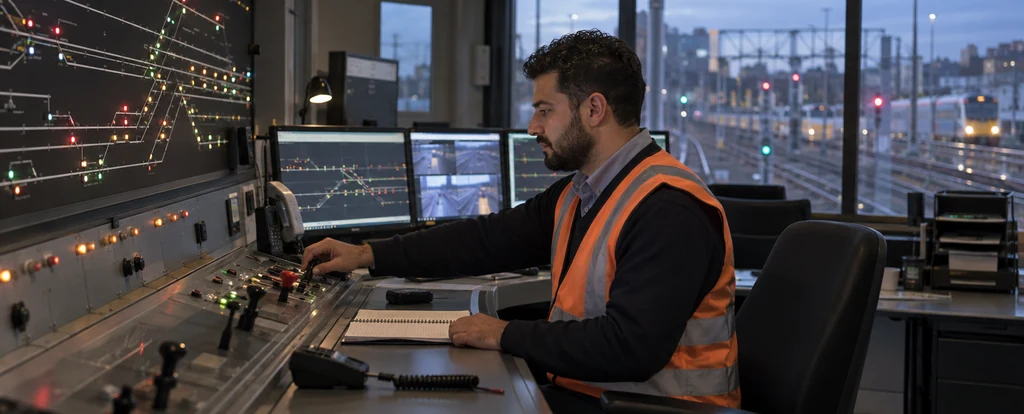
Railway signallers direct train movements from signal boxes and control centres, setting routes and signals so passenger and freight services run safely and on time.
- Median salary*
- $101,400
3.7%vs last year, before tax
- People employed
- 1,200
0.0%vs last year
- Projected growth
- +6.9%
to 2035
- AI exposure*
- Moderate
- automation risk
- Average hours
- 45/wk
+5h vs all jobs
- Shortage status
- Not in shortage
national
Railway signallers work in signal boxes and control centres for network operators such as ARTC and the state rail authorities, clearing routes and signals so trains can move without conflicting. The work is safety-critical and accredited under national rail safety law, which is why training is long and procedures are strict. The role sits close to train control: signallers handle signals and routes, while train controllers manage the wider timetable and network flow.
How much do railway signallers earn?
The median full-time salary for a railway signaller is $101,400 per annum, before tax, up $20,900 since 2018.
Pay is set by the enterprise agreement covering your network operator, so it differs between states and between metropolitan, regional and freight networks. Shift and penalty rates lift take-home pay above the base rate for most signallers, because signal boxes are staffed around the clock, and each step up the signaller grades brings a rise.
What does a railway signaller do day to day?
The list below is what fills most weeks; the exact mix shifts with seniority and whatever stage the current work is at.
- Setting routes and clearing signals for each train movement
- Monitoring train positions on the signalling panel and the train control management system
- Talking to train drivers, track workers and maintenance crews over the radio
- Recording delayed running, incidents and equipment faults in the electronic train register
- Coordinating track access so maintenance crews can work between services
What skills do railway signallers need?
Employers look for operations management, risk and internal controls, backed by Train Control Management System (TCMS) fluency and strong written communication.
Specialist skills
- Operations management
- Risk and internal controls
Software and tools
- Train Control Management System (TCMS)
- SCADA
- Radio dispatch console
- Signalling control panel
- Electronic train register
General skills
- Written communication
- Attention to detail
- Problem solving
- Time and deadline management
- Safety and compliance awareness
Is the job growing?
About 1,200 people work as railway signallers in Australia, and employment is projected to grow 6.9% over the decade to 2035. That's modest growth: demand is steady rather than booming.
How do you become a railway signaller?
Here's the path most railway signallers take, step by step.
- 1Meet the entry requirements
Operators generally ask for Year 12 or equivalent, a national police check and a category 1 rail safety medical covering hearing, vision and colour perception. Many also use aptitude testing, since the job depends on sustained concentration and divided attention.
- 2Apply for a traineeship with a rail operator
Signalling is trained in-house rather than through a general course, so entry is usually a paid traineeship with a network operator such as ARTC, Sydney Trains, Queensland Rail, V/Line or Metro Trains Melbourne. Intakes are small and advertised in rounds, so it helps to watch the operators' own careers pages.
- 3Complete the signalling qualification
Trainees work through a Certificate IV in rail operations with signalling units, or the equivalent operator qualification, combining classroom and simulator work with supervised shifts in a live signal box. It usually takes about a year to 18 months, depending on the network and how quickly you gain each competency.
- 4Get accredited for the panels you will work
You are certified for specific panels and control areas rather than for signalling in general, and accreditation follows an assessment on each one. Competency is reviewed regularly and can be suspended after an incident, so assessment continues for as long as you hold the role.
- 5Build experience toward train control
After a few years, signallers can apply for train controller roles, which use the same safe working rules and often run from the same control centres.
Ready to apply as a railway signaller?
Whether you're working toward becoming a railway signaller or already are one and want a hand with the next step (sharpening your resume for ATS screening, tightening your cover letter, or knowing what you'll actually be asked at interview), here are examples grounded in this specific role, not generic templates.
What jobs can a railway signaller move to?
Moving into Train Driver typically comes with the biggest pay rise, worth $54,700 a year more on average.
| Move to | Typical pay change | Overlap | Retraining |
|---|---|---|---|
| Train Driver Rail network knowledge and safe-working rules transfer, but driving a train requires substantial training and certification. | +$54,700 | 41% | reskill |
| Train Controller Signal control and rail safety procedures carry directly into train control, with little retraining needed.Known move | +$0 | 79% | minimal |
Moves are chosen from Jobs and Skills Australia's Data on Occupation Mobility, which follows income tax records between 2011-12 and 2020-21, together with entry requirements and skill overlap. A known move is one people were seen making in that data. Pay change compares median full-time pay for the two roles.
Who works as a railway signaller?
The typical railway signaller is 43 years old; 85% are men, 90% work full-time, and full-timers average 45 hours a week.
- 43
- Median age
- 15%
- Female share
- 90%
- Full-time
- +5h
- vs all-jobs avg
What's it like being a railway signaller?
The job runs to a roster rather than a business day, and much of a shift is steady watching and confirming, punctuated by a few minutes of concentrated action when a peak builds or something fails. Signallers who settle into it tend to like clear rules, a quiet room and work that is judged on whether the network kept moving. If you need daytime hours or a lot of variety in your week, the rotating roster is the part that wears.
What people like
- You see the whole network at once. A signaller knows where every train on the panel is and how the next hour will unfold, which is satisfying in a way that a narrow job rarely is.
- The rules are written down. Safe working procedures cover most situations, so decisions rest on training and the rule book rather than on guessing what a manager wants.
- Shift rosters suit some routines. Rotating shifts bring blocks of days off midweek, which can work well for study, family arrangements or anyone who prefers quiet daytime hours away from crowds.
- There is a clear path into control roles. Signalling is one of the recognised routes into train control, so the skills you build are the ones the next job asks for.
What people find hard
- The roster runs around the clock. Signal boxes are staffed overnight, at weekends and on public holidays, and night shifts take a while to get used to.
- Quiet stretches still demand attention. Nothing may happen for twenty minutes and then everything happens at once, so you cannot switch off between movements.
- Incidents bring scrutiny. A wrong route or a missed radio call triggers investigation and review, and near misses are recorded as carefully as accidents.
- You work to a timetable you do not control. Weather, late running and maintenance overruns all land on your panel, and you have to rework the plan while drivers wait for a signal.
Based on our synthesis of professional-body surveys and public accounts of the role, not first-person verified reviews.
Which industries employ railway signallers?
Transport, Postal and Warehousing employs the largest share of railway signallers, followed by Construction.
Top employing industries
- 1Transport, Postal and Warehousing
- 2Construction
- 3Manufacturing
Ranked by employment share; the source doesn't publish an exact percentage per industry.
| Year 12 or below | 46.8% | |
|---|---|---|
| Certificate III/IV | 34.7% | |
| Diploma / Advanced Diploma | 7.4% | |
| Bachelor degree | 5.1% | |
| Postgraduate | 2.2% |
Will AI replace railway signallers?
Automation has been part of signalling for a long time, and automatic route setting now handles routine movements on busy lines, so the job is moderately exposed rather than untouched. What remains with the signaller is the work that falls outside the plan: disruptions, failed equipment, unsignalled movements and the radio calls that follow. It is a smaller, more responsible job than it was thirty years ago rather than one that is disappearing.
Share of typical working time by exposure level
- Setting routes and clearing signalsBusy lines already set many routes automatically to a timetable, but degraded infrastructure, possession limits and manual moves still need a signaller to set them by hand.30%moderate
- Monitoring panels and control screensSoftware tracks train positions and flags conflicts, which shifts the signaller's attention from reading the panel to judging which alerts actually matter.25%moderate
- Radio talk with drivers and track crewsA driver reporting an obstruction or a track crew asking for extra time gives information that is urgent, partial or unexpected, and the exchange has to be worked out live.25%low
- Recording delays, incidents and faultsTrain registers and incident logs are largely generated from system data, so what used to be handwriting into a book is now checking, correcting and adding context to an automatic record.20%high
Common questions about becoming a railway signaller
Straight answers to the questions people ask most.
How much do railway signallers earn?
Railway signallers earn a median of $101,400 per annum before tax. What you actually take home depends on the enterprise agreement covering your network, the shift and penalty rates built into your roster, and the signaller grade you hold.
How do you become a railway signaller?
Most people enter through a paid traineeship with a rail network operator and complete a Certificate IV in rail operations with signalling units, or the operator's equivalent qualification. Trainees need Year 12 or equivalent, a police check and a rail safety medical, and they spend a year or more learning under supervision before working a panel alone.
Are railway signallers in demand?
Railway signallers are currently not in shortage, and employment is projected to grow 6.9% over the decade to 2035. With about 1,200 people in the role nationally, openings appear in particular networks rather than everywhere, so it helps to follow the rail operators in the state where you want to work.
Will AI replace railway signallers?
Not the job as a whole, though automation already handles part of it. Automatic route setting and train control systems manage routine movements on busy lines, while signallers step in for disruptions, degraded equipment and anything that falls outside the timetable.
What are the hours and shifts like?
Full-time railway signallers average about 45 hours a week, and signal boxes are staffed continuously, so rosters include nights, weekends and public holidays. Networks generally run long shifts on a rotating pattern, which is why the work suits people who can keep their concentration at three in the morning.
What can railway signallers move into?
Moving into train control takes little retraining, because the safe working rules and signal control work overlap, and pay is about the same. Becoming a train driver pays $54,700 more but requires substantial training and certification before you can take a train out on your own.
Related roles
- Train Controller
- Train Driver
- Railway Track Worker
- Train Controller
- Railway Station Assistant
- Air Traffic Controller
Not sure this is you? Take the career quiz and get a ranked shortlist of roles that fit how you like to work.