Train Controller
Train controllers direct the movement of trains across a rail network, setting routes and signals so passenger and freight services run safely and on time.
- Median salary*
- $101,400
4.4%vs last year, before tax
- People employed
- 1,300
0.0%vs last year
- Projected growth
- +6.9%
to 2035
- AI exposure*
- Moderate
- automation risk
- Average hours
- 43/wk
+3h vs all jobs
- Shortage status
- Not in shortage
national
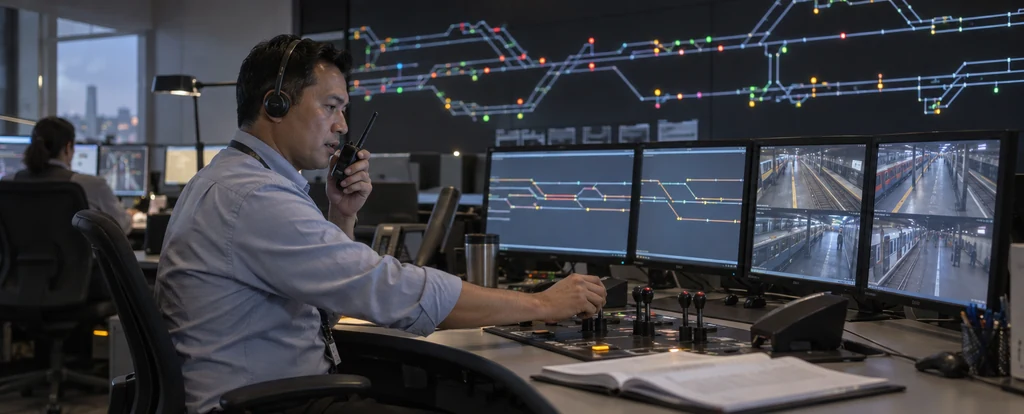
Train controllers work from a control centre, directing every train movement on their part of the network rather than driving or inspecting the trains themselves. The job is close to railway signalling but wider in scope: a signaller looks after a section of track, while a controller coordinates services across a network and decides what gives way when the timetable breaks down. Most work for state rail operators, with the rest in freight and mining railways, and control rooms run around the clock.
How much do train controllers earn?
The median full-time salary for a train controller is $101,400 per annum, before tax, up $21,400 since 2018.
Pay follows the enterprise agreement of the rail operator you work for, so a state passenger network and a private freight or mining railway can pay differently for the same work. Shift penalties and public holiday rates lift take-home pay above the base rate on a roster that covers the full 24 hours, and controllers on busier or more complex desks sit at higher levels within the same agreement.
What does a train controller do day to day?
The list below is what fills most weeks; the exact mix shifts with seniority and whatever stage the current work is at.
- Watching train movements on signalling and control screens
- Setting routes and signals to move trains safely through the network, sometimes by hand when automatic route setting cannot handle an out-of-course move
- Talking by radio with train drivers, signallers and maintenance crews
- Working through delays and incidents, then getting services moving again
- Logging what happened during a shift and handing over to the next controller
What skills do train controllers need?
Employers look for operations management, risk and internal controls, regulatory compliance, backed by Siemens Controlguide fluency and strong safety and compliance awareness.
Specialist skills
- Operations management
- Risk and internal controls
- Regulatory compliance
Software and tools
- Siemens Controlguide
- Westrace
- SCADA systems
- Two-way radio
- CCTV surveillance systems
General skills
- Safety and compliance awareness
- Written communication
- Problem solving
- Attention to detail
- Time and deadline management
Is the job growing?
About 1,300 people work as train controllers in Australia, and employment is projected to grow 6.9% over the decade to 2035. That's modest growth: demand is steady rather than booming.
How do you become a train controller?
Here's the path most train controllers take, step by step.
- 1Check the entry requirements for your state and operator
Rail operators generally ask for Year 12 or equivalent, a national police check and a rail safety worker medical, which includes drug and alcohol screening. These requirements sit with the operator and the state regulator, so they vary around the country.
- 2Get a start in rail operations
Many controllers come from signalling, train driving, conducting or station and operations roles, because operators prefer people who already know the safe working rules and the network. A qualification in rail operations, such as a Certificate IV, can help you into those first roles.
- 3Complete control room training
New controllers usually go through the operator's own program, which runs for several months and combines classroom work on the rule book with supervised time on a live desk. You are assessed on competence before you work a desk on your own.
- 4Build network knowledge and keep your competency current
Learning the geography of the network, the local instructions and the failure procedures takes time, and controllers are reassessed at regular intervals. Registration as a rail safety worker is renewed through the operator.
Ready to apply as a train controller?
Whether you're working toward becoming a train controller or already are one and want a hand with the next step (sharpening your resume for ATS screening, tightening your cover letter, or knowing what you'll actually be asked at interview), here are examples grounded in this specific role, not generic templates.
What jobs can a train controller move to?
Moving into Train Driver typically comes with the biggest pay rise, worth $54,700 a year more on average.
| Move to | Typical pay change | Overlap | Retraining |
|---|---|---|---|
| Train Driver Train controllers bring network-wide coordination and safe working knowledge to train driving, needing driver training to change roles.Known move | +$54,700 | 35% | reskill |
| Railway Signaller Train controllers bring operational awareness of the whole network and safe working rules to railway signalling with minimal retraining.Known move | +$0 | 79% | minimal |
Moves are chosen from Jobs and Skills Australia's Data on Occupation Mobility, which follows income tax records between 2011-12 and 2020-21, together with entry requirements and skill overlap. A known move is one people were seen making in that data. Pay change compares median full-time pay for the two roles.
Who works as a train controller?
The typical train controller is 45 years old; 82% are men, 93% work full-time, and full-timers average 43 hours a week.
- 45
- Median age
- 18%
- Female share
- 93%
- Full-time
- +3h
- vs all-jobs avg
What's it like being a train controller?
The work has a steady rhythm broken by sudden pressure: long stretches of close monitoring, then a signal failure or a trespasser on the line that has to be worked through in minutes. It suits people who stay calm on a radio, like knowing exactly what the rules allow, and are comfortable making a call and living with it. The control room is quiet and screen-based, so the job is more about attention and coordination than physical activity.
What people like
- You see how the whole network fits together. A controller holds the full picture that drivers, signallers and passengers each see only a piece of, and that view is what makes the work interesting over time.
- Most problems resolve in real time. When a service runs late or a signal fails, you make a decision and watch the effect on the screens in front of you, rather than handing it on and waiting.
- A clear rule book. Safe working rules and procedures set out what to do in most situations, which suits people who like knowing where their authority starts and ends.
- A small team and a calm room. You work with a handful of colleagues and a headset rather than a crowd, in a control centre that is deliberately quiet.
What people find hard
- Nights, weekends and public holidays. The roster covers the full 24 hours, so shifts fall across nights, weekends and public holidays rather than within a standard week.
- Long stretches of watching screens. Quiet periods still call for full attention on the displays, and a lapse in concentration is a safety issue rather than just a mistake.
- A mistake carries real consequences. Setting a route for the wrong train or missing a conflict can put people at risk, and serious incidents lead to a formal investigation.
- Heavy on procedures and paperwork. Rule books, local instructions and shift logs are a constant part of the job, and the record keeping continues after the incident itself is over.
Based on our synthesis of professional-body surveys and public accounts of the role, not first-person verified reviews.
Which industries employ train controllers?
Transport, Postal and Warehousing employs the largest share of train controllers, followed by Mining.
Top employing industries
- 1Transport, Postal and Warehousing
- 2Mining
Ranked by employment share; the source doesn't publish an exact percentage per industry.
| Certificate III/IV | 35.2% | |
|---|---|---|
| Year 12 or below | 33.8% | |
| Bachelor degree | 12.6% | |
| Diploma / Advanced Diploma | 11.4% | |
| Postgraduate | 2.9% |
Will AI replace train controllers?
Train control sits in the moderate range. Automatic route setting, train management systems and SCADA platforms already handle much of the routine work of moving timetabled services and spotting conflicts, so the screens are more automated than they once were. What keeps the job from being more exposed is degraded working: when a signal fails or an incident blocks the line, the controller has to apply safe working rules, prioritise services and coordinate people by radio.
Share of typical working time by exposure level
- Setting routes and signals through the control systemAutomatic route setting handles most timetabled moves, but controllers still set routes by hand when a train is out of course or a system is degraded.30%high
- Monitoring train running and adjusting the timetableSoftware flags late services and predicts conflicts, while the decision about which service takes priority stays with the controller.25%moderate
- Talking to drivers, signallers and maintenance crews by radioWorking a blocked line over two-way radio, agreeing who moves first and giving clear instructions is still done between people.25%low
- Responding to incidents and recording what happenedSystems increasingly template and draft incident logs, but the decisions taken in the minutes after a failure remain with the controller at the desk.20%moderate
Common questions about becoming a train controller
Straight answers to the questions people ask most.
How much do train controllers earn?
Train controllers earn a median of $101,400 per annum, before tax. Pay follows the enterprise agreement of the operator you work for, and shift penalties on a 24/7 roster can add a noticeable amount above the base rate.
How do you become a train controller?
Most people come into train control from another rail job, such as signalling, driving or conducting, and then complete the operator's own control room training. Operators generally ask for Year 12 or equivalent and a rail safety worker medical, with the exact requirements set by the operator and the state regulator.
Are train controllers in demand?
Train controllers are currently not in shortage, and employment is projected to grow 6.9% over the decade to 2035. About 1,300 people work in the role, so openings tend to arrive when an operator runs a recruitment round rather than continuously through the year.
Will AI replace train controllers?
It is changing the routine parts of the job rather than replacing the role outright. Automatic route setting and modern train management systems handle timetabled moves and flag late-running services, but degraded working, incident response and the judgement calls during a disruption still sit with the controller.
What jobs can train controllers move into?
Railway signalling is a common move in both directions, and the pay is about the same with little retraining needed, because both roles work to the same safe working rules. Train driving pays around $54,700 more and uses your route knowledge, though it needs driver training.
What are the hours like?
Train controllers work an average of 43 hours a week on a roster that covers nights, weekends and public holidays. Control rooms are staffed around the clock, so shift work is part of the job rather than an occasional extra.
Related roles
- Train Driver
- Railway Signaller
- Railway Signaller
- Train Driver
- Transport Conductor
- Airline Customer Service Agent
Not sure this is you? Take the career quiz and get a ranked shortlist of roles that fit how you like to work.