Transport Conductor
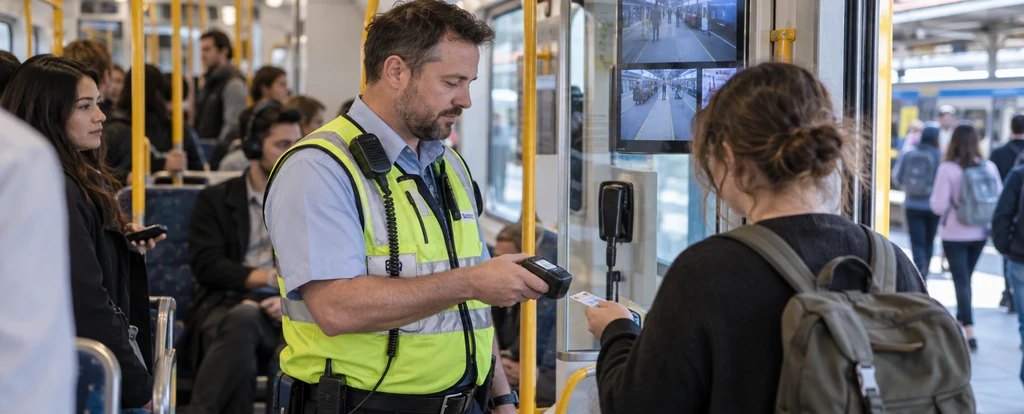
Transport conductors ride with a train, tram or long-distance service to check fares, help passengers and keep the journey safe.
- Median salary*
- $65,000
3.5%vs last year, before tax
- People employed
- 340
13.3%vs last year
- Projected growth
- +5.4%
to 2035
- AI exposure*
- Moderate
- automation risk
- Average hours
- 39/wk
−1h vs all jobs
- Shortage status*
- Not in shortage
national
Transport conductors work on board trains, trams and long-distance rail services, checking fares, helping passengers and handling whatever happens between stations. The role is most common on regional and longer-distance services, because many city networks have moved fare checking to station staff and roving authorised officers. Unlike a station assistant, who stays at one location, a conductor travels with the service and is the crew member passengers turn to first.
How much do transport conductors earn?
The median full-time salary for a transport conductor is $65,000 per annum, before tax, up $13,800 since 2018.
Most conductors are paid under an enterprise agreement with a rail operator, so the base rate and the loadings come from that agreement rather than from the job title. Shift penalties, weekend and public holiday rates, and overnight allowances on long-distance services can change a yearly figure noticeably. Progression usually happens through service or grade bands within the operator's agreement.
What does a transport conductor do day to day?
The list below is what fills most weeks; the exact mix shifts with seniority and whatever stage the current work is at.
- Checking fares and travel passes with a handheld validator, and recording passengers who haven't paid for revenue protection staff
- Helping passengers with connections, accessibility needs, prams and luggage, especially at busy stops
- Making live announcements about stops, changes and delays when the automated system can't cover what is happening
- Watching the carriage and the platform for safety issues, and stepping in when behaviour becomes a risk
- Working with the driver and control room through a disruption, then writing up an incident report at the end of the run
What skills do transport conductors need?
Employers look for operations management, backed by Ticket validators fluency and strong customer service.
Specialist skills
- Operations management
Software and tools
- Ticket validators
- Mobile ticketing apps
- Two-way radios
- Public address systems
- CCTV monitors
General skills
- Customer service
- Written communication
- Safety and compliance awareness
- Attention to detail
- Problem solving
Is the job growing?
About 340 people work as transport conductors in Australia, and employment is projected to grow 5.4% over the decade to 2035. That's modest growth: demand is steady rather than booming.
How do you become a transport conductor?
Here's the path most transport conductors take, step by step.
- 1Meet the entry requirements
Operators generally ask for Year 12 or equivalent, though the current workforce shows the bar is not high: 44% of transport conductors list Year 12 or below as their highest qualification.
- 2Pass the operator's background and medical checks
Expect a police check, a medical assessment as a rail safety worker, and a Working with Children Check where the role involves school or family travel. Some operators also want a current driver's licence because shifts start before public transport is running.
- 3Complete paid training with the operator
New conductors are trained by the operator, usually over several weeks of classroom sessions and supervised runs. Fare systems, emergency procedures, customer service and route knowledge are covered, and the training is paid.
- 4Add a certificate if you want to move on
A certificate III or IV in transport and logistics or rail operations, offered through TAFE, is not needed to start but helps later for train control, inspection or supervisory roles.
Ready to apply as a transport conductor?
Whether you're working toward becoming a transport conductor or already are one and want a hand with the next step (sharpening your resume for ATS screening, tightening your cover letter, or knowing what you'll actually be asked at interview), here are examples grounded in this specific role, not generic templates.
What jobs can a transport conductor move to?
Moving into Train Driver typically comes with the biggest pay rise, worth $91,100 a year more on average.
| Move to | Typical pay change | Overlap | Retraining |
|---|---|---|---|
| Train Driver Rail safety and passenger operations carry across, with short course training needed for the driver's cab and route knowledge.Known move | +$91,100 | 50% | short course |
| Train Controller Conductor knowledge of rail services and passenger safety supports controlling trains, with short course training in signalling and coordination.Known move | +$36,400 | 47% | short course |
| Bus Driver Passenger transport and safety experience from conductor work supports bus driving, though a licence and reskilling are needed.Known move | +$28,300 | 33% | reskill |
| Transport Operations Inspector Rail operations and compliance experience supports inspection work, with short course training in transport regulations and enforcement.Known move | +$23,400 | 47% | short course |
| Railway Station Assistant Onboard safety and ticket compliance experience transfers to platform and station duties, with little extra training required.Known move | +$2,600 | 100% | minimal |
Moves are chosen from Jobs and Skills Australia's Data on Occupation Mobility, which follows income tax records between 2011-12 and 2020-21, together with entry requirements and skill overlap. A known move is one people were seen making in that data. Pay change compares median full-time pay for the two roles.
Who works as a transport conductor?
The typical transport conductor is 43 years old; 71% are men, 90% work full-time, and full-timers average 39 hours a week.
- 43
- Median age
- 29%
- Female share
- 90%
- Full-time
- −1h
- vs all-jobs avg
What's it like being a transport conductor?
A conductor's day is spent moving: boarding at the start of a run, walking the carriages between stops, and finishing with paperwork if something went wrong. Full-time hours average 39 a week, but they arrive as shifts across early mornings, evenings, weekends and public holidays, and much of the work is done on your feet. It suits people who are comfortable around strangers, stay calm in a crowded carriage, and can apply the same rule to everyone.
What people like
- You are moving, not sitting at a desk. The working day travels through the network, which appeals to people who dislike being tied to one office or counter. It is active work, with a different carriage and a different set of passengers every run.
- Regular passengers make a route familiar. On commuter and regional services you start to recognise the same faces, and small help such as pointing out a connection or carrying a bag lands well. The work has a social side that a fare machine cannot replace.
- There are clear procedures and a team on the radio. Rail safety rules tell you what to do in most situations, and the driver, control room and station staff are a call away when they don't. That structure makes the job less isolating than it sounds.
- You help on the days that go wrong. When a service is cancelled or a passenger is unwell, the conductor is often the person who makes it manageable. Those shifts are the memorable ones.
What people find hard
- Shifts land on nights, weekends and holidays. Railways run when other people are off, so rosters include early starts, late finishes and Christmas Day on a rotating basis. The penalty rates compensate, but the pattern is hard on family routines.
- Peak hour brings crowding and aggression. Fare disputes, drunken behaviour and packed carriages are part of the job, and a conductor is expected to stay composed while being sworn at. Support is available, but you are the person standing there when it happens.
- You are on your feet for most of the shift. Walking the length of a train repeatedly, plus standing through station stops, adds up over a full week. Good shoes and a decent level of fitness matter more than people expect.
- The same route, several times a day. Most shifts repeat the same stops in the same order, so the work can feel monotonous between disruptions. People who need variety tend to look at other roles on the network after a few years.
Based on our synthesis of professional-body surveys and public accounts of the role, not first-person verified reviews.
Which industries employ transport conductors?
Transport, Postal and Warehousing employs the largest share of transport conductors.
Top employing industries
- 1Transport, Postal and Warehousing
Ranked by employment share; the source doesn't publish an exact percentage per industry.
| Year 12 or below | 43.7% | |
|---|---|---|
| Certificate III/IV | 24.1% | |
| Bachelor degree | 11.3% | |
| Diploma / Advanced Diploma | 10.4% | |
| Postgraduate | 3.9% |
Will AI replace transport conductors?
Automation has taken over much of the routine side of this job, so transport conductors have a moderate level of exposure. Fare validators, contactless payment systems and recorded announcements now do work that once filled a conductor's day, and rostering and incident software handles the administration. What remains is physical presence in the carriage, which is why the role has not disappeared.
Share of typical working time by exposure level
- Managing crowding and disruptionsWhen a peak service is packed or a train is held between stations, someone has to decide who moves where and keep passengers informed in person.35%low
- Safety incidents and difficult passengersFirst aid, evacuations and de-escalating an aggressive passenger need a person in the carriage; the report afterwards is often written in software, but the response is not.30%low
- Fare checks and validationsValidators and tap-on systems confirm most fares automatically, so conductors spend more time on exceptions such as a failed tap or a passenger travelling without a valid pass.20%high
- Onboard announcements and passenger informationRecorded systems call the routine stops; conductors are left to explain the unusual, like a changed platform or a delay with no clear cause yet.15%high
Common questions about becoming a transport conductor
Straight answers to the questions people ask most.
How much do transport conductors earn?
Full-time transport conductors earn $65,000 per year before tax. Penalty rates for nights, weekends and public holidays, plus long-distance allowances, can lift actual earnings above that figure, while part-time rosters sit below it.
How do you become a transport conductor?
You apply directly to a rail operator, which runs its own recruitment and training rather than requiring a degree. Applicants need a police check, a rail safety medical and often a Working with Children Check. About 44% of people in the role list Year 12 or below as their highest qualification, so formal study is not the barrier.
Are transport conductors in demand?
Transport conductors are currently not in shortage, and employment is projected to grow 5.4% over the decade to 2035. With about 340 people working in the role nationally, most openings appear when an operator adds services or replaces someone who has moved on, rather than from steady expansion.
Will AI replace transport conductors?
Not entirely, but the routine parts of the job are already automated. Fare validators, contactless payment and recorded announcements have taken over much of what conductors once did, while crowd management, emergencies and difficult passengers still need a person on board.
What can transport conductors move into?
Most moves stay inside rail operations. Train control uses the same rail safety and coordination knowledge with short course training, and earnings are $36,400 more, while a railway station assistant role covers similar platform and fare duties and pays $2,600 more. Train driving takes route knowledge and training and pays $91,100 more.
Do transport conductors work shifts?
Yes. Full-time conductors average 39 hours a week, but the hours come as a rotating roster covering early, late, weekend and public holiday services. Rosters are usually published weeks ahead, which makes planning possible even though the pattern is irregular.
Related roles
- Bus Driver
- Train Driver
- Train Controller
- Railway Station Assistant
- Transport Operations Inspector
- Railway Station Assistant
Not sure this is you? Take the career quiz and get a ranked shortlist of roles that fit how you like to work.