Train Driver
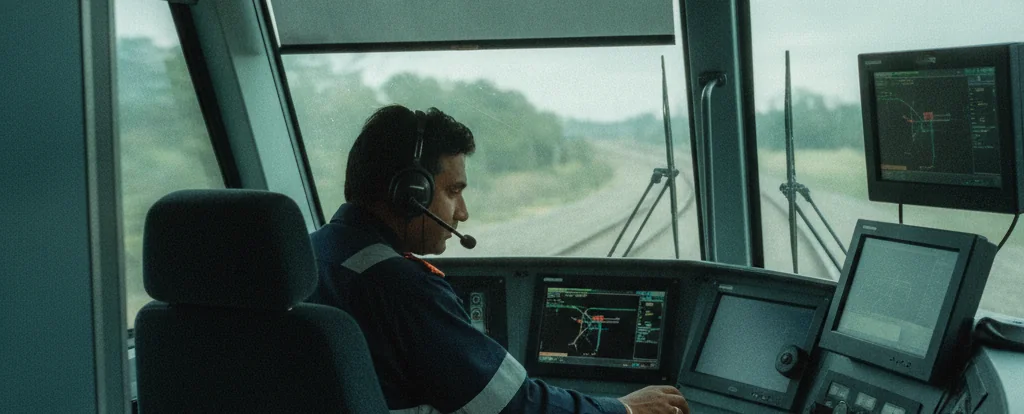
Train drivers operate the locomotives that carry passengers and freight along fixed rail routes, controlling speed and braking against the signals and timetable that govern the network.
- Median salary
- $156,100
3.5%vs last year, before tax
- People employed
- 18,700
0.0%vs last year
- Projected growth
- +6.3%
to 2035
- AI exposure*
- Moderate
- automation risk
- Average hours
- 44/wk
+4h vs all jobs
- Shortage status
- Not in shortage
national
Train drivers work for passenger operators, such as metropolitan and regional rail networks, and for freight operators moving bulk goods and containers on long-haul routes that can keep a driver away from a home depot overnight. Unlike a tram or bus driver, a train driver works inside a signalling system controlled from outside the cab, so much of the skill is reading signals and following the rulebook rather than steering around other traffic. Most drivers hold accreditation as a rail safety worker, which brings regular medical checks and drug and alcohol testing that most other driving jobs do not require.
How much do train drivers earn?
The median full-time salary for a train driver is $156,100 per annum, before tax, up $33,200 since 2018.
Train driver pay comes from enterprise agreements negotiated with each operator, so a metropolitan passenger driver, a regional driver and a freight driver on long-haul work can earn quite different amounts under the same job title. Shift penalties, weekend and public holiday loadings and overtime make up a real share of take-home pay, which is why the annual figure reflects rosters that include plenty of unsocial hours. Moving onto longer routes or higher locomotive classes usually brings a higher classification and rate.
What does a train driver do day to day?
The list below is what fills most weeks; the exact mix shifts with seniority and whatever stage the current work is at.
- Running the controls solo in the cab for hours at a stretch, matching speed to signals and timetable
- Reading track conditions and signalling constantly, even when nothing seems to be happening
- Working through pre-trip and post-trip checks on the locomotive before and after each shift
- Reacting fast to a fault, obstruction or delay and following the rulebook procedure for it
- Logging fuel use, delays and incidents so the next crew and control know exactly where things stand
What skills do train drivers need?
Employers look for driving and transport operations, operations management, emergency response, backed by locomotive control systems fluency and strong attention to detail.
Specialist skills
- Driving and transport operations
- Operations management
- Emergency response
Software and tools
- locomotive control systems
- train braking systems
- radio communication equipment
- signalling display systems
- logbook and monitoring software
General skills
- Attention to detail
- Safety and compliance awareness
- Problem solving
- Written communication
Is the job growing?
About 18,700 people work as train drivers in Australia, and employment is projected to grow 6.3% over the decade to 2035. That's modest growth: demand is steady rather than booming.
How do you become a train driver?
Here's the path most train drivers take, step by step.
- 1Meet the entry requirements
Operators usually ask for Year 12 or equivalent, a clean police check and the ability to pass a rail medical covering vision, hearing and fitness. A current driver's licence and a steady work history help, because training is long and expensive for the employer.
- 2Apply for a trainee program with an operator
Most drivers enter through a paid traineeship with a metropolitan, regional or freight rail business, which combines classroom study with supervised driving. Studying at TAFE on your own rarely works, because the supervised hours need an operator's trains and track access.
- 3Complete the Certificate IV in Train Driving
The qualification covers rail safety, signalling, train handling and emergency procedures, and usually takes around 12 to 18 months depending on the operator and how quickly you build hours. Trainees are paid while they train in most programs.
- 4Get accredited and build route knowledge
You need accreditation as a rail safety worker under the national rail safety scheme, with ongoing medicals and drug and alcohol testing, and requirements can vary by state. You then sign on routes one at a time, learning gradients, signals and speed limits under supervision before driving them alone.
Ready to apply as a train driver?
Whether you're working toward becoming a train driver or already are one and want a hand with the next step (sharpening your resume for ATS screening, tightening your cover letter, or knowing what you'll actually be asked at interview), here are examples grounded in this specific role, not generic templates.
What jobs can a train driver move to?
None of the roles train drivers typically move into pay more than the role itself. Truck Driver is the closest match. If a bigger salary is the goal, moving up into a senior or principal position within the role is usually the faster route than moving sideways.
| Move to | Typical pay change | Overlap | Retraining |
|---|---|---|---|
| Truck Driver A train driver brings heavy vehicle control, safety focus and shift discipline to road freight, but a truck licence and road experience are required.Known move | −$54,200 | 41% | reskill |
| Train Controller A train driver brings route knowledge, signalling discipline and timetable awareness to network control, though control room training is required.Known move | −$54,700 | 35% | reskill |
| Railway Station Manager A train driver brings rail safety, timetable and operational knowledge to station leadership, but customer service and management study are needed.Known move | −$59,900 | 32% | reskill |
| Tram Driver A train driver brings rail signalling, braking and timetable skills to tram operations, needing only familiarisation with tram systems and routes. | −$67,700 | 71% | minimal |
Moves are chosen from Jobs and Skills Australia's Data on Occupation Mobility, which follows income tax records between 2011-12 and 2020-21, together with entry requirements and skill overlap. A known move is one people were seen making in that data. Pay change compares median full-time pay for the two roles.
Who works as a train driver?
The typical train driver is 47 years old; 84% are men, 94% work full-time, and full-timers average 44 hours a week.
- 47
- Median age
- 16%
- Female share
- 94%
- Full-time
- +4h
- vs all-jobs avg
What's it like being a train driver?
The job has a distinctive rhythm: long stretches of quiet monitoring broken by short bursts that demand everything at once. Drivers work shifts across the clock, including nights, weekends and public holidays, and spend much of the day alone in a cab with the rulebook as the constant reference. It suits people who are comfortable with routine, comfortable on their own and able to stay sharp when very little is happening.
What people like
- The cab is your own space. Most of the shift is solo, with radio contact and depot crews at either end, which appeals to people who prefer working without someone over their shoulder.
- A good run is visible. Arriving on time with smooth braking and no complaints means you handled the trip well, and that feedback comes from the timetable rather than a manager.
- Route knowledge becomes real expertise. Learning the gradients, signals and speed limits of a line takes months, and drivers who know a network deeply can anticipate what the train will do before it does it.
- Rostered days off land midweek. Because rail runs every day, days off often fall outside the weekend, which suits people who would rather avoid crowded shops and peak-hour commuting.
What people find hard
- The hours are unforgiving. Very early starts, night shifts and public holidays are normal, and rosters are usually allocated by seniority, so new drivers take what is left.
- Vigilance over uneventful stretches. Staying alert when nothing has happened for an hour is the hardest part for many drivers, and the monitoring equipment in the cab exists precisely because attention drifts.
- One mistake carries weight. Passing a signal at danger or missing a speed restriction triggers an investigation and can end a career, so the rulebook is followed literally rather than loosely.
- Facilities are limited while you are out. Toilet access and meal breaks usually wait until the next terminal, and on long freight runs the cab offers little beyond the seat and the radio.
Based on our synthesis of professional-body surveys and public accounts of the role, not first-person verified reviews.
Which industries employ train drivers?
Transport, Postal and Warehousing employs the largest share of train drivers, followed by Mining.
Top employing industries
- 1Transport, Postal and Warehousing
- 2Mining
Ranked by employment share; the source doesn't publish an exact percentage per industry.
| Certificate III/IV | 40% | |
|---|---|---|
| Year 12 or below | 33.8% | |
| Bachelor degree | 8.4% | |
| Diploma / Advanced Diploma | 7.5% | |
| Postgraduate | 2.9% |
Will AI replace train drivers?
Train driving sits in the middle: signalling and automatic train operation already handle much of the routine control of speed and separation on newer lines, but the driver still owns what happens on the track ahead. The reporting side of the job, including fuel, delay and incident logs, is the part most likely to be automated further. Fault diagnosis and incident response still need someone in the cab with the rulebook and a view of the line.
Share of typical working time by exposure level
- Driving and responding to signalsSpeed control follows the signalling system and automatic train operation already does much of it on a few new lines, but the driver still manages train handling and station stopping.30%low
- Watching the track aheadCameras and track intrusion detection help, yet spotting a person, animal or obstruction and reacting in time remains a human job.25%moderate
- Logs, delay reports and radio communicationRecording fuel use, delays and incidents is already partly automated through on-board systems, and voice-to-text tools are starting to handle radio logs.25%high
- Handling faults and incidentsDeciding whether a fault means continuing, isolating a system or stopping the train relies on judgement and the rulebook rather than a fixed script.20%low
Common questions about becoming a train driver
Straight answers to the questions people ask most.
How much do train drivers earn?
Train drivers earn a median of $156,100 per year before tax, and that figure includes the shift loadings, penalty rates and overtime built into most rosters rather than a plain base rate. Passenger and freight operators negotiate separate agreements, so treat the number as a guide to what full-time drivers earn rather than a starting rate. Moving to a higher locomotive class or a longer route usually lifts the classification and the pay.
How do you become a train driver?
Most people enter through a paid trainee program run by a rail operator, which combines the Certificate IV in Train Driving (TLI42622) with supervised hours on the network. You will need to pass a rail medical, a police check and usually aptitude testing, and training runs around 12 to 18 months. The supervised hours cannot be completed without an operator behind you, which is why applying directly to rail businesses matters more than choosing a course.
Are train drivers in demand?
Train drivers are currently not in shortage, and employment is projected to grow 6.3% over the decade to 2035. The workforce is small compared with most occupations and operators recruit in intakes rather than continuously, so vacancies tend to appear in batches when a network expands or a training group finishes. Watching the operators' own careers pages is more useful than waiting for a general job listing.
Will AI replace train drivers?
Automation already handles part of the job: automatic train operation controls speed on a small number of newer lines, and signalling systems increasingly supervise braking and separation. What stays with the driver is the unpredictable side, watching for people and obstructions on the track, judging an incident as it unfolds and being accountable for the train. That is why full automation has been introduced on a few new lines rather than across existing networks.
What other jobs can a train driver move into?
Tram driving uses much the same braking, signalling and timetable skills, and the change usually needs only familiarisation with tram systems and routes, with pay around $67,700 less. Train control draws on route knowledge and timetable awareness but needs control room training, and pays around $54,700 less. Moving into station management or road freight is possible, though it needs management study or a truck licence first.
Is there an age limit to becoming a train driver?
Operators generally set no upper age limit, and trainees in their fifties are accepted, provided they pass the rail medical and can complete the training period. The bigger constraint is the recruitment cycle, which can take a year or more from application to a start date. Aptitude testing and the medical usually screen out more applicants than age does.
Related roles
- Train Controller
- Railway Station Manager
- Tram Driver
- Truck Driver
- Railway Station Assistant
- Transport Conductor
Not sure this is you? Take the career quiz and get a ranked shortlist of roles that fit how you like to work.