Transport Revenue Officer
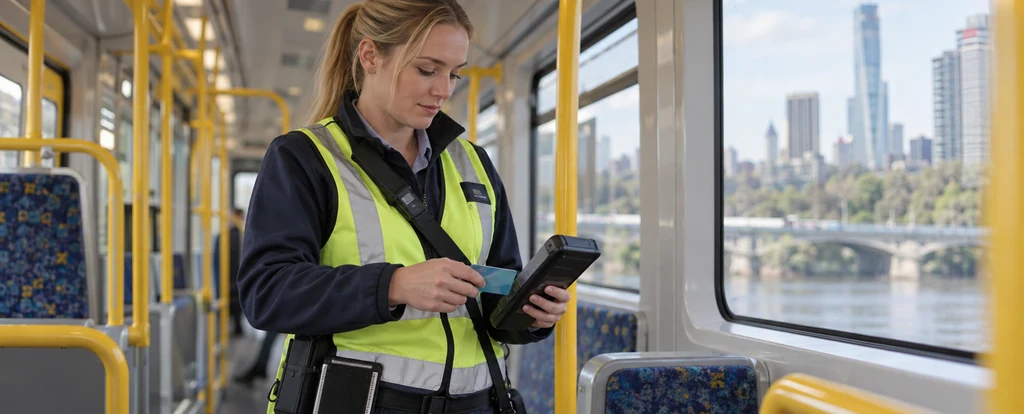
Transport revenue officers check that passengers have paid the right fare and help the network recover the money it is owed.
- Median salary*
- $79,000
4.5%vs last year, before tax
- People employed
- 270
10.0%vs last year
- Projected growth*
- +2.5%
to 2035
- AI exposure*
- Moderate
- automation risk
- Average hours*
- 38/wk
−2h vs all jobs
- Shortage status*
- Not in shortage
national
They work across trains, buses, trams and ferries, usually for a state transit authority or the company contracted to run the service. Most of the week is spent on the network or at stations: checking proof of payment, answering questions about fares and concessions, and following up fare evasion. The role is often confused with a transport conductor, who also checks fares but travels as part of the onboard crew of one service.
How much do transport revenue officers earn?
The median full-time salary for a transport revenue officer is $79,000 per annum, before tax, up $16,700 since 2018.
Your pay is set mostly by the enterprise agreement of the transit authority or operator you work for, so it varies between states and networks. Shift work is standard, and penalty rates for nights, weekends and public holidays make up a real part of what you take home. Moving into a compliance, revenue protection or team leader role is the usual way the figure rises.
What does a transport revenue officer do day to day?
The list below is what fills most weeks; the exact mix shifts with seniority and whatever stage the current work is at.
- Checking proof of payment and concession cards on trains, buses, trams and ferries
- Issuing infringement notices to passengers who cannot show a valid fare
- Reconciling fare revenue collected against ticketing system records
- Investigating ticketing discrepancies and preparing compliance reports
- Explaining fare rules, concession entitlements and top-up options to passengers
What skills do transport revenue officers need?
Employers look for regulatory compliance, operations management, backed by Microsoft Excel fluency and strong customer service.
Specialist skills
- Regulatory compliance
- Operations management
Software and tools
- Microsoft Excel
- Opal ticketing system
- myki
- TransLink go card
- customer relationship management (CRM) software
General skills
- Customer service
- Attention to detail
- Written communication
- Problem solving
Is the job growing?
About 270 people work as transport revenue officers in Australia, and employment is projected to grow 2.5% over the decade to 2035. That's modest growth: demand is steady rather than booming.
How do you become a transport revenue officer?
Here's the path most transport revenue officers take, step by step.
- 1Finish Year 12 or equivalent
Most entrants hold Year 12 or a trade equivalent, though a share of the current workforce came in without it. Subjects that build written communication and numeracy help, because the reports and notices you write need to stand up if a penalty is challenged.
- 2Start in a customer-facing role on a transport network
Station assistant, conductor and customer service roles are the common entry points, and they teach you the ticketing system, the fare rules and how to handle a disagreement in public.
- 3Complete a Certificate III or IV
Qualifications in transport and logistics, business or government administration are the most common in the role. Many employers support staff through the certificate while they work, so it's worth asking before you enrol and pay for it yourself.
- 4Learn the ticketing platform used in your state
Opal, myki and the TransLink go card work differently, and each network has its own rules for concessions, daily caps and top-ups. This is the knowledge you use every shift.
- 5Apply to the transit authority or operator
Recruitment runs through the state authority or the operator holding the contract, and includes a police check. Roles are advertised on the authority's own careers site as well as general job boards.
Ready to apply as a transport revenue officer?
Whether you're working toward becoming a transport revenue officer or already are one and want a hand with the next step (sharpening your resume for ATS screening, tightening your cover letter, or knowing what you'll actually be asked at interview), here are examples grounded in this specific role, not generic templates.
What jobs can a transport revenue officer move to?
Moving into Railway Station Manager typically comes with the biggest pay rise, worth $17,200 a year more on average.
| Move to | Typical pay change | Overlap | Retraining |
|---|---|---|---|
| Railway Station Manager Rail passenger experience and revenue knowledge support managing station operations and staff. | +$17,200 | 38% | reskill |
| Trade Measurement Inspector Compliance checking and enforcement experience transfer to inspecting trade measurement and regulatory standards. | +$4,200 | 64% | short course |
| Settlements Officer Cash handling and revenue reconciliation skills transfer to processing financial settlements and transactions. | +$4,200 | 64% | minimal |
| Airline Customer Service Agent Passenger service and ticketing skills transfer directly to airline customer service and check-in duties. | −$11,400 | 91% | minimal |
Moves are chosen from Jobs and Skills Australia's Data on Occupation Mobility, which follows income tax records between 2011-12 and 2020-21, together with entry requirements and skill overlap. A known move is one people were seen making in that data. Pay change compares median full-time pay for the two roles.
Who works as a transport revenue officer?
The typical transport revenue officer is 37 years old; 58% are men, 78% work full-time, and full-timers average 38 hours a week.
- 37
- Median age
- 42%
- Female share
- 78%
- Full-time
- −2h
- vs all-jobs avg
What's it like being a transport revenue officer?
The work runs on a roster rather than a nine to five, so your week looks different depending on whether you're on an early, late or weekend shift. It suits people who are comfortable approaching strangers, staying calm when someone is annoyed, and applying a set of rules evenly to everyone. The satisfaction comes from knowing the network runs on the revenue you help collect, and the hard part is that not everyone you approach is pleased to see you.
What people like
- You see the whole city. A shift moves you through stations, interchanges and busy corridors, so you learn the network and the people who use it far better than a desk job would allow.
- The rules are clear. Fare entitlements, concessions and penalty amounts are written down, so you are applying a known standard rather than making a judgement call each time.
- Shift work can fit around other commitments. Rosters often include early and late starts, which suits some people with study, family or second jobs. Weekend and night shifts also carry penalty rates.
- There is a path upwards inside the network. Revenue protection, compliance and team leader roles sit directly above this one, and they are usually filled from people who already know the ticketing system.
What people find hard
- Some conversations turn hostile. Fare evasion checks put you in front of people who may be embarrassed, angry or unwilling to give their details, and you deal with that alone until a colleague or police officer arrives.
- The roster includes nights and weekends. Services run late and every day of the week, so your shifts follow the timetable rather than your preferences.
- A lot of the work is repetitive. Running the same fare checks on the same routes shift after shift can feel monotonous, particularly outside peak periods.
- You are outdoors and on your feet. Platforms, bus interchanges and tram stops are cold, hot, wet and noisy, and there is very little sitting down.
Based on our synthesis of professional-body surveys and public accounts of the role, not first-person verified reviews.
Which industries employ transport revenue officers?
Urban Transit Systems employs the largest share of transport revenue officers, followed by Rail Transport.
Top employing industries
- 1Urban Transit Systems
- 2Rail Transport
- 3Bus Transport
- 4Government Administration
Ranked by employment share; the source doesn't publish an exact percentage per industry.
| Certificate III/IV | 34% | |
|---|---|---|
| Diploma / Advanced Diploma | 26% | |
| Bachelor degree | 20% | |
| Year 12 or below | 20% |
Will AI replace transport revenue officers?
AI and automation reach into parts of this job, but not evenly. Contactless ticketing and revenue software now do most of the counting and reconciliation that used to be manual, which removes a chunk of the back-office side. What remains is the on-platform work: stopping a passenger at a barrier to check a concession card, issuing a notice for an unpaid fare, and talking through a dispute at the gate.
Share of typical working time by exposure level
- Checking proof of payment and concession cards on servicesGates and validators catch most unpaid travel automatically, but officers still walk through carriages and interchanges to check concession cards and other passes a machine can't verify.30%low
- Reconciling fare revenue against ticketing recordsSoftware matches daily takings to tap-on and tap-off data and flags the exceptions, which leaves the officer reviewing and explaining the discrepancies rather than tallying totals by hand.25%high
- Answering passenger questions about fares and passesA passenger whose concession card has been rejected at the gate or who can't work out which top-up to buy needs an answer on the spot, and that exchange is not something a chatbot handles well at a busy interchange.25%low
- Issuing infringement notices for fare evasionNotices are generated through a handheld device that pulls the fare rules and the passenger's details, so the paperwork is largely automated, though the decision to issue it and the conversation around it are not.20%moderate
Common questions about becoming a transport revenue officer
Straight answers to the questions people ask most.
How much does a transport revenue officer earn?
The median is $79,000 per annum, before tax, for full-time workers. Because pay is set by the enterprise agreement covering your network, the figure shifts with the state you work in and how many penalty-rate shifts you pick up. It is a median across the occupation, so individual earnings sit above and below it.
How do I become a transport revenue officer?
Most people enter through a customer-facing job on a network, such as a station assistant or conductor, then move across when a revenue protection vacancy opens. A Certificate III or IV in transport and logistics, business or government administration is common in the role, and many employers help staff complete it. A police check is part of the recruitment process.
Are transport revenue officers in demand?
Transport revenue officers are currently not in shortage, and employment is projected to grow 2.5% over the decade to 2035 over the decade to 2035. The occupation is small, so the number of vacancies in any one network is limited and openings depend on state budgets and contract changes. Watching the careers pages of the authority or operator in your state is more useful than national figures.
Will AI replace transport revenue officers?
Automation has already taken over much of the counting and matching: contactless fare systems record every tap, and software reconciles daily takings against ticketing records. What remains is the part that happens in public, stopping a passenger at a barrier to check a concession card, issuing a notice for an unpaid fare and handling someone who disputes it, which needs a person standing there. The role is moderately exposed rather than at risk of disappearing.
What can a transport revenue officer move into?
Airline customer service is a close fit, since passenger ticketing and check-in use much the same skills, though it pays $11,400 less. Moving into station management uses your knowledge of the network and its revenue, and pays $17,200 more, but it needs retraining because the job is mostly rostering, staff and operations. Transport conductor work sits alongside this role and pays $14,000 more.
What is the difference between a transport revenue officer and a transport conductor?
A conductor travels with one service as part of its onboard crew, helping passengers, managing the doors and checking fares along the way. A revenue officer works across the network with fare compliance as the main job, including issuing penalties and reconciling revenue records. The two roles share a lot of skills, and people move between them.
Related roles
- Airline Customer Service Agent
- Railway Station Manager
- Trade Measurement Inspector
- Settlements Officer
- Railway Station Assistant
- Transport Conductor
Not sure this is you? Take the career quiz and get a ranked shortlist of roles that fit how you like to work.