Train Examiner
Train examiners inspect trains and rolling stock before they enter service, testing brakes, couplings and safety systems so each service can leave the yard safely.
- Median salary*
- $98,800
3.8%vs last year, before tax
- People employed
- 140
40.0%vs last year
- Projected growth
- +7%
to 2035
- AI exposure*
- Moderate
- automation risk
- Average hours
- 42/wk
+2h vs all jobs
- Shortage status
- Not in shortage
national
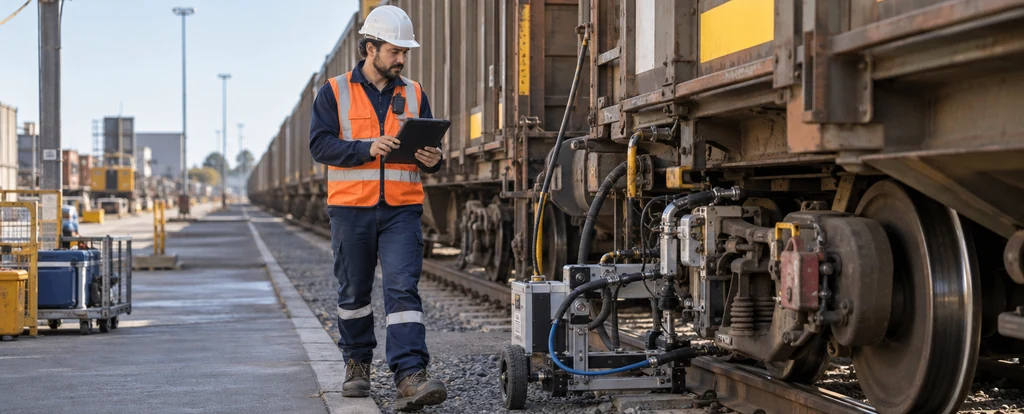
The work happens in rail depots, sidings and yards, often outdoors and often at night, because that is when rolling stock is standing still and available to examine. It sits between maintenance and driving: examiners do not repair faults or drive the train, they test the equipment, record what they find and certify that the train is fit to run. Most work for freight, passenger or mining rail operators, and the occupation is small, with about 140 people in it nationally.
How much do train examiners earn?
The median full-time salary for a train examiner is $98,800 per annum, before tax, up $20,400 since 2018.
Pay is usually set by an enterprise agreement with a rail operator, so the figure moves with the operator, the classification you hold and the penalties built into your roster. Night shifts, weekend work and public holidays lift earnings above the base rate, and overtime during network shutdowns adds more again. Regional and remote depots sometimes pay above city rates to attract examiners, though how much varies by employer.
What does a train examiner do day to day?
The list below is what fills most weeks; the exact mix shifts with seniority and whatever stage the current work is at.
- Walking the length of a train to check wheels, brake shoes, couplings and hoses for wear and damage
- Running brake tests on each vehicle and confirming the readings meet the operator's standards
- Testing doors, alarms, lights and communication systems before a service departs
- Logging defects, measurements and sign-offs in the maintenance system so repairs can be scheduled
- Working with maintenance crews and shunters to get a failed unit repaired or taken out of service
What skills do train examiners need?
Employers look for regulatory compliance, field inspection and testing, installation and maintenance, backed by Computerised maintenance management system (CMMS) fluency and strong attention to detail.
Specialist skills
- Regulatory compliance
- Field inspection and testing
- Installation and maintenance
- Plant and equipment operation
Software and tools
- Computerised maintenance management system (CMMS)
- Ultrasonic testing equipment
- Thermal imaging cameras
- Brake testing rigs
- Handheld inspection tablets
General skills
- Attention to detail
- Problem solving
- Safety and compliance awareness
- Time and deadline management
Is the job growing?
About 140 people work as train examiners in Australia, and employment is projected to grow 7% over the decade to 2035. That's modest growth: demand is steady rather than booming.
How do you become a train examiner?
Here's the path most train examiners take, step by step.
- 1Start in a rail or heavy-industry role
Most examiners come across from rail operations, track work, rolling stock maintenance or a mechanical trade, because operators prefer people who already understand how rail equipment behaves. A calibration or testing background transfers well too, since much of the job is measurement against a written standard.
- 2Complete a Certificate III or IV
Certificate III/IV is the most common qualification in the role, held by about 47% of the people doing it, usually in rail infrastructure or rolling stock maintenance. It is often done as a traineeship with an operator, so you earn while you learn.
- 3Pass the operator's competency assessment
Each rail operator certifies examiners against its own safety management system, which means supervised examinations, a written and practical assessment and a rail medical. Expect several months of on-the-job training before you sign off a train on your own.
- 4Keep your competencies and medical current
Rail medicals are renewed periodically and competency assessments are repeated, so staying in the role means keeping up with changes to rolling stock, braking systems and safety rules. Operators generally fund this training once you are on staff.
Ready to apply as a train examiner?
Whether you're working toward becoming a train examiner or already are one and want a hand with the next step (sharpening your resume for ATS screening, tightening your cover letter, or knowing what you'll actually be asked at interview), here are examples grounded in this specific role, not generic templates.
What jobs can a train examiner move to?
Moving into Train Driver typically comes with the biggest pay rise, worth $57,300 a year more on average.
| Move to | Typical pay change | Overlap | Retraining |
|---|---|---|---|
| Train Driver Train examiners bring rail safety knowledge and rolling stock familiarity to train driving, though full driver certification is required.Known move | +$57,300 | 12% | reskill |
| Non-destructive Testing Technician Train examiners bring fault detection and testing experience to non-destructive testing, needing a short course in NDT methods. | +$2,600 | 60% | short course |
Moves are chosen from Jobs and Skills Australia's Data on Occupation Mobility, which follows income tax records between 2011-12 and 2020-21, together with entry requirements and skill overlap. A known move is one people were seen making in that data. Pay change compares median full-time pay for the two roles.
Who works as a train examiner?
The typical train examiner is 49 years old; 87% are men, 89% work full-time, and full-timers average 42 hours a week.
- 49
- Median age
- 13%
- Female share
- 89%
- Full-time
- +2h
- vs all-jobs avg
What's it like being a train examiner?
The job has a clear rhythm: quiet stretches while you work through a train, then pressure to finish before a departure time. Most examiners work shifts, including nights and weekends, in a yard in whatever weather the season brings. It suits people who like having a written standard to work to and take satisfaction in signing something off as safe.
What people like
- You see the result of your work. An examination ends with a decision: the train runs or it does not, and you know exactly which defects you found and why they mattered.
- Fault finding rewards curiosity. A repeated brake fault or an odd wheel reading can point to something a quick visual check would miss, and tracking it down is the part many examiners enjoy most.
- Clear rules and standards. There is a written standard behind almost every check, so you are rarely guessing what good looks like and you can explain your call if it is questioned.
- Shift work buys time off. Rostered days off during the week and penalty rates for nights and weekends suit people who would rather not work a standard Monday to Friday.
What people find hard
- Nights, weather and yard conditions. Much of the work happens outdoors in the dark, in heat or rain, with the noise of locos and shunters moving around you.
- Departure times do not move. If a train is due out at a set time, the examination has to be finished by then, and a late defect can mean staying back to see it resolved.
- The record keeping. Every check, measurement and defect goes into the maintenance system, and the data entry can take up a real share of the shift.
- A small occupation. With few examiners nationally, jobs cluster around major depots and freight corridors, so you may need to move or travel for work.
Based on our synthesis of professional-body surveys and public accounts of the role, not first-person verified reviews.
Which industries employ train examiners?
Transport, Postal and Warehousing employs the largest share of train examiners, followed by Mining.
Top employing industries
- 1Transport, Postal and Warehousing
- 2Mining
- 3Manufacturing
Ranked by employment share; the source doesn't publish an exact percentage per industry.
| Certificate III/IV | 46.5% | |
|---|---|---|
| Year 12 or below | 32% | |
| Diploma / Advanced Diploma | 6.9% | |
| Bachelor degree | 4.9% | |
| Postgraduate | 0% |
Will AI replace train examiners?
Train examining sits in the middle: software and sensors have absorbed a lot of the recording and trend spotting, but the hands-on tests and the sign-off still happen in the yard. Wayside detectors and onboard telemetry flag wheels and bearings that need a closer look before an examiner reaches the train, which changes how the shift is spent rather than removing the job. That is why the exposure sits at moderate.
Share of typical working time by exposure level
- Pre-departure brake and safety testsYou apply the test, read the gauges and confirm the brake system releases and applies correctly, which needs hands on the equipment and an ear for anything abnormal.30%low
- Fault finding on rolling stock systemsDetector data and sensor logs point you towards a suspect axle or door, but working out why it is failing still comes down to inspection and experience.25%moderate
- Recording defects and sign-offsResults now go straight into a maintenance system on a tablet, and the software can pre-fill most of the record from the measurements you enter.25%high
- Wheel, bearing and component wear measurementLaser and ultrasonic gauges take some readings automatically, though positioning the tool and judging an unusual result remain manual work.20%moderate
Common questions about becoming a train examiner
Straight answers to the questions people ask most.
How much does a train examiner earn?
Train examiners earn a median of $98,800 per annum, before tax. Pay is set by enterprise agreements with rail operators, so night shifts, weekend rosters and overtime push actual earnings above the base rate. The figure is a guide to what people in the role are paid rather than a starting rate.
How do you become a train examiner?
Most people enter through a rail operator, usually after time in rail operations, track work or a mechanical trade, then complete a Certificate III or IV and the operator's competency assessment. There is no single national licence, because each operator certifies examiners against its own safety management system. The training is paid, and it usually runs alongside supervised examinations in a depot.
Are train examiners in demand?
Train examiners are currently not in shortage. Employment is projected to grow 7% over the decade to 2035 over the decade to 2035, with openings coming mainly from examiners retiring and from fleets being expanded or replaced. Because the occupation is small, vacancies tend to appear at particular depots rather than across the country, so it pays to watch the operators that run your local network.
Will AI replace train examiners?
AI takes over parts of the job rather than the whole of it. Wayside detectors, onboard telemetry and software that flags wear patterns already do some of the screening before a train reaches the yard, and inspection records are now captured on tablets instead of paper. The physical tests and the decision to sign a train off as safe still need someone standing next to the equipment.
Is train examining physical work?
It is active rather than heavy. You walk the length of a train several times a shift, climb ladders and crouch to reach brake gear and couplings, often in cold, heat or rain. There is no regular lifting of heavy loads, but the shift is spent on your feet and the yard is noisy.
What can a train examiner move into?
Train driving is a common move for examiners who want to stay on the network, and it needs full driver certification through an operator, with pay around $57,300 more. Non-destructive testing is the other natural step, since examiners already test components and interpret readings, and the pay there is $2,600 more.
Related roles
- Train Driver
- Non-destructive Testing Technician
- Railway Track Worker
- Calibration Technician
- Marine Engine Driver
- Railway Track Machine Operator
Not sure this is you? Take the career quiz and get a ranked shortlist of roles that fit how you like to work.