Dialysis Technician
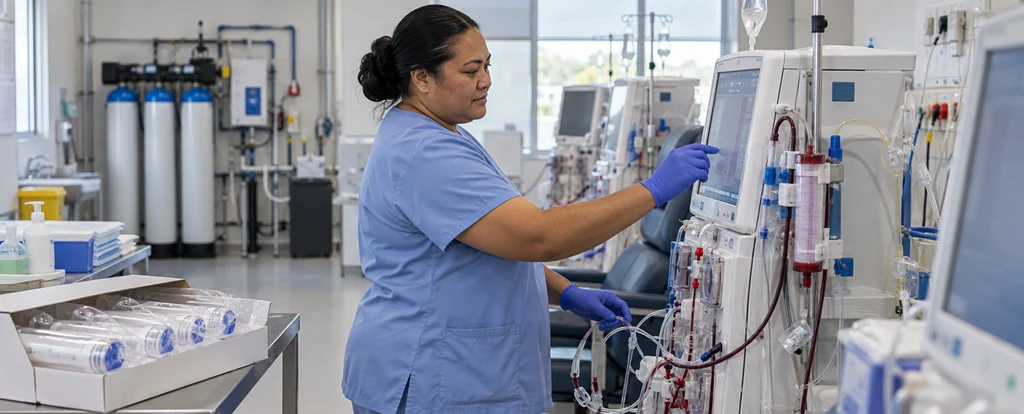
Dialysis technicians run the haemodialysis machines that keep people with kidney failure well between treatments.
- Median salary*
- $70,200
4.3%vs last year, before tax
- People employed*
- 3,500
0.0%vs last year
- Projected growth*
- +7%
to 2035
- AI exposure*
- Low
- automation risk
- Average hours*
- 38/wk
−2h vs all jobs
- Shortage status*
- In shortage
national
Most work in hospital renal units, community dialysis clinics and outpatient centres, setting up and running treatments under the supervision of registered nurses and nephrologists. The role sits closer to equipment than to nursing: technicians prepare machines and water systems, watch patients and machinery through a session, and keep the unit's gear clean and calibrated. Unlike registered nurses, they don't assess patients or manage care plans, so the work is technical and procedural rather than clinical.
How much do dialysis technicians earn?
The median full-time salary for a dialysis technician is $70,200 per annum, before tax, up $14,800 since 2018.
Most dialysis technicians are paid under a health services award or a hospital enterprise agreement, and the classification you're appointed to and your years on the job move the rate more than anything else. Shift work matters, since early starts, weekend rosters and on-call in some units attract penalty rates, and private clinic work can pay differently from the public hospital system.
What does a dialysis technician do day to day?
The list below is what fills most weeks; the exact mix shifts with seniority and whatever stage the current work is at.
- Setting up and priming haemodialysis machines and circuits before each session
- Watching vital signs and machine readings while a patient dialyses, and acting when something changes
- Responding to alarms and tracing faults in machines, lines and water treatment systems
- Recording treatment details, fluid removed and patient observations in the medical record
- Reprocessing, disinfecting and testing dialysers, machines and reverse osmosis equipment
What skills do dialysis technicians need?
Employers look for patient care and support, infection control and hygiene, plant and equipment operation, backed by Haemodialysis machines (Fresenius, Nipro) fluency and strong attention to detail.
Specialist skills
- Patient care and support
- Infection control and hygiene
- Plant and equipment operation
Software and tools
- Haemodialysis machines (Fresenius, Nipro)
- Water treatment and reverse osmosis systems
- Electronic medical records (eg Cerner)
- Dialysis monitoring software
- Peritoneal dialysis cyclers
General skills
- Attention to detail
- Written communication
- Problem solving
- Safety and compliance awareness
Is the job growing?
About 3,500 people work as dialysis technicians in Australia, and employment is projected to grow 7% over the decade to 2035. That's modest growth: demand is steady rather than booming.
How do you become a dialysis technician?
Here's the path most dialysis technicians take, step by step.
- 1Finish Year 12 or an equivalent
English and a science subject help with the terminology, though units also take people who left school earlier and bring relevant work experience from a hospital or care setting.
- 2Complete a Certificate III in Health Services Assistance or a Certificate IV in Health Care
TAFE and private providers offer both, usually over six months to a year full time, and they cover infection control, patient care, manual handling and clinical equipment. Around 34% of dialysis technicians hold a certificate III or IV, which is what hospital renal units tend to ask for at hiring.
- 3Start as a trainee or assistant and learn the machines on the unit
Machine competence is built on the job under supervision from nurses and senior technicians, working up from assisting to running sessions independently over several months. No single national licence covers dialysis, so each unit trains technicians on the specific machines and water systems it uses.
- 4Add a diploma or degree if you want to specialise
A Diploma of Nursing (HLT54121) or a nursing degree opens registered nurse and clinical coordinator roles, while further study in renal care suits technicians heading into peritoneal dialysis, home training or transplant coordination.
Ready to apply as a dialysis technician?
Whether you're working toward becoming a dialysis technician or already are one and want a hand with the next step (sharpening your resume for ATS screening, tightening your cover letter, or knowing what you'll actually be asked at interview), here are examples grounded in this specific role, not generic templates.
What jobs can a dialysis technician move to?
Moving into Cardiac Technician typically comes with the biggest pay rise, worth $17,200 a year more on average.
| Move to | Typical pay change | Overlap | Retraining |
|---|---|---|---|
| Cardiac Technician Dialysis technicians can apply their monitoring and technical skills to cardiac testing after completing further study. | +$17,200 | 75% | reskill |
| Operating Theatre Technician Dialysis technicians already work in hospital clinical settings and can move into operating theatre technician work with minimal retraining. | +$10,400 | 86% | minimal |
| Anaesthetic Technician Dialysis technicians bring strong machine and patient monitoring skills to anaesthetic technology, though a diploma is required. | +$10,400 | 100% | reskill |
| Respiratory and Sleep Technician Dialysis technicians can use their patient monitoring and equipment skills in respiratory and sleep testing with further study. | +$9,900 | 58% | reskill |
Moves are chosen from Jobs and Skills Australia's Data on Occupation Mobility, which follows income tax records between 2011-12 and 2020-21, together with entry requirements and skill overlap. A known move is one people were seen making in that data. Pay change compares median full-time pay for the two roles.
Who works as a dialysis technician?
The typical dialysis technician is 41 years old; 68% are women, 62% work full-time, and full-timers average 38 hours a week.
- 41
- Median age
- 68%
- Female share
- 62%
- Full-time
- −2h
- vs all-jobs avg
What's it like being a dialysis technician?
The day is built around booked sessions, so the work is routine by design: set up, run, strip down, repeat, often with an early start because units open before 7am. The pressure arrives mid-session, when a patient's blood pressure drops or a machine alarms and the rest of the list is waiting. Technicians who enjoy it tend to like machinery, be comfortable with the same treatment several times a day, and get on well with patients they see three times a week for years.
What people like
- Patients you know by name. Dialysis runs long term, so technicians often treat the same people for years and follow them through transplant listings and setbacks.
- Hands-on technical work. Priming circuits, running reverse osmosis systems and chasing faults suits people who want to understand how equipment works and keep it that way.
- A defined routine. Sessions are booked and the sequence rarely changes, which makes the work easier to predict than many other roles in a hospital.
- A small, close team. Renal units are usually compact, with technicians working alongside the same nurses and doctors each shift.
What people find hard
- Early starts and weekend rosters. Units generally run from before dawn and operate across the week, so the job doesn't fit a standard Monday to Friday pattern.
- Repetition. The same set-up and strip-down happens for every patient, several times a shift, and the tasks don't vary much between them.
- Patients who don't get better. People on dialysis are often seriously unwell, and some die while still on the machine list, which is a regular part of the work rather than a rare event.
- A backed-up list. When one session runs late the whole day shifts, and technicians carry the pressure of turning the room around quickly for the next patient.
Based on our synthesis of professional-body surveys and public accounts of the role, not first-person verified reviews.
Which industries employ dialysis technicians?
Hospitals employs the largest share of dialysis technicians, followed by Renal dialysis clinics.
Top employing industries
- 1Hospitals
- 2Renal dialysis clinics
- 3Community health services
- 4Outpatient care centres
Ranked by employment share; the source doesn't publish an exact percentage per industry.
| Certificate III/IV | 34% | |
|---|---|---|
| Diploma / Advanced Diploma | 26% | |
| Bachelor degree | 20% | |
| Year 12 or below | 20% |
Will AI replace dialysis technicians?
Dialysis technician work is only lightly exposed to AI and automation, because most of it happens at the machine and with the patient. Modern machines automate fluid removal, conductivity and alarm monitoring, and water treatment plants run largely on their own, but someone still primes the circuit, connects the patient and decides what to do when a reading changes. The parts most affected are documentation and scheduling, where renal software and remote monitoring for home dialysis patients already do a lot of the recording.
Share of typical working time by exposure level
- Setting up and priming machines and circuitsThe machine checks pressures and flows once it is running, but the sterile connection and priming sequence is still done by hand for every patient.30%low
- Watching the patient and the machine through a sessionMonitoring software logs pressures and flags trends, yet noticing a patient turning pale or a pulse climbing is still a person's job.25%moderate
- Troubleshooting alarms and water treatment faultsReverse osmosis systems and machine sensors report their own faults, but working out whether to reset, change the circuit or stop the session comes from experience.25%low
- Recording treatment details and handover notesElectronic medical records and dictation tools draft much of the note from machine data, though the technician still confirms what actually happened.20%high
Common questions about becoming a dialysis technician
Straight answers to the questions people ask most.
How much do dialysis technicians earn?
The median for dialysis technicians is $70,200 per annum, before tax, for full-time work. That is a middle figure rather than a starting rate, so your offer depends on the classification, your years on the job and whether the roster includes shift penalties.
How do you become a dialysis technician?
Most people complete a Certificate III in Health Services Assistance (HLT33115) or a Certificate IV in Health Care (HLT41120), then train on haemodialysis machines in a hospital renal unit or clinic. There is no single national licence for the role, so employers look for clinical study plus supervised machine training in a real unit. Some technicians come across from assistant in nursing or orderly work and pick up the certificate along the way.
Are dialysis technicians in demand?
Dialysis technicians are currently in shortage nationally, and employment is projected to grow 7% over the decade to 2035 over the decade to 2035. Demand follows the number of people living with kidney failure who need regular treatment, so the openings sit in hospital renal units and community clinics rather than spreading evenly across the health system.
Will AI or automation replace dialysis technicians?
Exposure is low, because the job is hands-on and a person still has to set up the circuit, connect the patient and watch the session. What has changed is the record-keeping and monitoring side, where dialysis software logs treatment data and remote monitoring supports patients dialysing at home. Judgement at the chair, infection control and noticing a patient who is deteriorating stay with the technician and the nurse.
What can dialysis technicians move into?
Operating theatre technician is a common move, where the pay is $10,400 more and the hospital setting and equipment skills carry straight across. Anaesthetic technician and cardiac technician are further options after additional study, with cardiac technician paying $17,200 more, and both build on the same monitoring and machine work. The path also runs the other way, with assistants in nursing and hospital orderlies moving into dialysis technology after a short course.
Do you need to be a nurse to work as a dialysis technician?
No. Dialysis technicians work alongside registered nurses rather than replacing them, and the role covers machines, water systems and treatment monitoring. Nurses manage care plans, medications and access decisions, while technicians keep the equipment running and the session on track.
Related roles
- Operating Theatre Technician
- Anaesthetic Technician
- Cardiac Technician
- Respiratory and Sleep Technician
- Assistant in Nursing
- Hospital Orderly
Not sure this is you? Take the career quiz and get a ranked shortlist of roles that fit how you like to work.