Home Manufacturing & Production
Engineering Patternmaker
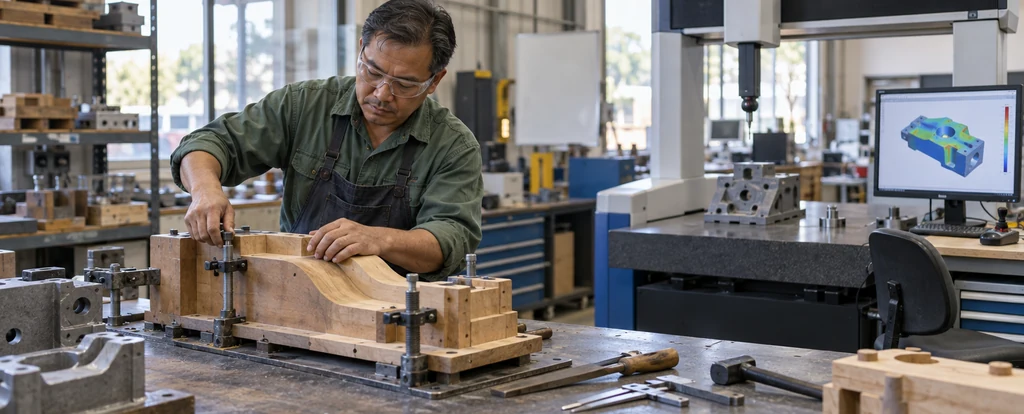
Engineering patternmakers build the precision patterns, core boxes and tooling that foundries use to cast metal and moulded parts.
- Median salary*
- $82,200
4.2%vs last year, before tax
- People employed
- 170
15.0%vs last year
- Projected growth
- +10.3%
to 2035
- AI exposure*
- Moderate
- automation risk
- Average hours
- 39/wk
−1h vs all jobs
- Shortage status
- In shortage
national
Engineering patternmakers make the patterns, core boxes and tooling that foundries and moulding shops use to produce castings and moulded components. They work from engineering drawings and CAD models, machining timber, resin, metal and composite materials to fine tolerances, and building in the shrinkage and draft a casting needs to come out at size. The trade sits close to toolmaking and machining, but the output is the shape a part is cast from rather than the finished part, and most patternmakers work in pattern shops attached to foundries or manufacturing businesses.
How much do engineering patternmakers earn?
The median full-time salary for an engineering patternmaker is $82,200 per annum, before tax, up $17,200 since 2018.
Pay follows the manufacturing award or enterprise agreement covering the workshop, so shift loadings, overtime during a production run and site allowances all change the total. Patternmakers with strong CAD and CAM skills, or experience in defence, aerospace and mining supply chains, tend to sit higher, and because the trade is small, moving to a different employer or state can shift the figure as much as a promotion does.
What does an engineering patternmaker do day to day?
The list below is what fills most weeks; the exact mix shifts with seniority and whatever stage the current work is at.
- Reading engineering drawings and CAD models to work out pattern dimensions, parting lines and machining allowances
- Machining and shaping patterns and core boxes from timber, resin, metal and composite materials
- Building in shrinkage and draft allowances so a casting finishes at the specified size
- Finishing, sealing and gauging patterns and tooling against tolerances, often on a coordinate measuring machine
- Repairing and modifying worn patterns and sitting in on trial casts with foundry staff
What skills do engineering patternmakers need?
Employers look for craft and handmade production, reading plans and specifications, cAD and technical drawing, backed by AutoCAD fluency and strong attention to detail.
Specialist skills
- Craft and handmade production
- Reading plans and specifications
- CAD and technical drawing
- Hand and power tool work
- Plant and equipment operation
Software and tools
- AutoCAD
- SolidWorks
- Fusion 360
- CNC routers
- Coordinate measuring machines
General skills
- Attention to detail
- Problem solving
Is the job growing?
About 170 people work as engineering patternmakers in Australia, and employment is projected to grow 10.3% over the decade to 2035. That's healthy, above-average growth, and the role should stay in solid demand.
How do you become an engineering patternmaker?
Here's the path most engineering patternmakers take, step by step.
- 1Finish Year 10 or Year 12 with maths on your record
Maths, along with a design and technology or metalwork subject, gives you the measurement and drawing base the trade runs on. There is no degree requirement, and employers look less at your results than at whether you can read a drawing and work accurately.
- 2Start a patternmaking apprenticeship
The standard entry is a Certificate III in Engineering (Mechanical Trade) with a patternmaking specialisation, delivered as a four-year apprenticeship through a pattern shop or foundry and a TAFE or group training provider. Apprenticeships are paid, and you spend most of the week on the tools with block or day release for the theory.
- 3Learn the trade in a working pattern shop
Patternmaking is largely learned by doing: reading drawings, setting up machines, judging allowances and finishing work by hand. Aim for a shop that covers both traditional timber patternmaking and CNC machining, because the trade now uses both.
- 4Add CAD, CAM and metrology skills
Training in software such as SolidWorks or Fusion 360, and experience with coordinate measuring machines, opens up complex tooling and defence or aerospace work. A Certificate IV in engineering or a short CAD and CAM course is the usual way to build on the trade.
- 5Or come across from a related trade
Toolmakers and metal machinists can move into patternmaking with recognition of prior learning, though most employers still expect formal training in patternmaking methods before they will sign off the trade.
Ready to apply as an engineering patternmaker?
Whether you're working toward becoming an engineering patternmaker or already are one and want a hand with the next step (sharpening your resume for ATS screening, tightening your cover letter, or knowing what you'll actually be asked at interview), here are examples grounded in this specific role, not generic templates.
What jobs can an engineering patternmaker move to?
Moving into Metal Machinist typically comes with the biggest pay rise, worth $53,300 a year more on average.
| Move to | Typical pay change | Overlap | Retraining |
|---|---|---|---|
| Metal Machinist Engineering Patternmakers bring drawing interpretation and precision machining to metal machining roles, though retraining is needed for production machining environments. | +$53,300 | 48% | reskill |
| Fitter and Turner Engineering Patternmakers bring precision assembly and machining skills to fitting and turning, though retraining is needed for broader mechanical fitting work. | +$3,600 | 42% | reskill |
| Precision Instrument Maker Engineering Patternmakers bring fine detail and precision work to instrument making, though retraining is needed for the smaller scale and different materials. | −$4,200 | 31% | reskill |
| Foundry Moulder Engineering Patternmakers bring pattern design and casting knowledge to foundry moulding, though retraining is needed for moulding and pouring processes. | −$12,000 | 48% | reskill |
| Toolmaker Engineering Patternmakers bring precision machining and pattern layout skills to toolmaking, but retraining is needed to focus on jigs, fixtures and dies. | −$17,200 | 61% | reskill |
Moves are chosen from Jobs and Skills Australia's Data on Occupation Mobility, which follows income tax records between 2011-12 and 2020-21, together with entry requirements and skill overlap. A known move is one people were seen making in that data. Pay change compares median full-time pay for the two roles.
Who works as an engineering patternmaker?
The typical engineering patternmaker is 54 years old; 84% are men, 78% work full-time, and full-timers average 39 hours a week.
- 54
- Median age
- 16%
- Female share
- 78%
- Full-time
- −1h
- vs all-jobs avg
What's it like being an engineering patternmaker?
The work runs at the pace of a workshop rather than a production line: long stretches of measuring, machining and hand finishing, then a trial cast that either fits or sends the pattern back for adjustment. Patternmakers tend to be people who like a result they can measure and who are comfortable working alone on a job for days at a time. It suits someone patient with detail, less so someone who wants fast turnaround or a lot of contact with customers.
What people like
- You can measure whether it is right. A pattern either produces a casting to size or it does not, and the gauges and the trial cast tell you which without argument.
- Every job is a one-off. Patterns are usually made in ones and twos for a specific casting, so the drawing, the material and the machining setup change from job to job instead of repeating.
- A trade with few people in it. Patternmaking knowledge is passed on in the workshop rather than taught widely, so a good patternmaker becomes hard to replace.
- Workshop conditions. Most days are spent in a pattern shop with your own bench and machines, and there is very little customer-facing work.
What people find hard
- Few employers to choose from. Pattern shops cluster around foundries, defence suppliers and larger manufacturing businesses, so changing jobs can mean moving town or changing state.
- Slow feedback. A pattern can take days or weeks to make and the trial cast adds more time, so you live with a job for a while before you know it works.
- Heavy, dusty materials. Timber, resins, metal and composite stock are heavy to handle, and the work is physical, often noisy and sometimes dusty.
- Downstream pressure. When a pattern is late, the foundry's production and the customer's order wait on it, which puts the deadline squarely on your bench.
Based on our synthesis of professional-body surveys and public accounts of the role, not first-person verified reviews.
Which industries employ engineering patternmakers?
Manufacturing employs the largest share of engineering patternmakers.
Top employing industries
- 1Manufacturing
Ranked by employment share; the source doesn't publish an exact percentage per industry.
| Certificate III/IV | 71.3% | |
|---|---|---|
| Year 12 or below | 14.9% | |
| Diploma / Advanced Diploma | 9.8% | |
| Bachelor degree | 4.6% | |
| Postgraduate | 0% |
Will AI replace engineering patternmakers?
Patternmaking sits in the middle: the drawing, modelling and allowance calculations are increasingly software-assisted, while the machining, fitting and hand finishing that decide whether a pattern works stay with the tradesperson. CAD and CAM have been part of the trade for years, so the change is in how quickly a pattern can be modelled and cut, not in whether the job exists. A pattern still has to be gauged by hand and proven in a trial cast.
Share of typical working time by exposure level
- Machining and hand shaping patternsCutting, turning and filing a pattern, and judging how a timber or resin shape will release from the sand, still depends on feel and experience.35%low
- Reading drawings and building CAD modelsMost patterns now start as a 3D model, and software handles the drawing, the shrinkage scale-up and the machining paths.25%high
- Working out allowances and checking dimensionsSoftware can apply a standard shrinkage factor and print a measurement report, but deciding what allowance suits this casting and this foundry is a judgement call.20%moderate
- Trial casts, repairs and reworkStanding at the mould with foundry staff when a trial casting comes out, and working out why a corner tore or a core shifted, is hands-on problem solving.20%low
Common questions about becoming an engineering patternmaker
Straight answers to the questions people ask most.
How much do engineering patternmakers earn?
Engineering patternmakers earn a median of $82,200 per year before tax. That is the midpoint for full-time workers in the trade rather than a starting rate, and shift loadings and overtime push actual earnings above it in many workshops.
How do you become an engineering patternmaker?
Most people enter through a paid four-year apprenticeship, usually a Certificate III in Engineering (Mechanical Trade) with a patternmaking specialisation, combining workshop time with TAFE study. School maths and a design or metalwork subject help you get a start, and there is no degree requirement.
Are engineering patternmakers in demand?
Engineering patternmakers are currently in shortage nationally, and employment is projected to grow 10.3% over the decade to 2035. Only about 170 people work in the trade nationally, so demand varies sharply by region, and it is worth checking which foundries, defence suppliers and manufacturers near you keep pattern shops.
Will AI replace engineering patternmakers?
Not the trade itself, though parts of it are changing. CAD and CAM software now handles the drawing work, applying shrinkage factors and generating machining paths, while the machining, hand finishing and trial casts that decide whether a pattern works stay with the tradesperson.
Is patternmaking a dying trade?
The trade has shrunk as 3D printing and CNC machining have taken over some pattern work, but castings are still needed for pumps, valves, defence equipment and heavy machinery, and someone has to make and prove the tooling. The work has shifted towards CAD modelling and machining rather than disappearing.
What can engineering patternmakers move into?
Toolmaking is a close move, using the same precision machining and layout skills, and it pays $17,200 less. Metal machining pays $53,300 more, though it needs some retraining because the work moves towards production machining rather than pattern construction.
Related roles
Not sure this is you? Take the career quiz and get a ranked shortlist of roles that fit how you like to work.